

Introduction
When organizations map out their cybersecurity defense plans, their minds naturally drift to external adversaries: state-sponsored hacking collectives, global ransomware syndicates, or shadowy threat actors probing network perimeters from afar. While these external hazards capture major headlines, the most complex and devastating security vulnerability often walks right through the front door—or logs into the corporate VPN from a home office.
In the distributed corporate environments of 2026, insider threats have emerged as a critical point of failure for modern enterprises. An insider threat occurs when an employee, contractor, vendor, or trusted business partner utilizes their legally granted access privileges to compromise the confidentiality, integrity, or availability of organizational systems. Because these individuals are already past the castle gates, traditional defensive perimeters are completely blind to their movements.
The Core Vulnerability: The Danger of Pre-Authorized Access
The fundamental reason insider threats are so uniquely dangerous comes down to a structural paradox in security design: trust.
[External Attacker] ── Must Bypass Firewall ──> [Network Perimeter]
[Internal Threat]   ── Already Authenticated  ──> [Sensitive Data Core]
An external cybercriminal must expend significant resources scanning for unpatched software, staging phishing campaigns, or attempting access-key bypasses. An insider, conversely, encounters none of these obstacles. They possess valid network credentials, understand internal database structures, know where proprietary source code or consumer personal data is kept, and are fully aware of organizational operational blind spots. They do not need to hack the system; they are already authorized to use it.
The Three Profiles of Insider Risks
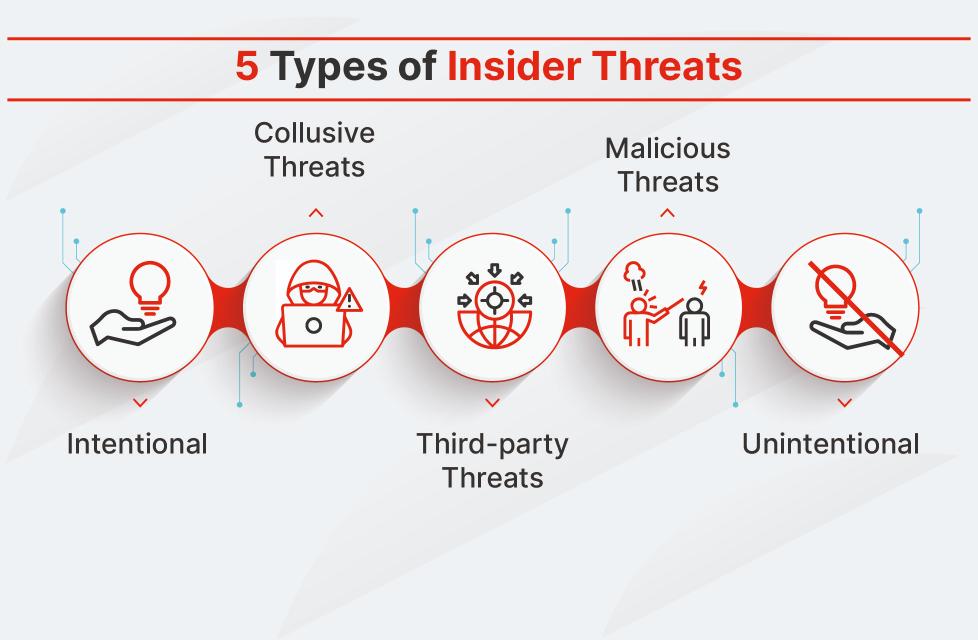
Not all internal security threats are born from malicious intent. Security teams categorize insider risks into three distinct operational profiles, each requiring a tailored defensive response.
1. The Malicious Insider
Malicious insiders consciously choose to abuse their network privileges to inflict harm or secure personal advantages. Common drivers include corporate espionage, financial desperation, or professional spite. A disgruntled employee passed over for a promotion or an engineer preparing to jump to a direct competitor might quietly exfiltrate intellectual property, trade secrets, or customer registries. Because they know what data is highly valued, they can target critical assets with pinpoint accuracy.
2. The Negligent Insider
Negligence is the most common driver of internal security incidents. These are well-meaning employees who simply prioritize operational convenience over established security protocols. Examples include:
Copying restricted database folders onto unsecured personal cloud accounts to work from home.
Using unauthorized third-party SaaS applications to speed up workflows—a major driver of corporate vulnerability explored in our deep-dive on Shadow IT: The Hidden Cybersecurity Risk Inside Organizations.
Accidentally sending email attachments containing sensitive employee data to external distribution lists.
3. The Compromised Insider Account
In this scenario, the employee is entirely oblivious to the breach. Instead, an external threat actor manages to hijack a legitimate employee’s account using techniques like credential stuffing, session hijacking, or advanced phishing. Once inside the perimeter using valid user profiles, the attacker navigates internal systems silently. To standard security monitoring software, the hacker’s lateral movements look exactly like a normal employee carrying out routine daily tasks.
Why Insider Activity Evades Traditional Defensive Layers
Traditional enterprise security architecture is built on an old-school paradigm: trust everything inside the network and distrust everything outside. Firewalls, intrusion prevention systems, and web gateways scan inbound traffic for malicious signatures, but they rarely monitor what an authenticated user does once they are safely inside.
Distinguishing between standard operational workflows and malicious data theft is incredibly difficult. For example, if a senior financial analyst downloads a massive batch of quarterly balance sheets, a standard security filter flags it as normal behavior. However, if that analyst is planning to hand those documents to an external short-seller, the exact same technical action becomes a severe security breach. This blending of legitimate routine work with data exposure creates a major blind spot for traditional IT departments.
Early Indicators: Technical and Behavioral Red Flags
While catching internal threats is difficult, anomalous activity almost always leaves a trail. Organizations can identify risks early by cross-referencing technical indicators with observed behavioral shifts.
Technical Red Flags
Anomalous Data Movements: An employee downloading unusual volumes of proprietary data or transferring files to personal external cloud environments.
Privilege Probing: Regular, unexplained attempts to access high-security networks or folders entirely unrelated to the user’s specific job description.
Off-Hours Activity: System logins occurring at highly unusual times—such as 3:00 AM on a weekend—without any operational justification.
Behavioral Red Flags
Sudden Professional Friction: Expressing intense dissatisfaction with management, open hostility toward colleagues, or erratic reactions to performance evaluations.
Resignation Patterns: A sharp drop in workplace engagement combined with an uncharacteristic spike in file downloads right before a planned departure.
Financial Anomalies: Sudden, unexplained wealth or open discussions about severe financial distress can indicate vulnerability to external recruitment by corporate espionage networks.
Building a Layered Defense Against Internal Risks
Protecting corporate architecture from internal vectors requires moving away from implicit trust and implementing a layered, data-centric security policy.
| Defensive Strategy | Core Objective | Enterprise Operational Impact |
| Zero Trust Architecture | Eliminate absolute implicit trust. | Mandates continuous identity verification for every single user request. |
| Least Privilege Access | Restrict data access. | Ensures employees only have visibility into systems required for their active role. |
| Behavioral Analytics (UEBA) | Baseline normal network patterns. | Uses machine learning to instantly flag anomalous file downloads or odd login hours. |
| Data Loss Prevention (DLP) | Prevent unauthorized data movement. | Blocks the copying of restricted files to personal USB drives or unauthorized clouds. |
Transforming the Workforce into a Psychological Defense Layer
Mitigating insider risk requires a balanced approach. While technical restrictions and automated tracking tools are necessary, an over-engineered surveillance environment can damage company culture, lower morale, and accidentally create the very disgruntlement that fuels malicious insiders.

Enterprise security teams must pair technical controls with transparent, continuous behavioral education. Employees need to understand why certain data access boundaries exist. When a workforce understands that security policies are designed to protect corporate stability rather than micro-manage individual performance, they shift from being a potential vulnerability to serving as an active line of defense. To explore how human cognitive blind spots are directly weaponized by threat actors to manipulate employees, read our thorough analysis on The Psychology of Cybercrime: Why People Fall for Online Scams.
Strengthening Human Firewall Capabilities with FireShark
A truly resilient corporate security framework acknowledges that human behavior is an active, dynamic element of the security perimeter. Technical tools can flag data movement, but building an enduring security culture requires a workforce that is thoroughly trained to recognize security slip-ups, identify social engineering traps, and handle sensitive assets with consistent care.
FireShark works directly with modern enterprises to build strong human firewalls through professional security awareness and training programs. Our educational tracks show employees how negligence exposes company networks, how credential hijacking occurs, and how to spot early signs of internal compromise. By giving your team practical insights into data ownership and behavioral security, FireShark helps enterprises build a proactive culture where security is everyone’s responsibility.
Conclusion
Insider threats show us that an effective cybersecurity strategy must look inward just as closely as it watches external horizons. Whether a risk stems from malicious intent, careless shortcuts, or compromised credentials, the damage to corporate finances and brand reputation can be immense. By pairing strong Zero Trust authentication models and behavioral analytics with comprehensive employee education, businesses can comfortably protect their critical data assets while keeping internal operations running smoothly.
Frequently Asked Questions (FAQs)
1. What is the fundamental definition of an insider threat?
An insider threat is any security risk that originates from within an organization. It involves current or former employees, contractors, or trusted vendors who use their legitimate system access to compromise data, introduce malware, or disrupt operational infrastructure, either intentionally or accidentally.
2. Why are traditional firewalls ineffective against insider threats?
Traditional firewalls function as perimeter gates, designed to keep unauthenticated external traffic out of the private network. Because an insider already possesses legitimate, authorized credentials, they bypass these perimeter checkpoints completely, leaving the firewall unable to distinguish their activity from normal business operations.
3. What is User and Entity Behavior Analytics (UEBA) and how does it catch insiders?
UEBA is a security technology that uses machine learning to build a baseline profile of an employee’s normal daily digital habits (such as typical login locations, working hours, and file access patterns). If that user’s account suddenly deviates from the baseline—like downloading thousands of customer files at midnight—UEBA flags the anomaly for immediate investigation.
4. How does the principle of least privilege reduce internal risk profiles?
The principle of least privilege ensures that employees are only granted the absolute minimum network access required to fulfill their specific job duties. By cutting off unnecessary access to adjacent databases, organizations successfully limit the potential blast radius if an account is compromised or an insider chooses to act maliciously.
5. How can companies run insider threat monitoring without violating employee privacy?
Effective insider threat monitoring focuses strictly on evaluating system logs, data transfer volumes, and file access points rather than reading personal communications or monitoring keystrokes. Organizations preserve trust by maintaining transparency, outlining monitoring parameters in employee handbooks, and ensuring all tracking conforms closely to local data privacy laws.