
Table of Contents
Introduction
Artificial Intelligence (AI) has become a core technology behind cybersecurity platforms, healthcare systems, financial services, autonomous vehicles, recommendation engines, and business automation. Organizations trust AI models to make important decisions because these systems can process enormous amounts of data faster than humans. However, the reliability of any AI model depends entirely on the quality and integrity of the data used to train it.
While most cybersecurity discussions focus on protecting deployed AI models from attacks such as prompt injection or adversarial examples, an equally dangerous threat exists much earlier in the AI lifecycle—the training pipeline. If an attacker compromises the training process itself, they may be able to manipulate the model before it is ever released. This type of attack is known as model poisoning or data poisoning, and it has become one of the most concerning security risks in modern machine learning.
Unlike traditional cyberattacks that target servers or applications after deployment, training pipeline attacks silently influence how an AI model learns. A poisoned model may appear accurate during testing while secretly making incorrect decisions under carefully selected conditions. Because these manipulations are embedded into the model’s learning process, detecting them can be extremely difficult.
This article explains how attackers target the AI training pipeline, the different forms of model poisoning, the real-world impact on organizations, and the security measures that can reduce these risks.
Understanding the AI Training Pipeline
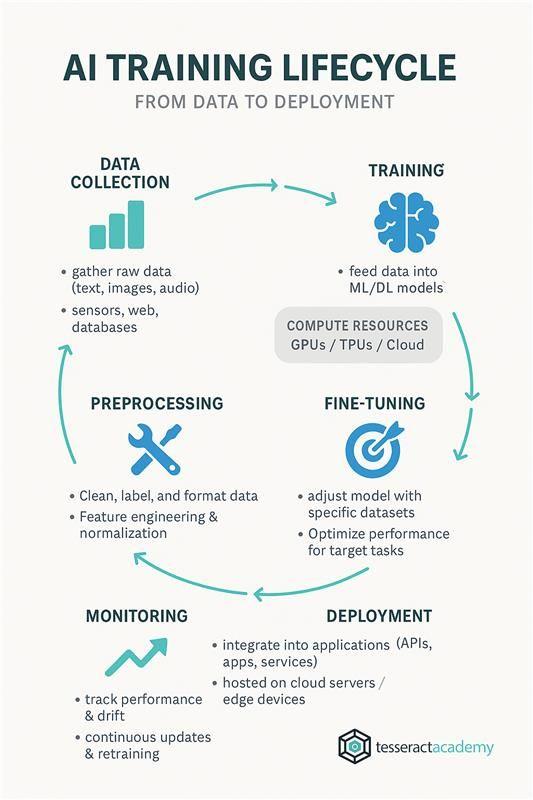
Before understanding model poisoning, it is important to understand how an AI model is created. An AI training pipeline is a sequence of stages through which raw information is transformed into a trained machine learning model.
The process usually begins with collecting data from multiple sources such as public datasets, enterprise databases, customer interactions, IoT devices, security logs, or web scraping. This raw data is then cleaned by removing duplicate records, correcting errors, filling missing values, and standardizing formats.
Once prepared, the data is labeled so that the AI system understands what patterns it should learn. For example, a cybersecurity model may receive labels identifying malicious and legitimate network traffic, while a medical AI system may receive labels distinguishing healthy and diseased tissue.
After preprocessing, the model is trained by repeatedly analyzing the dataset and adjusting internal parameters until it recognizes meaningful patterns. The trained model is then validated, tested, optimized, and finally deployed into production.
Every one of these stages represents a potential attack surface. If attackers can manipulate even one part of this pipeline, the resulting AI model may inherit hidden vulnerabilities.
What is Model Poisoning?
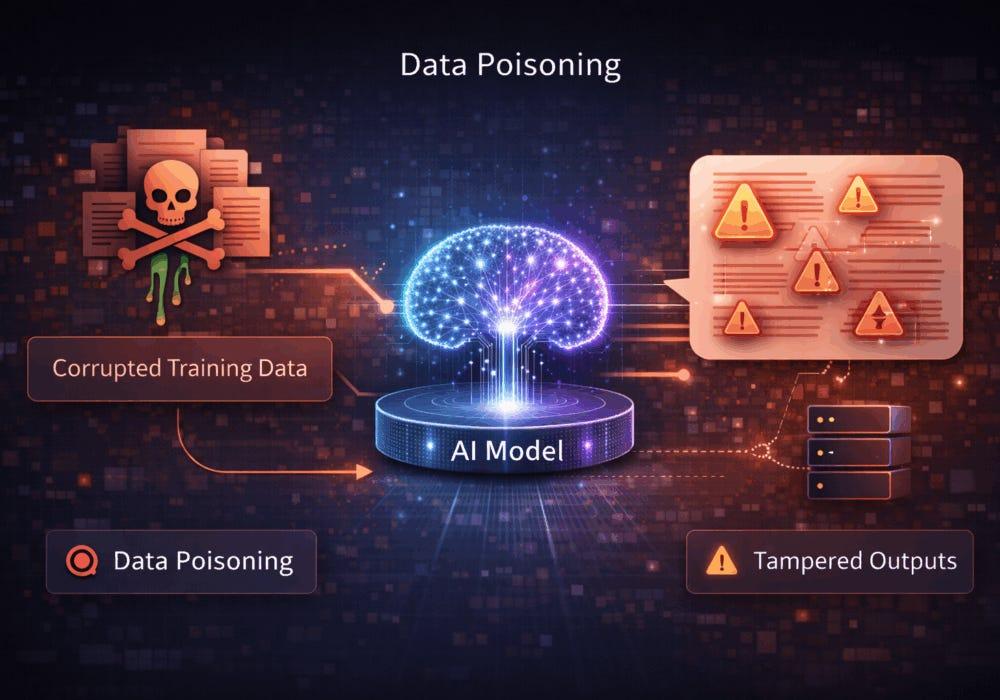
Model poisoning refers to the deliberate manipulation of training data or the training process so that an AI model learns incorrect or malicious behavior. Instead of attacking the AI after deployment, attackers influence what the model learns during training.
The manipulation may be extremely small. An attacker might change only a tiny fraction of the training data, yet that small modification can significantly affect how the model behaves in production.
The objective is often not to reduce the model’s overall accuracy. Instead, attackers want the AI system to behave normally in almost every situation while producing incorrect outputs only under specific conditions that benefit the attacker. This makes poisoned models particularly dangerous because traditional accuracy testing may not detect the hidden behavior.
How Attackers Compromise the AI Training Pipeline
The AI training pipeline depends on numerous external resources, including datasets, cloud storage, third-party repositories, annotation services, machine learning frameworks, and automated CI/CD workflows. Every dependency creates another opportunity for attackers.
One common method involves compromising public datasets. Many organizations rely on open-source datasets to reduce development costs. If an attacker inserts malicious samples into a dataset before it is downloaded, every organization using that dataset may unknowingly train vulnerable AI models.
Attackers may also target data labeling services. Since many organizations outsource annotation tasks, compromised or malicious annotators can intentionally assign incorrect labels to selected samples. Even a relatively small percentage of incorrect labels can influence how the AI interprets future inputs.
Supply chain attacks are another growing concern. Modern machine learning relies heavily on third-party libraries, pretrained models, and open-source repositories. If any of these components are modified before integration into the training pipeline, the final AI system may inherit hidden backdoors without developers realizing it.
Insider threats also represent a major risk. Employees, contractors, or researchers with access to training infrastructure can intentionally modify datasets, alter training configurations, or replace legitimate models with poisoned versions.
Cloud environments further increase the attack surface. Weak identity management, insecure storage buckets, or compromised credentials can allow attackers to upload modified datasets or replace model checkpoints during training.
Types of Model Poisoning Attacks
Although model poisoning can take several forms, the objective remains the same: influence how the AI model learns.
Data poisoning occurs when attackers directly modify the training dataset. This may involve adding fake records, changing labels, inserting misleading information, or introducing biased samples that shift the model’s understanding.
Label poisoning specifically targets annotations rather than the raw data itself. For example, malicious software samples might intentionally be labeled as safe software. Over time, the model begins to classify actual malware as legitimate.
Backdoor poisoning is one of the most dangerous techniques. During training, attackers insert samples containing a hidden trigger, such as a specific image pattern, keyword, or digital signature. Whenever that trigger appears after deployment, the model behaves incorrectly while remaining accurate for every other input.
Availability poisoning attempts to reduce the model’s overall performance. The goal is to make the AI system unreliable by increasing prediction errors, reducing accuracy, or preventing successful learning.
Bias poisoning manipulates datasets to create unfair or discriminatory behavior. This may lead to biased hiring recommendations, inaccurate loan approvals, or unequal medical diagnoses.
Real-World Consequences of Training Pipeline Attacks
The consequences of poisoned AI models extend far beyond technical failures.
In cybersecurity, malware detection systems may begin classifying malicious files as harmless, allowing attackers to bypass security controls.
Financial institutions using AI for fraud detection may fail to identify fraudulent transactions because poisoned training data has weakened the detection model.
Healthcare AI systems could generate incorrect diagnoses if attackers manipulate medical imaging datasets or patient records during training.
Autonomous vehicles may incorrectly recognize road signs or traffic conditions if poisoned datasets influence computer vision models.
Recommendation engines may intentionally promote fraudulent products, fake news, or manipulated content if attackers successfully influence their training data.
Government agencies using AI for surveillance, intelligence analysis, or national security decision-making could unknowingly rely on compromised models that produce strategically incorrect results.
Why Model Poisoning is Difficult to Detect
One reason model poisoning is so dangerous is that poisoned models often perform normally during conventional testing. Standard evaluation datasets rarely contain the hidden triggers required to activate malicious behavior.
Attackers carefully design poisoned samples so they blend naturally with legitimate training data. As a result, security teams may never notice any unusual behavior until the AI encounters a specific trigger months after deployment.
Machine learning models themselves are highly complex mathematical systems. Even if abnormal predictions occur, identifying which training samples caused the problem can be extremely difficult.
Best Practices for Protecting the AI Training Pipeline
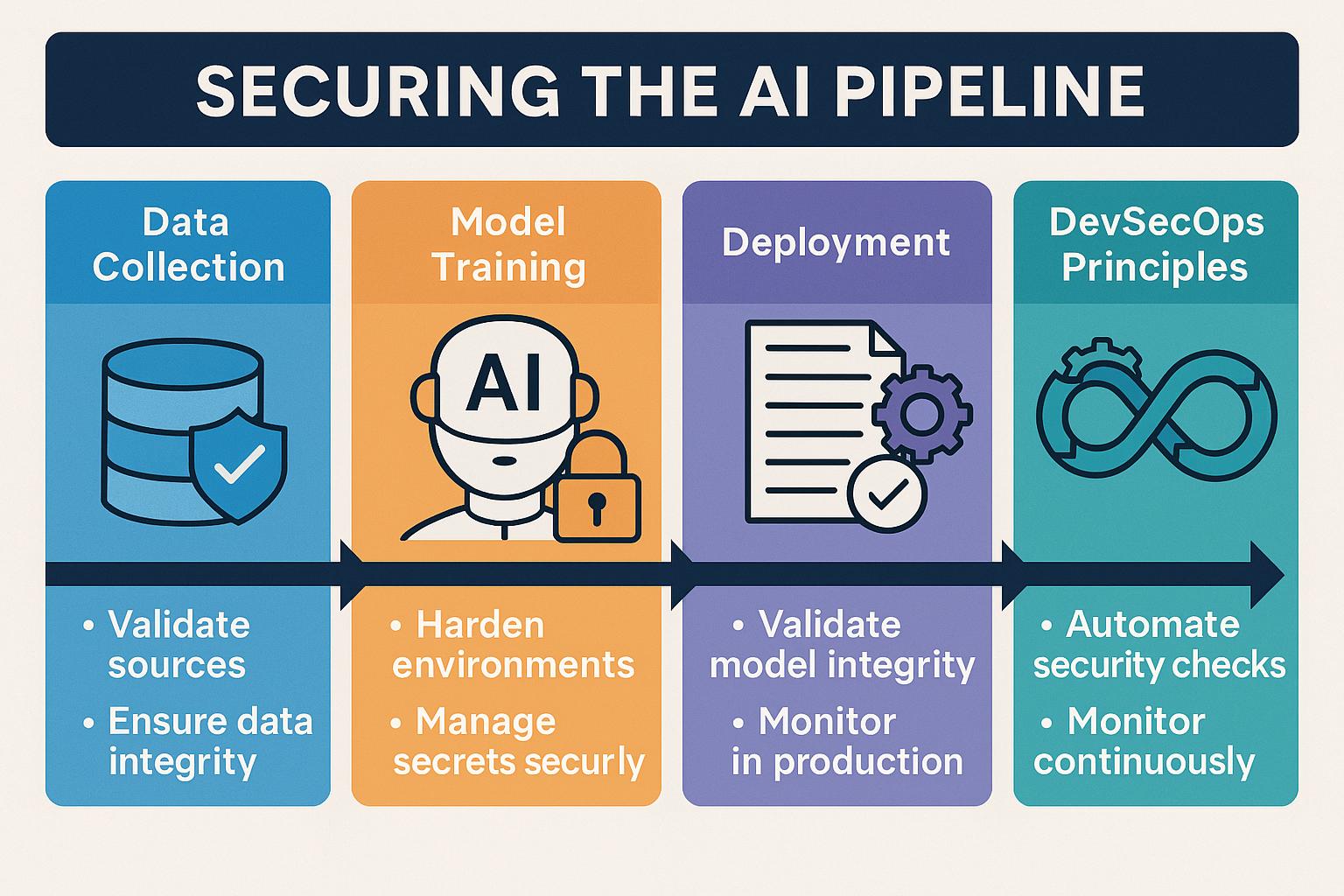
Organizations should secure every stage of the machine learning lifecycle rather than focusing only on deployed models.
Training datasets should always be collected from trusted sources and verified using integrity checks before use. Strong access controls should restrict who can upload, modify, or delete training data.
Dataset versioning provides a complete history of changes, making unauthorized modifications easier to detect. Regular audits can identify unusual patterns or suspicious records before training begins.
Data validation pipelines should automatically scan incoming datasets for anomalies, duplicate entries, unexpected distributions, or malicious triggers. Statistical analysis and anomaly detection algorithms can help identify suspicious data before it reaches the training stage.
Organizations should also secure their software supply chain by verifying pretrained models, machine learning libraries, and third-party dependencies using cryptographic signatures and trusted repositories.
Continuous monitoring should extend beyond deployment. AI models should be evaluated regularly using adversarial testing, red team exercises, and security-focused validation datasets designed to detect hidden backdoors.
Finally, Zero Trust principles should be applied throughout AI infrastructure. Every user, service, and system interacting with the training pipeline should be authenticated, authorized, and continuously verified.
The Future of AI Training Security
As organizations increasingly adopt Generative AI, Large Language Models (LLMs), and autonomous AI agents, protecting the training pipeline will become even more important. Future AI systems will depend on larger datasets collected from numerous external sources, increasing opportunities for attackers to introduce poisoned information.
Researchers are actively developing techniques such as robust learning algorithms, secure federated learning, differential privacy, trusted execution environments, and explainable AI to improve resistance against poisoning attacks. Nevertheless, no single defense completely eliminates the risk. Effective protection requires a combination of secure data governance, infrastructure security, continuous monitoring, and rigorous validation.
Conclusion
AI is only as trustworthy as the data and processes used to train it. Attacking the AI training pipeline allows adversaries to compromise machine learning models long before they reach production, making model poisoning one of the most subtle and dangerous threats facing modern AI systems.
Organizations that rely on AI must view the training pipeline as critical infrastructure. Protecting datasets, securing supply chains, validating training inputs, monitoring model behavior, and implementing strong governance are no longer optional—they are essential requirements for building trustworthy AI.
As AI becomes increasingly responsible for critical business decisions and security operations, defending the training pipeline against model poisoning will play a central role in ensuring the reliability, safety, and integrity of future intelligent systems.
Frequently Asked Questions (FAQs)
Q1. What is an AI training pipeline?
An AI training pipeline is the complete process of building a machine learning model. It includes collecting data, cleaning and labeling it, training the model, validating its performance, and deploying it for real-world use. Each stage must be secured to ensure the AI model remains accurate and trustworthy.
Q2. What is model poisoning in AI?
Model poisoning is a cyberattack where attackers intentionally manipulate training data or the training process to make an AI model learn incorrect or malicious behavior. The poisoned model may appear to work normally but produce harmful results under specific conditions.
Q3. How do attackers poison AI training data?
Attackers can inject fake or misleading data into training datasets, alter data labels, compromise third-party datasets, exploit cloud storage, manipulate open-source repositories, or introduce hidden backdoors during model training.
Q4. What is the difference between data poisoning and model poisoning?
Data poisoning specifically targets the training dataset by inserting or modifying data. Model poisoning is a broader term that includes data poisoning as well as attacks that manipulate the training process, model parameters, or training infrastructure.
Q5. Why are AI training pipeline attacks difficult to detect?
These attacks are often subtle and affect only a small portion of the training data. As a result, the AI model may achieve high accuracy during testing while still containing hidden vulnerabilities or backdoors that activate only under specific conditions.