
Table of Contents
Introduction
Modern enterprises rely heavily on cloud computing to build scalable, flexible, and globally accessible digital services. Websites, customer portals, APIs, SaaS platforms, development environments, marketing campaigns, and internal applications are often distributed across multiple cloud providers such as AWS, Microsoft Azure, Google Cloud, Cloudflare, GitHub Pages, Shopify, Heroku, and many other third-party services.
While this distributed cloud approach offers agility and faster deployment, it also introduces a hidden cybersecurity risk that many organizations underestimate—malicious subdomain takeover. A single forgotten or misconfigured subdomain can become an entry point for cybercriminals, allowing them to impersonate an organization’s trusted domain, distribute malware, steal credentials, or launch sophisticated phishing attacks.
As enterprises continue expanding their cloud infrastructure, the number of inactive, abandoned, or improperly configured subdomains grows rapidly. Without continuous monitoring, these forgotten assets become valuable targets for attackers.
Understanding Subdomains
A subdomain is an extension of a primary domain that helps organize different services or applications under the same brand.
For example, if an organization owns:
company.com
It may also use subdomains such as:
login.company.com
support.company.com
careers.company.com
blog.company.com
api.company.com
Each subdomain can point to a different server, application, or cloud service.
Large organizations may own hundreds or even thousands of subdomains spread across multiple departments, vendors, and cloud platforms.
What is a Subdomain Takeover?
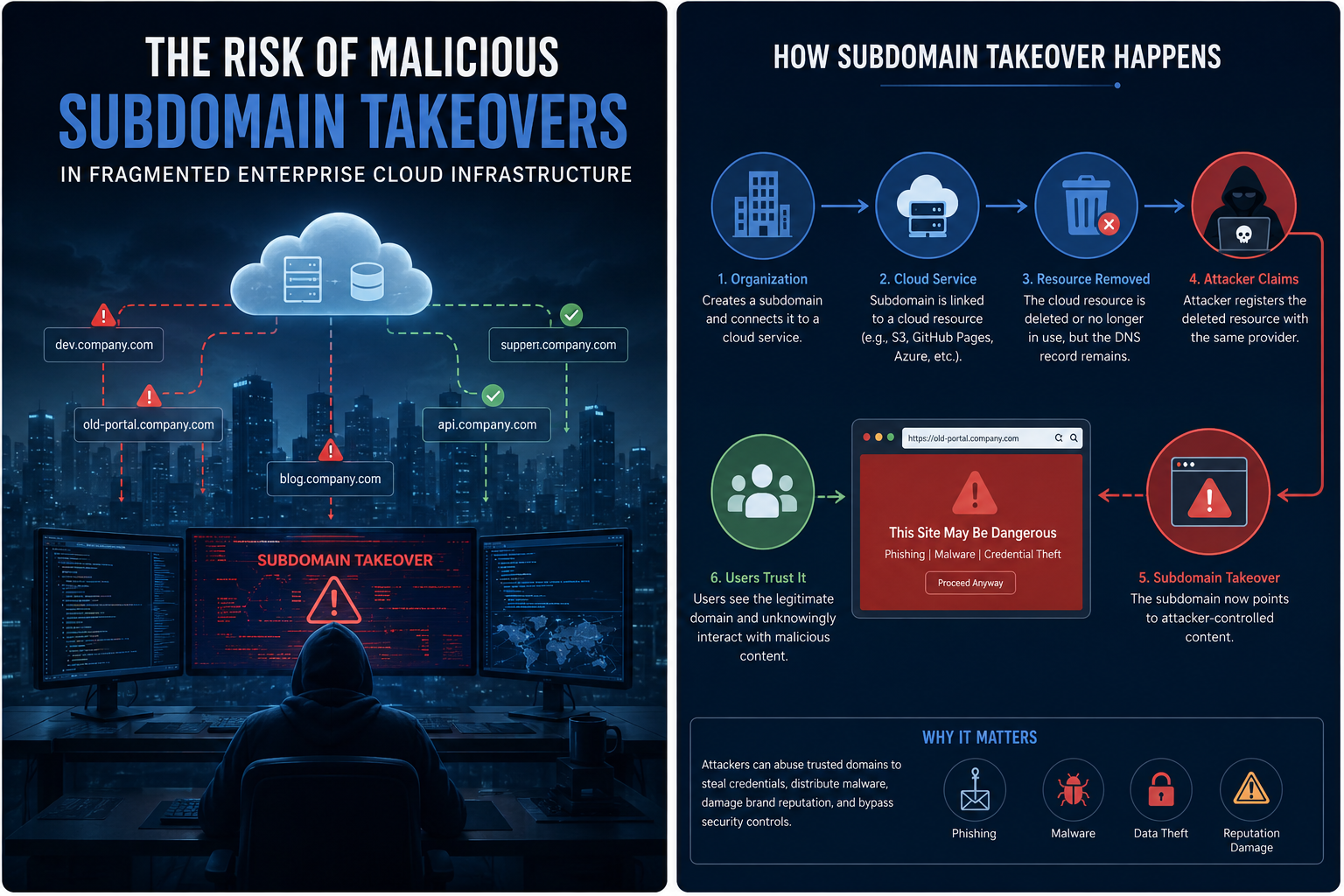
A subdomain takeover occurs when a DNS record still points to an external cloud service that is no longer active or has been deleted.
Imagine a company creates:
blog.company.com
and connects it to a cloud-hosted blogging platform. Months later, the blog is removed, but the DNS record continues pointing to that service.
If another person registers the same cloud resource before the company notices, the attacker gains control of blog.company.com without ever compromising the organization’s servers.
Because visitors still see the company’s official domain, they naturally trust the website, making phishing and credential theft significantly more effective.
Why Fragmented Enterprise Cloud Infrastructure Makes the Problem Worse
Today’s enterprise environment is rarely managed from a single platform.
Different teams often use different cloud services for different purposes. The marketing team may launch campaign microsites, developers may deploy test environments, HR may use recruitment portals, and customer support may rely on external ticketing systems. Over time, projects end, vendors change, and temporary environments are forgotten.
The DNS records, however, often remain active.
As organizations grow, these forgotten cloud connections accumulate, creating a large attack surface that security teams may not even realize exists.
Cloud migrations, mergers, acquisitions, and digital transformation initiatives further increase the complexity, making it difficult to maintain an accurate inventory of all subdomains.
How Attackers Perform a Subdomain Takeover
Cybercriminals usually begin by scanning publicly available DNS records to identify subdomains that point to inactive cloud services.
When they discover a vulnerable DNS configuration, they attempt to recreate the deleted cloud resource using the same service provider.
If successful, the DNS automatically starts directing users to infrastructure controlled by the attacker.
No malware or server hacking is required.
The attacker simply takes ownership of the abandoned cloud resource that the organization’s DNS already trusts.
Real-World Consequences
The impact of a malicious subdomain takeover extends far beyond website defacement.
Since the compromised subdomain belongs to a trusted corporate domain, attackers can host convincing phishing pages that mimic login portals or customer dashboards. Employees and customers are more likely to enter usernames, passwords, or payment information because the URL appears legitimate.
Attackers may also distribute malware, ransomware, or fake software updates through the compromised subdomain. Search engines may temporarily trust the domain, allowing malicious content to spread before detection.
In some cases, compromised subdomains have been used to steal authentication tokens, hijack user sessions, host malicious JavaScript, or manipulate API communications.
The damage can include financial losses, customer distrust, regulatory penalties, and significant reputational harm.
Common Causes of Subdomain Takeovers
Most subdomain takeovers result from operational oversights rather than technical vulnerabilities.
Organizations frequently retire cloud services without removing associated DNS records. Temporary development environments remain online after projects conclude. Third-party vendors discontinue services, yet DNS entries continue pointing toward inactive infrastructure.
Cloud migrations can also leave behind outdated DNS configurations, while mergers and acquisitions often introduce unknown digital assets into an organization’s environment.
Without regular audits, these orphaned records remain exposed for months or even years.
Business Risks
Beyond technical concerns, subdomain takeovers present serious business risks.
Customers who encounter malicious pages under a company’s domain may permanently lose confidence in the brand. Security incidents involving trusted domains often attract media attention and can trigger compliance investigations under data protection regulations.
For organizations operating in finance, healthcare, government, or e-commerce, even a single compromised subdomain can have significant legal and financial consequences.
Detecting Vulnerable Subdomains
Security teams should continuously monitor their DNS infrastructure for inactive cloud resources.
Regular asset discovery helps identify forgotten subdomains that no longer serve a business purpose. Organizations should compare DNS records against active cloud deployments to ensure every configured destination still exists.
Automated security scanners can detect dangling DNS records before attackers exploit them.
Periodic penetration testing and attack surface management programs also play an important role in identifying hidden exposures.
Best Practices for Prevention
Preventing subdomain takeovers requires strong cloud governance rather than relying solely on firewalls or endpoint protection.
Organizations should maintain an up-to-date inventory of every subdomain and document its owner, purpose, and hosting provider. Whenever a cloud service is retired, associated DNS records should be removed immediately.
Continuous monitoring should verify that all DNS entries resolve only to valid and authorized cloud resources. Temporary environments must have defined expiration dates, ensuring they are automatically decommissioned when no longer needed.
Organizations should also establish change-management procedures that involve security teams whenever cloud services are created, modified, or removed.
Regular penetration testing, DNS audits, and external attack surface assessments help detect misconfigurations before cybercriminals do.
The Role of Security Teams
Modern cybersecurity teams must view DNS as a critical security asset rather than just a networking component.
Effective collaboration between cloud engineers, DevOps teams, IT administrators, and cybersecurity professionals is essential for maintaining visibility across distributed infrastructure.
Continuous monitoring, asset inventory management, and proactive risk assessments significantly reduce the likelihood of forgotten cloud resources becoming attack vectors.
How FireShark Can Help
Organizations with complex cloud environments often require specialized expertise to identify hidden security risks. FireShark provides services including Vulnerability Assessment and Penetration Testing (VAPT), External Attack Surface Management, Cloud Security Assessments, Web Application and API Security Testing, Security Audits, Infrastructure Hardening, and Continuous Security Monitoring.
By identifying orphaned DNS records, cloud misconfigurations, and exposed digital assets before attackers do, FireShark helps organizations strengthen their cloud security posture and reduce the risk of subdomain takeover attacks.
Conclusion
As enterprise cloud environments continue expanding across multiple providers and third-party platforms, forgotten subdomains are becoming one of the most overlooked cybersecurity risks. A single abandoned DNS record can allow attackers to gain control of a trusted corporate domain without compromising internal systems.
The solution lies in maintaining complete visibility of digital assets, enforcing proper cloud governance, conducting regular DNS audits, and continuously monitoring the organization’s external attack surface.
In today’s fragmented cloud ecosystem, securing every subdomain is no longer optional—it is a fundamental part of protecting enterprise reputation, customer trust, and business continuity.
Frequently Asked Questions (FAQs)
What is a subdomain takeover?
A subdomain takeover is a security vulnerability that occurs when a subdomain points to an inactive cloud resource that an attacker can claim and control.
Why are enterprises vulnerable to subdomain takeovers?
Large organizations often use multiple cloud providers and third-party services. Over time, inactive services may leave behind DNS records that attackers can exploit.
Can a subdomain takeover lead to phishing?
Yes. Because the malicious website uses a trusted company domain, users are much more likely to believe it is legitimate and provide sensitive information.
How can organizations prevent subdomain takeovers?
Regular DNS audits, cloud asset inventory management, continuous attack surface monitoring, timely removal of unused DNS records, and periodic penetration testing are among the most effective preventive measures.