

Table of Contents
Introduction
Artificial Intelligence has transformed industries by enabling organizations to build applications that can understand language, recognize images, generate content, and automate complex tasks. Behind every AI model lies an essential component known as a model checkpoint. These checkpoint files allow developers to save a model’s learned parameters so they can resume training or deploy the model without starting from scratch.
However, while model checkpoints make AI development easier, they have also introduced a growing cybersecurity concern. Researchers have demonstrated that maliciously crafted AI model checkpoints can execute arbitrary code when loaded by vulnerable applications. This means that what appears to be an ordinary AI model could actually become a delivery mechanism for a cyberattack.
As organizations increasingly download pretrained models from public repositories and third-party sources, understanding this threat has become essential for developers, security teams, AI researchers, and businesses deploying machine learning solutions.
What Are AI Model Checkpoints?
A model checkpoint is essentially a saved version of a machine learning model. It contains the information required to recreate the trained model, including learned weights, optimizer states, training progress, and various configuration parameters.
During training, checkpoints are created periodically so developers can recover from interruptions without losing days or weeks of computation. Once training is complete, these checkpoint files are distributed to other developers for inference, fine-tuning, or research purposes.
Popular AI frameworks such as PyTorch, TensorFlow, and others support saving and loading checkpoints using different serialization methods. While serialization makes sharing models convenient, it also introduces security risks if unsafe serialization mechanisms are used.
Why Are Model Checkpoints Becoming a Security Risk?
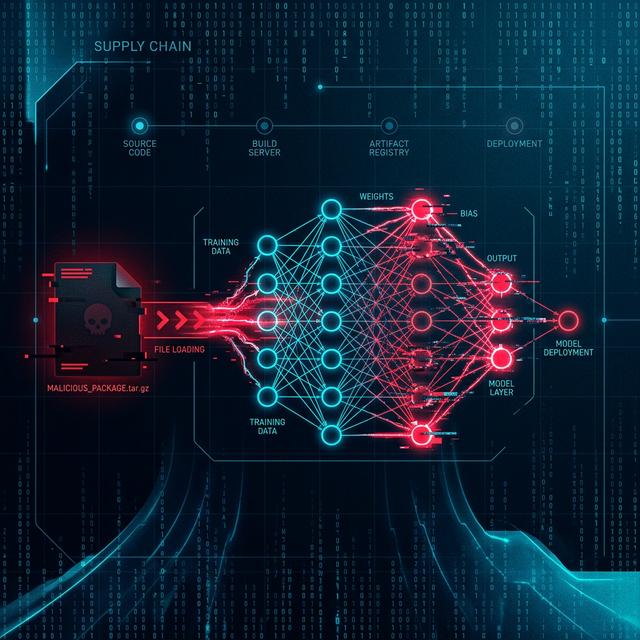
Unlike traditional files such as images or PDFs, AI model checkpoints are often serialized Python objects. Some serialization formats are capable of storing executable Python instructions alongside model data.
When an application loads such a checkpoint without verifying its contents, the deserialization process may automatically execute embedded Python code.
Instead of simply loading neural network weights, the application unknowingly runs attacker-controlled commands.
This turns what appears to be a harmless AI model into a malware delivery mechanism.
The danger becomes even greater because developers frequently trust checkpoints downloaded from:
- Public AI model repositories
- GitHub projects
- Research papers
- Community forums
- Shared cloud storage
- Third-party vendors
Many developers assume these files only contain mathematical weights, when in reality they may contain executable objects.
Understanding Remote Code Execution (RCE)
Remote Code Execution (RCE) is one of the most severe vulnerabilities in cybersecurity.
It allows an attacker to execute arbitrary commands on another person’s computer or server.
If successful, an attacker may:
- Install malware
- Steal confidential information
- Create administrator accounts
- Deploy ransomware
- Access cloud credentials
- Move laterally inside enterprise networks
- Take complete control of servers
When RCE originates from loading an AI checkpoint, the victim often has no indication that the attack occurred because the model may still function normally.
How Attackers Exploit AI Model Checkpoints
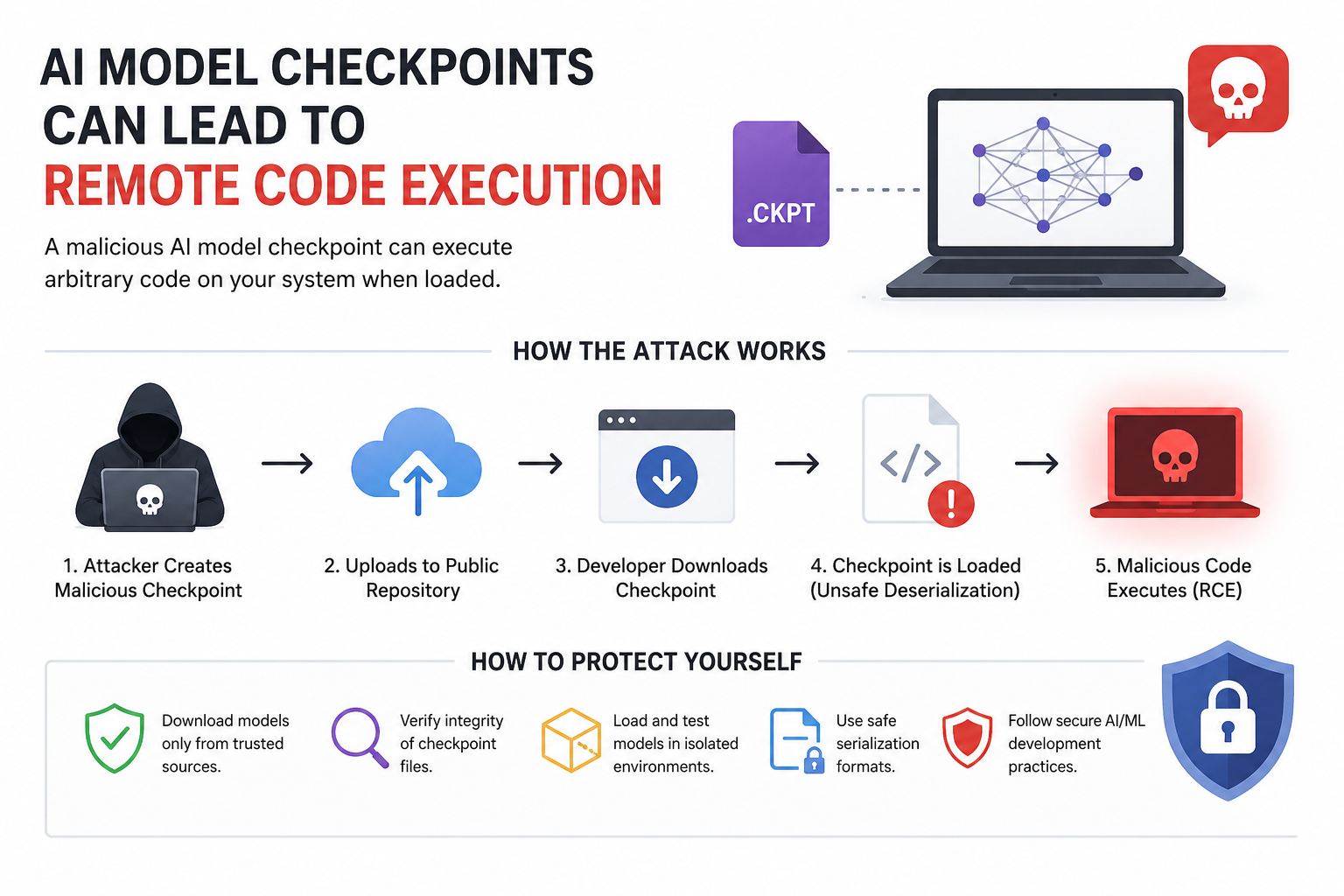
The attack generally begins with a malicious actor creating a seemingly useful AI model. The attacker trains a legitimate model or copies an existing one before embedding malicious code inside its checkpoint file.
The infected checkpoint is then uploaded to a public repository or shared through forums, GitHub projects, or file-sharing platforms. It often includes attractive descriptions such as improved accuracy, optimized performance, or compatibility with popular frameworks.
A developer searching for a pretrained model downloads the checkpoint and loads it into their application using standard framework functions.
During the loading process, vulnerable serialization libraries automatically deserialize the embedded objects.
Instead of simply restoring model parameters, hidden malicious instructions are executed immediately.
Depending on the attacker’s objectives, these instructions may silently install malware, open reverse shells, steal authentication tokens, or establish persistent remote access while the AI model appears to work perfectly.
Because the model performs as expected, developers may never suspect that malicious code executed during loading.
Why Python Serialization Makes This Possible
Many AI applications use Python because of its extensive machine learning ecosystem.
Python commonly relies on serialization libraries to save and restore objects.
Some serialization mechanisms are powerful because they preserve nearly every aspect of an object’s internal state.
Unfortunately, this flexibility also allows specially crafted objects to trigger arbitrary function execution during deserialization.
If applications deserialize untrusted checkpoints directly, they effectively execute code supplied by unknown parties.
This issue is not unique to AI but becomes particularly dangerous because AI developers frequently exchange serialized models across the internet.
A Realistic Attack Scenario
Imagine a software company developing an internal chatbot.
One of the developers downloads an open-source language model from an online repository because it promises faster inference and improved accuracy.
The checkpoint file loads successfully, and the chatbot performs exactly as advertised.
Unknown to the developer, the checkpoint contained hidden instructions that silently execute during loading.
Those instructions collect cloud API keys stored in environment variables, transmit them to an attacker-controlled server, and install a backdoor.
Days later, attackers use the stolen credentials to access the company’s cloud infrastructure, extract customer databases, and deploy ransomware.
Although the breach originated from a single AI model download, the consequences affect the organization’s entire infrastructure.
Supply Chain Risks in AI
Modern AI development heavily depends on external resources.
Organizations rarely train every model from scratch.
Instead, they frequently reuse:
- Open-source foundation models
- Community checkpoints
- Fine-tuned language models
- Third-party embeddings
- Research implementations
- Shared datasets
This creates an AI supply chain similar to software package ecosystems.
If any component in that chain becomes compromised, every downstream user becomes a potential victim.
Supply chain attacks have already affected software ecosystems worldwide, and AI repositories are increasingly becoming attractive targets.
Why Traditional Antivirus May Miss These Attacks
Traditional antivirus software primarily searches for known malware signatures or suspicious executable files.
Malicious AI checkpoints often appear to be ordinary data files rather than executable programs.
Since the harmful code only activates during deserialization inside a trusted application, many security tools fail to recognize the threat beforehand.
This makes checkpoint attacks especially stealthy.
Who Is Most at Risk?
Several groups face increased exposure to this threat.
AI researchers frequently download experimental models from public repositories.
Machine learning engineers often integrate community checkpoints into production systems.
Data scientists regularly exchange pretrained models across organizations.
Cloud AI platforms process uploaded checkpoints from multiple users.
Startups building AI-powered products may prioritize rapid development over security validation.
Educational institutions also share research models extensively, making them attractive targets for attackers seeking widespread distribution.
How Organizations Can Protect Themselves
Preventing checkpoint-based attacks requires both secure development practices and organizational security policies.
Organizations should only download AI models from trusted publishers with verified identities. Every downloaded checkpoint should undergo integrity verification before being used in production.
Where possible, safer model formats that store only tensor weights should be preferred over formats capable of arbitrary code execution.
AI models should first be tested inside isolated sandbox environments rather than directly on production servers.
Security teams should continuously monitor outbound network connections during model loading because unexpected network activity may indicate malicious behavior.
Organizations should also maintain software bill of materials (SBOM) records for AI assets, allowing them to trace the origin of every deployed model.
Regular security reviews of machine learning pipelines are becoming just as important as code reviews for traditional software.
The Future of AI Model Security
As AI adoption accelerates, attackers are increasingly targeting machine learning infrastructure rather than individual applications.
Future threats may include:
- Malicious pretrained foundation models
- Poisoned fine-tuning datasets
- Backdoored AI plugins
- Compromised model hubs
- AI package dependency attacks
- Cloud-hosted model manipulation
Security researchers are actively developing safer serialization formats, cryptographic verification techniques, secure model registries, and automated scanning tools to reduce these risks.
AI security is rapidly evolving into a specialized discipline that combines machine learning with traditional cybersecurity practices.
Conclusion
AI model checkpoints are indispensable for modern machine learning, enabling developers to share, resume, and deploy models efficiently. However, their convenience comes with significant security implications. When checkpoints use unsafe serialization formats, they can become vehicles for Remote Code Execution (RCE), allowing attackers to run malicious code on systems that load them.
As organizations increasingly rely on third-party models, treating AI artifacts with the same caution as software executables is essential. Verifying the source of model files, using safer serialization formats, testing models in isolated environments, and monitoring AI pipelines for unusual behavior are critical steps toward reducing risk.
The future of AI depends not only on building more powerful models but also on ensuring they can be shared and deployed securely. By integrating cybersecurity best practices into every stage of the AI lifecycle, developers and organizations can harness AI’s potential while protecting their infrastructure from emerging threats.