Introduction
Multi-Factor Authentication (MFA) has long been considered one of the most effective ways to protect online accounts and sensitive systems. By requiring users to verify their identity using more than just a password, MFA adds an additional layer of security that makes unauthorized access significantly more difficult. However, cybercriminals are constantly evolving their tactics, and one increasingly popular technique known as MFA Fatigue is proving that even strong security mechanisms can be manipulated through human behavior.
Rather than breaking encryption or exploiting software vulnerabilities, attackers exploit something much easier—the user’s patience and attention. By bombarding victims with repeated authentication requests, hackers attempt to frustrate, confuse, or trick them into approving a login request they never intended to authorize. This form of social engineering has become a major threat to organizations worldwide and has been responsible for several high-profile security breaches.
Understanding Multi-Factor Authentication
Traditional passwords are vulnerable to phishing attacks, credential leaks, and brute-force attempts. Multi-Factor Authentication improves security by requiring additional proof of identity, such as:
A push notification on a mobile device.
A one-time password (OTP).
Biometric verification like fingerprints or facial recognition.
Hardware security keys.
Even if attackers steal a user’s password, they typically cannot access the account without completing the second verification step. Unfortunately, hackers have found ways to turn this protective mechanism against users themselves.
What is MFA Fatigue?
MFA Fatigue, also called Push Bombing or Authentication Fatigue, is a social engineering attack in which cybercriminals repeatedly send authentication requests to a victim’s device. Since many authentication systems rely on simple “Approve” or “Deny” notifications, attackers hope that eventually the victim will become annoyed, distracted, or assume the requests are legitimate and press “Approve.”
Once the approval is granted, the attacker gains access to the account despite the presence of Multi-Factor Authentication.
Unlike sophisticated malware attacks, MFA Fatigue relies primarily on psychological pressure rather than technical complexity.
How Attackers Obtain the Initial Credentials
MFA Fatigue attacks usually begin after attackers have already stolen a user’s password. They commonly acquire credentials through:
Phishing Emails
Victims receive fake emails appearing to come from Microsoft, Google, banks, or company IT departments. These messages direct users to counterfeit login pages designed to steal usernames and passwords.
Credential Leaks
Millions of usernames and passwords are exposed every year through data breaches. Attackers purchase these credentials on underground marketplaces and use them to attempt account access.
Password Reuse
Many users reuse passwords across multiple websites. If one service is compromised, attackers may use the same credentials to target business accounts and cloud services.
Malware and Keyloggers
Malicious software installed on infected devices can secretly capture login information and transmit it to attackers.
Once attackers possess valid credentials, they proceed to overwhelm the victim with repeated MFA prompts.
How MFA Fatigue Attacks Work
The attack often unfolds in several stages.
First, the attacker logs into an account using stolen credentials. Since Multi-Factor Authentication is enabled, access is blocked pending approval from the legitimate user.
The authentication system immediately sends a push notification to the victim’s smartphone asking whether the login attempt should be approved.
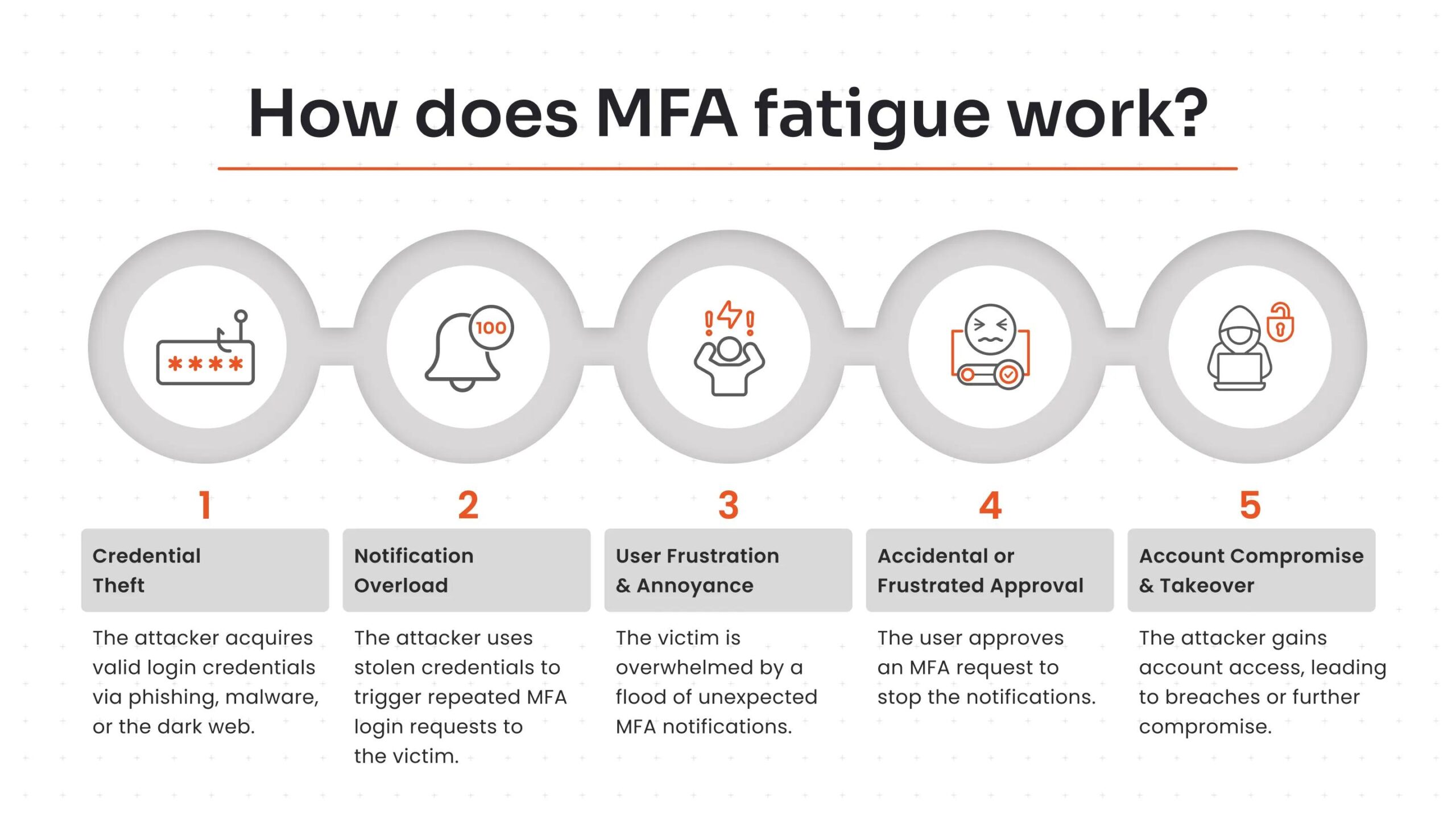
The victim denies the request because they did not initiate the login.
However, the attacker simply repeats the process over and over again. Notifications continue arriving every few seconds or minutes. Eventually, the victim may:
Mistakenly approve the request.
Become frustrated and press “Accept” to stop the notifications.
Assume the prompts are caused by a system error.
Receive a phone call from the attacker pretending to be IT support and requesting approval.
As soon as the request is accepted, the attacker gains access and can move laterally throughout the network, steal sensitive data, deploy ransomware, or escalate privileges.
Why MFA Fatigue Attacks Are Effective
Humans naturally become less attentive when repeatedly exposed to the same interruption. This phenomenon, known as alert fatigue, is common in healthcare, aviation, and cybersecurity environments.
Hackers understand that people are busy. Receiving dozens of login prompts during work meetings, while sleeping, or during travel increases the likelihood that users will approve one accidentally.
The attack exploits trust and impatience rather than weaknesses in encryption or authentication technology.
Real-World Examples
Uber Breach (2022)
One of the most widely publicized MFA Fatigue attacks targeted Uber in 2022. Attackers obtained an employee’s credentials and flooded the victim with push notifications. Eventually, they contacted the employee while impersonating IT support and convinced them to approve the login request. The attackers subsequently gained access to internal systems and sensitive information.
Microsoft Incident Reports
Microsoft has repeatedly warned organizations about cybercriminal groups using push notification spam to bypass authentication systems. Threat actors increasingly combine credential theft with social engineering to defeat traditional MFA mechanisms.
Okta and Cloud Service Attacks
Identity management providers have documented numerous cases where attackers abused push notifications to compromise accounts and gain access to enterprise cloud environments.
These incidents demonstrate that attackers do not always need advanced malware; sometimes human psychology is enough.
Warning Signs of an MFA Fatigue Attack
Users should become suspicious when they notice:
Multiple authentication requests they did not initiate.
Login prompts appearing late at night or during periods of inactivity.
Repeated notifications after pressing “Deny.”
Unexpected calls or messages claiming to be from IT support.
Login alerts from unfamiliar locations or devices.
Ignoring these warning signs can lead to account compromise.
How Organizations Can Prevent MFA Fatigue Attacks
Modern organizations are adopting stronger authentication practices to reduce the effectiveness of push bombing attacks.
Number Matching
Instead of allowing users to simply approve notifications, systems display a number on the login screen that must be entered into the authentication app. Attackers cannot see the number and therefore cannot trick users into approving blindly.
Biometric Authentication
Fingerprint and facial recognition add another layer of identity verification that is difficult to bypass remotely.
Hardware Security Keys
Physical security keys based on FIDO2 standards provide phishing-resistant authentication and significantly reduce the risk of MFA fatigue attacks.
Conditional Access Policies
Organizations can restrict access based on device health, user location, and risk assessments. Suspicious login attempts can be automatically blocked before notifications reach the user.
User Awareness Training
Employees should understand that repeated authentication requests are signs of a possible attack and should immediately report them to the security team.
Rate Limiting Authentication Requests
Security teams can configure identity platforms to limit the number of MFA prompts sent within a specific timeframe, reducing opportunities for push bombing.
Password Hygiene
Strong, unique passwords combined with password managers help prevent attackers from obtaining credentials in the first place.
The Future of Authentication
As cybercriminals become more sophisticated, security professionals are shifting toward phishing-resistant authentication technologies. Passwordless authentication, hardware security keys, passkeys, and Zero Trust architectures are emerging as powerful defenses against MFA Fatigue attacks.
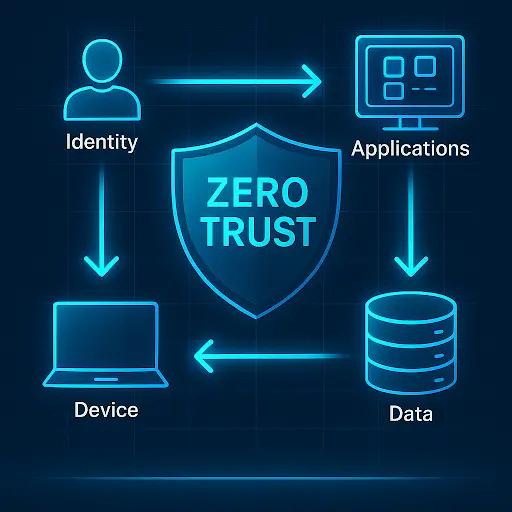
The future of cybersecurity will depend not only on stronger technologies but also on designing systems that minimize human error. Since attackers increasingly target users rather than systems, organizations must combine technical controls with continuous security awareness.
Conclusion
Multi-Factor Authentication remains one of the most important defenses against unauthorized access, but it is not invulnerable. MFA Fatigue attacks demonstrate that cybercriminals can exploit human behavior instead of attacking the technology itself. By overwhelming victims with repeated authentication requests and using social engineering tactics, hackers can bypass security protections that many organizations consider sufficient.
Implementing phishing-resistant authentication methods, enabling number matching, educating users, and adopting Zero Trust principles can significantly reduce the risk posed by MFA Fatigue attacks. As the threat landscape continues to evolve, organizations must recognize that cybersecurity is as much about protecting people as it is about protecting systems.
Frequently Asked Questions (FAQs)
1. What is MFA Fatigue?
MFA Fatigue is a cyberattack where hackers repeatedly send authentication requests to users in the hope that they will eventually approve one accidentally or out of frustration.
2. Is Multi-Factor Authentication still secure?
Yes. MFA remains highly effective, but organizations should use advanced methods such as number matching, passkeys, or hardware security keys to prevent abuse.
3. What is Push Bombing?
Push Bombing is another name for MFA Fatigue attacks in which users receive continuous authentication notifications until they unknowingly approve one.
4. Which industries are most vulnerable to MFA Fatigue attacks?
Any industry using push-based authentication can be targeted, including healthcare, finance, education, cloud services, and government organizations.
5. How can users protect themselves from MFA Fatigue attacks?
Never approve unexpected login requests, report suspicious notifications immediately, use strong passwords, and enable phishing-resistant authentication methods whenever possible.