Table of Contents
Introduction
Cloud computing has transformed the way organizations manage applications, users, and data. From Microsoft 365 and Google Workspace to Salesforce, AWS, and countless SaaS platforms, cloud services rely heavily on OAuth (Open Authorization) to provide seamless and secure access. OAuth allows users to log in with existing accounts and enables applications to communicate without exposing passwords. While this approach improves convenience and reduces password-related risks, it has also created a new attack surface that cybercriminals are actively exploiting.
In recent years, security researchers have observed a significant increase in OAuth token hijacking attacks. Unlike traditional credential theft, these attacks allow adversaries to maintain persistent access to cloud environments even after passwords have been changed. As organizations continue to adopt cloud-first strategies, understanding the growing threat of OAuth token hijacking has become essential for cybersecurity professionals and businesses alike.
Understanding OAuth and Access Tokens
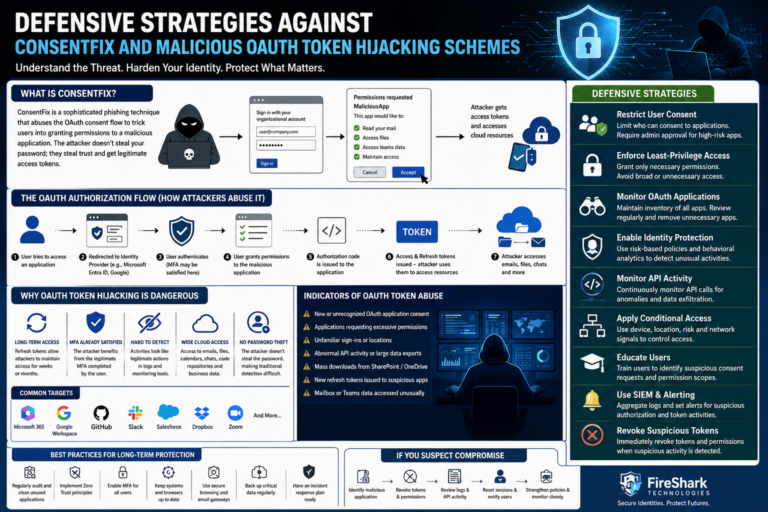
OAuth is an authorization framework that enables applications to access resources on behalf of users without storing their passwords. When a user grants permission to an application, the authorization server issues tokens that act as digital keys.
There are generally two important types of tokens:
- Access Tokens, which allow applications to access specific resources for a limited time.
- Refresh Tokens, which can generate new access tokens without requiring the user to log in again.
These tokens simplify authentication and improve user experience. However, if attackers obtain these tokens, they can impersonate legitimate users and gain access to cloud resources without knowing the actual password.
Why OAuth Tokens Have Become a Prime Target
Traditional cyberattacks focused on stealing usernames and passwords. Today, attackers recognize that OAuth tokens offer a more attractive target. Tokens often remain valid for extended periods and are trusted by cloud applications.
A stolen token can provide access to:
- Email accounts
- Shared documents
- Cloud storage
- Customer databases
- Internal collaboration platforms
- CRM systems
- Development repositories
Since token-based authentication is considered legitimate by the cloud service, malicious activities can easily blend with normal user behavior, making detection significantly more difficult.
How OAuth Token Hijacking Attacks Work
Initial Compromise
Attackers typically begin by compromising a user’s system through phishing emails, malware infections, browser extension attacks, or compromised applications. Instead of focusing on passwords, they aim to steal authentication tokens stored in browsers, cookies, or local application caches.
Once acquired, these tokens provide direct access to cloud resources.
Exploiting Legitimate Sessions
Since OAuth tokens represent already authenticated sessions, attackers bypass many security controls, including password resets. Even organizations that enforce strong passwords may remain vulnerable because the token itself acts as proof of identity.
This technique is often called session hijacking or token replay.
Persistence Through Refresh Tokens
Refresh tokens are particularly dangerous because they allow attackers to generate new access tokens repeatedly. This enables long-term persistence inside cloud environments without triggering password-related alerts.
An attacker may maintain access for weeks or even months before being discovered.
Common Methods Used to Steal OAuth Tokens
Phishing Attacks
Modern phishing campaigns have evolved beyond credential harvesting. Attackers increasingly trick users into authorizing malicious applications or capturing session tokens directly.
Victims may receive emails claiming to be from Microsoft, Google, or corporate IT departments, leading them to fake authentication pages.
Malicious Browser Extensions
Browser extensions often request excessive permissions. Once installed, malicious extensions can access cookies and session data, extracting OAuth tokens without the user’s knowledge.
Infostealer Malware
Infostealer malware families such as RedLine, Lumma, and Vidar specialize in collecting browser cookies, credentials, and OAuth tokens. These stolen artifacts are then sold on underground marketplaces.
Compromised Third-Party Applications
Organizations frequently integrate external applications with cloud services. If one of these applications becomes compromised, attackers may gain access to issued OAuth tokens and leverage them to infiltrate connected systems.
Token Leakage in Logs and Source Code
Developers occasionally expose tokens in configuration files, API logs, or public repositories. Attackers actively scan GitHub and cloud storage buckets searching for exposed secrets and tokens.
Why Multi-Factor Authentication Alone Cannot Stop Token Hijacking
Many organizations assume that enabling MFA provides complete protection. While MFA is extremely effective against password-based attacks, it offers limited defense once an OAuth token has already been issued.
When attackers steal a valid token, they bypass the login process entirely. Since the user has already completed MFA, the cloud service treats the attacker as an authenticated session.
This makes token theft one of the most dangerous forms of identity compromise.
Real-World Impact on Cloud Environments
OAuth token hijacking can have devastating consequences.
Business Email Compromise
Attackers gaining access to Microsoft 365 or Google Workspace accounts can monitor emails, steal sensitive information, and conduct fraudulent transactions.
Data Exfiltration
Cloud storage platforms such as OneDrive, SharePoint, and Google Drive become attractive targets. Sensitive files, intellectual property, and customer information can be quietly extracted.
Lateral Movement
Compromised identities allow attackers to access multiple integrated applications, expanding their reach across the organization.
Ransomware Preparation
Cybercriminal groups often spend weeks exploring cloud environments after stealing tokens. This reconnaissance phase helps them identify valuable assets before launching ransomware attacks.
OAuth Consent Phishing: An Emerging Threat
One particularly dangerous technique is OAuth consent phishing.
Instead of stealing credentials, attackers create malicious applications and request permissions that appear harmless. Users unknowingly approve these requests, granting attackers legitimate access to their cloud accounts.
Since the authorization process is performed through trusted platforms like Microsoft or Google, traditional phishing detection mechanisms may fail.
The malicious application can then read emails, access calendars, download files, or maintain persistent access through refresh tokens.
Indicators of OAuth Token Hijacking
Organizations should monitor for unusual behavior, including:
- Login activity from unfamiliar geographic locations.
- New OAuth applications appearing without authorization.
- Unusual API calls and excessive file downloads.
- Unexpected mailbox forwarding rules.
- Long-lived sessions that remain active despite password changes.
- Access patterns occurring outside normal business hours.
Continuous identity monitoring and cloud logging are essential for identifying these subtle signs.
Best Practices for Preventing OAuth Token Hijacking
Implement Zero Trust Security
Zero Trust assumes that no session or device should be automatically trusted. Continuous verification helps limit unauthorized access and reduces the impact of stolen tokens.
Enforce Conditional Access Policies
Conditional access evaluates factors such as device health, user location, and risk levels before granting access. Suspicious sessions can be blocked automatically.
Limit OAuth Application Permissions
Applications should receive only the minimum permissions required. Excessive privileges increase the potential damage caused by compromised tokens.
Monitor OAuth Activity
Security teams should regularly review:
- Authorized applications
- Consent grants
- API usage
- Session logs
- Identity anomalies
Cloud-native tools like Microsoft Defender for Cloud Apps and Google Workspace security dashboards can help identify suspicious activity.
Rotate and Revoke Tokens
Organizations should establish policies for token expiration and revocation. Short-lived tokens reduce attackers’ persistence opportunities.
Protect Endpoints
Endpoint Detection and Response (EDR) solutions help detect infostealer malware and browser attacks before tokens can be stolen.
Educate Employees
Users should understand the risks associated with:
- Granting permissions to unknown applications.
- Installing untrusted browser extensions.
- Clicking suspicious links.
- Sharing authentication tokens or screenshots.
The Future of Identity-Based Attacks
Cybersecurity threats are shifting from passwords toward identities and sessions. Attackers increasingly prefer OAuth token hijacking because it provides stealth, persistence, and the ability to evade traditional security controls.
As cloud adoption expands and organizations integrate hundreds of SaaS applications, identity becomes the new security perimeter. Future attacks will likely focus even more on tokens, APIs, and trusted applications rather than brute-force password attacks.
Businesses that continue relying solely on passwords and MFA may struggle against these evolving threats. Advanced identity protection, continuous monitoring, and Zero Trust principles are becoming essential components of modern cloud security.
Conclusion
OAuth token hijacking represents one of the fastest-growing threats in cloud environments. By stealing access and refresh tokens, attackers can bypass passwords, evade multi-factor authentication, and maintain persistent access to critical resources. From phishing campaigns and infostealer malware to malicious OAuth applications, cybercriminals are constantly developing new ways to exploit identity-based systems.
Organizations must recognize that identity has become the primary attack surface in modern cloud infrastructures. Combining Zero Trust architectures, continuous monitoring, conditional access controls, endpoint security, and employee awareness can significantly reduce the risk of token hijacking and help protect sensitive data from increasingly sophisticated adversaries.
FAQs
1. What is OAuth token hijacking?
OAuth token hijacking is a cyberattack in which attackers steal authentication tokens and use them to gain unauthorized access to cloud applications without needing passwords.
2. Can changing a password stop token hijacking?
Not always. If attackers possess valid access or refresh tokens, they may continue accessing resources even after passwords are changed.
3. Why is OAuth token theft dangerous?
Stolen tokens can bypass multi-factor authentication and provide persistent access to email, cloud storage, and other connected services.
4. What are the most common ways attackers steal OAuth tokens?
Phishing attacks, infostealer malware, malicious browser extensions, compromised third-party applications, and exposed tokens in source code are common methods.
5. How can organizations defend against OAuth token hijacking?
Implementing Zero Trust security, monitoring OAuth activity, restricting application permissions, rotating tokens, securing endpoints, and educating employees are effective defense strategies.