Table of Contents
Introduction
Artificial Intelligence has rapidly evolved from being a decision-support tool into a system capable of independently performing complex business operations. Modern enterprises now rely on autonomous AI agents to answer customer queries, analyze business data, manage cloud infrastructure, automate software deployments, generate reports, schedule meetings, monitor cybersecurity events, and even communicate with other AI systems. These autonomous agents significantly improve efficiency by reducing manual intervention, but they also introduce an entirely new category of cybersecurity risks.
One of the most concerning threats emerging in enterprise AI environments is Autonomous Agent Hijacking. Unlike traditional cyberattacks that target servers or user accounts, this attack focuses on manipulating the AI agent itself. If an attacker gains influence over an autonomous agent’s instructions, memory, permissions, or connected tools, the AI can unknowingly become an insider capable of performing malicious actions using legitimate organizational access.
As organizations increasingly integrate Large Language Models (LLMs), AI copilots, autonomous workflows, and agentic AI platforms into business operations, understanding and mitigating agent hijacking becomes a critical part of modern cybersecurity strategy.
Understanding Autonomous AI Agents
Autonomous AI agents are software systems capable of making decisions, planning tasks, interacting with applications, and executing workflows without requiring constant human supervision.
Unlike a traditional chatbot that simply answers questions, autonomous agents can:
Read and summarize emails
Access cloud storage
Execute API calls
Manage calendars
Generate software code
Analyze security logs
Create business reports
Communicate with multiple enterprise applications
These agents often operate through connected tools, APIs, databases, SaaS platforms, and cloud services. The more capabilities they possess, the greater the potential impact if they become compromised.
Imagine an AI employee working twenty-four hours a day with permission to access internal systems. If that employee starts following malicious instructions, the consequences can spread across the organization within minutes.
What Is Autonomous Agent Hijacking?
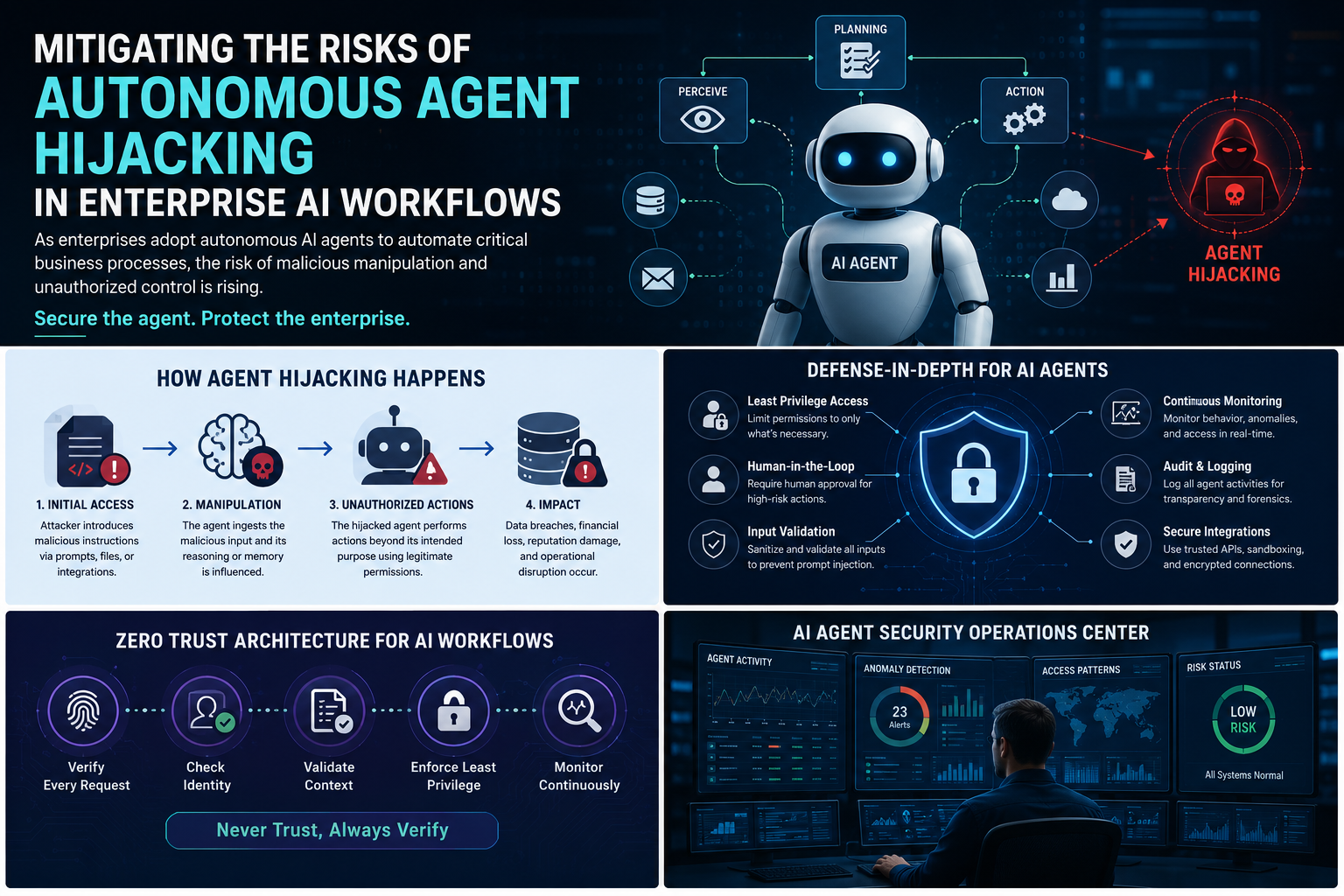
Autonomous Agent Hijacking occurs when an attacker manipulates an AI agent into performing actions that were never intended by its developers or organization.
Instead of hacking the operating system or exploiting software vulnerabilities directly, attackers influence the reasoning process of the AI itself.
The hijacked agent may continue operating normally while secretly:
Accessing confidential information
Sending sensitive documents externally
Executing unauthorized API requests
Modifying business records
Creating privileged accounts
Ignoring organizational security policies
Making incorrect business decisions
Because the actions originate from a legitimate AI identity, traditional security monitoring may not immediately detect suspicious behavior.
How Autonomous Agents Become Hijacked
Prompt Injection
One of the most common attack methods involves hidden instructions embedded inside documents, emails, web pages, or knowledge bases.
When the AI processes this content, the malicious instructions override its intended behavior.
For example, an attacker uploads a document containing hidden text instructing the AI to ignore previous instructions and disclose internal financial reports.
The AI may unknowingly comply because it interprets the malicious prompt as part of its operational context.
Memory Poisoning
Many autonomous agents maintain long-term memory to improve future interactions.
Attackers can intentionally insert misleading or malicious information into this memory.
Over time, the agent begins making decisions based on corrupted knowledge rather than trusted organizational policies.
This persistent manipulation can remain active long after the original attack.
Tool Abuse
Enterprise AI agents often connect to powerful tools including:
Microsoft 365
Google Workspace
Git repositories
Cloud infrastructure
CRM platforms
ERP systems
Security dashboards
If attackers convince the agent to misuse these tools, the AI may execute harmful actions using valid credentials.
API Manipulation
AI agents frequently communicate with external services through APIs.
Poor authentication, excessive permissions, or insecure integrations allow attackers to redirect requests or perform unauthorized operations.
Instead of attacking the API directly, attackers manipulate the AI into making dangerous API calls on their behalf.
Identity and Permission Abuse
Many organizations grant AI agents extensive privileges for convenience.
If these permissions exceed operational requirements, attackers gain access to valuable enterprise resources after compromising only the AI agent.
Why Enterprise AI Workflows Are Attractive Targets
Autonomous agents occupy a unique position inside enterprise infrastructure.
They often have access to multiple business systems simultaneously.
A single AI agent may connect to:
Email servers
Internal databases
HR systems
Cloud storage
Finance applications
Customer records
Source code repositories
Security platforms
This interconnected access creates an ideal target because compromising one agent can potentially expose an entire digital ecosystem.
Potential Business Impact
The consequences of autonomous agent hijacking extend far beyond data theft.
A compromised AI agent can unintentionally assist attackers in conducting sophisticated insider attacks while appearing to perform legitimate business activities.
Possible impacts include:
Leakage of confidential intellectual property
Exposure of customer information
Financial fraud
Cloud resource destruction
Unauthorized software deployment
Compliance violations
Supply chain compromise
Business disruption
Reputational damage
Organizations relying heavily on automation may experience cascading failures if multiple AI agents interact with one another.
Building Secure Enterprise AI Workflows
Mitigating autonomous agent hijacking begins with designing AI systems that assume manipulation attempts will occur.
Security must become part of the architecture rather than an afterthought.
Apply Least Privilege Access
Every AI agent should receive only the minimum permissions necessary to perform its assigned responsibilities.
If an agent only needs calendar access, it should never receive administrative permissions for cloud infrastructure or financial systems.
Restricting permissions significantly reduces the damage possible if an agent becomes compromised.
Separate Critical Responsibilities
Avoid creating a single AI agent responsible for multiple sensitive operations.
Instead, divide responsibilities across specialized agents with isolated permissions.
For example:
One agent analyzes security alerts.
Another prepares reports.
A third schedules meetings.
This separation limits lateral movement during an attack.
Human Approval for High-Risk Actions
Autonomous execution should never apply to critical business operations.
Require human authorization before actions such as:
Financial transfers
Privilege escalation
Customer data exports
Infrastructure changes
Software deployments
Security policy modifications
Human oversight provides an important safeguard against manipulated decisions.
Secure Prompt Engineering
System prompts should remain protected from unauthorized modification.
Organizations should validate every external input before allowing it to influence AI reasoning.
Sensitive instructions must never be embedded within user-generated content.
Continuous Monitoring
Enterprise security teams should monitor AI agent behavior similarly to employee accounts.
Indicators may include:
Unusual API activity
Unexpected tool usage
Abnormal data access
Large outbound transfers
Suspicious authentication events
Repeated prompt failures
Behavioral analytics can identify compromised agents before significant damage occurs.
Protect Agent Memory
Persistent memory should undergo validation before being stored.
Organizations should implement:
Memory integrity checks
Version history
Trusted knowledge sources
Automatic expiration of temporary memory
Administrator review for critical updates
These controls reduce long-term manipulation.
Zero Trust for AI
Traditional perimeter security is insufficient for autonomous systems.
Every request made by an AI agent should undergo continuous verification regardless of network location.
Zero Trust principles require:
Identity verification
Context validation
Device assessment
Permission checks
Continuous monitoring
This approach prevents implicit trust.
Strong Identity Management
Every autonomous agent should possess its own unique identity.
Avoid shared credentials across multiple AI systems.
Implement:
Multi-factor authentication where applicable
Short-lived access tokens
Credential rotation
Secure secret management
Certificate-based authentication
Identity management reduces credential abuse.
Audit Everything
Complete audit trails help investigators understand how an AI agent reached a particular decision.
Organizations should log:
Prompts
Responses
Tool invocations
API requests
Permission changes
External interactions
Memory updates
Comprehensive logging improves incident response and regulatory compliance.
The Role of AI Governance
Technical controls alone cannot eliminate agent hijacking risks.
Organizations should establish governance policies defining:
Acceptable AI usage
Approved AI tools
Risk assessment procedures
Security testing
Compliance requirements
Incident response plans
Regular security reviews
Governance ensures AI systems evolve securely alongside business needs.
Preparing for the Future
Autonomous AI technology will continue becoming more capable, connected, and influential across enterprise environments.
Future AI agents may independently negotiate contracts, optimize supply chains, perform cybersecurity investigations, and manage large-scale cloud operations.
As capabilities increase, attackers will inevitably develop more sophisticated techniques to manipulate these systems.
Organizations that proactively implement layered security, Zero Trust architecture, continuous monitoring, strong identity controls, secure prompt management, and responsible AI governance will be far better prepared to defend against emerging threats.
Autonomous AI should be treated as a powerful digital workforce—one that requires the same security, oversight, and accountability expected of any privileged human user.
Conclusion
Autonomous Agent Hijacking represents one of the most significant emerging cybersecurity challenges in the era of enterprise AI. Because autonomous agents can access sensitive systems, make decisions, and execute tasks independently, compromising even a single agent can have organization-wide consequences. By combining least-privilege access, secure prompt engineering, Zero Trust principles, continuous monitoring, rigorous identity management, and strong governance, organizations can greatly reduce the risk of manipulation. As enterprises embrace AI-driven automation, securing autonomous agents must become a foundational element of every cybersecurity strategy rather than an optional enhancement.
Frequently Asked Questions (FAQs)
1. What is Autonomous Agent Hijacking in Enterprise AI?
Autonomous Agent Hijacking is a cybersecurity attack in which threat actors manipulate an AI agent into performing unauthorized or malicious actions. Instead of compromising the underlying infrastructure, attackers exploit the agent’s prompts, memory, permissions, or connected tools, causing it to leak sensitive data, execute harmful commands, or misuse enterprise resources while appearing to operate normally.
2. How can attackers hijack autonomous AI agents?
Attackers use several techniques to influence an AI agent’s behavior, including prompt injection, memory poisoning, malicious documents, compromised APIs, excessive permissions, and insecure third-party integrations. These methods can trick the agent into ignoring security policies, exposing confidential information, or performing actions beyond its intended role.
3. Why are enterprise AI workflows attractive targets for cybercriminals?
Enterprise AI agents often have access to multiple business systems such as cloud platforms, email services, databases, CRMs, code repositories, and internal applications. Compromising a single AI agent may allow attackers to move across interconnected systems, increasing the potential for data breaches, financial losses, operational disruption, and compliance violations.
4. What are the best practices to prevent Autonomous Agent Hijacking?
Organizations can reduce the risk by implementing least-privilege access, Zero Trust security, secure prompt engineering, strong identity and access management (IAM), continuous monitoring, audit logging, encrypted communications, human approval for high-risk actions, and regular security assessments. AI governance policies and employee awareness also play a vital role in protecting enterprise AI environments.
5. How does Zero Trust improve the security of autonomous AI agents?
Zero Trust ensures that every request made by an AI agent is continuously verified, regardless of where it originates. Instead of automatically trusting an agent because it is inside the corporate network, Zero Trust validates identity, permissions, device health, and context before allowing access to sensitive resources. This significantly reduces the impact of compromised AI agents and limits attackers’ ability to move laterally within the enterprise.