Table of Contents
Introduction
Artificial Intelligence has entered a new era where it is no longer limited to generating text, writing code, or answering questions. Frontier AI models—the most advanced AI systems developed by leading research organizations—are beginning to demonstrate capabilities once thought to be exclusive to elite cybersecurity researchers. These models can analyze millions of lines of source code, identify subtle security flaws, reason through complex software architectures, and in controlled research settings, generate proof-of-concept exploits for previously unknown vulnerabilities.
This technological leap is transforming cybersecurity. Organizations can now discover critical vulnerabilities before attackers do, dramatically reducing the time needed to secure software. At the same time, the very same capabilities raise serious concerns because malicious actors could eventually use similar systems to accelerate cyberattacks. The future of cybersecurity is rapidly becoming an AI-versus-AI battlefield where automated defenders race against automated attackers.
Understanding Zero-Day Vulnerabilities
A zero-day vulnerability is a software security flaw that is unknown to the vendor responsible for the software. Since the vendor has had “zero days” to develop and distribute a patch, attackers who discover the flaw first have an enormous advantage.
Unlike publicly known vulnerabilities that have documented fixes, zero-days remain invisible until someone discovers them. They are among the most valuable assets in cyber warfare because they can compromise systems that appear fully updated and secure.
Historically, discovering zero-days required years of expertise in reverse engineering, programming languages, operating systems, and exploit development. Today, frontier AI models are beginning to automate significant portions of this research process. Multiple recent research efforts and industry demonstrations indicate rapid improvements in AI-assisted vulnerability discovery, although current systems still require human oversight and are not universally successful across all targets.
What Makes Frontier AI Models Different?
Traditional machine learning systems perform narrow tasks. Frontier AI models combine several advanced capabilities:
- Long-term reasoning
- Multi-step planning
- Large-scale code understanding
- Autonomous tool usage
- Memory across lengthy workflows
- Ability to execute complex software engineering tasks
Rather than simply predicting the next word, these systems behave like autonomous research assistants capable of planning investigations, running analyses, interpreting outputs, and refining their approach based on intermediate results. This combination enables them to assist with sophisticated cybersecurity workflows.
The Autonomous Vulnerability Discovery Pipeline
Instead of following predefined rules, frontier AI models increasingly perform vulnerability discovery as an iterative reasoning process.
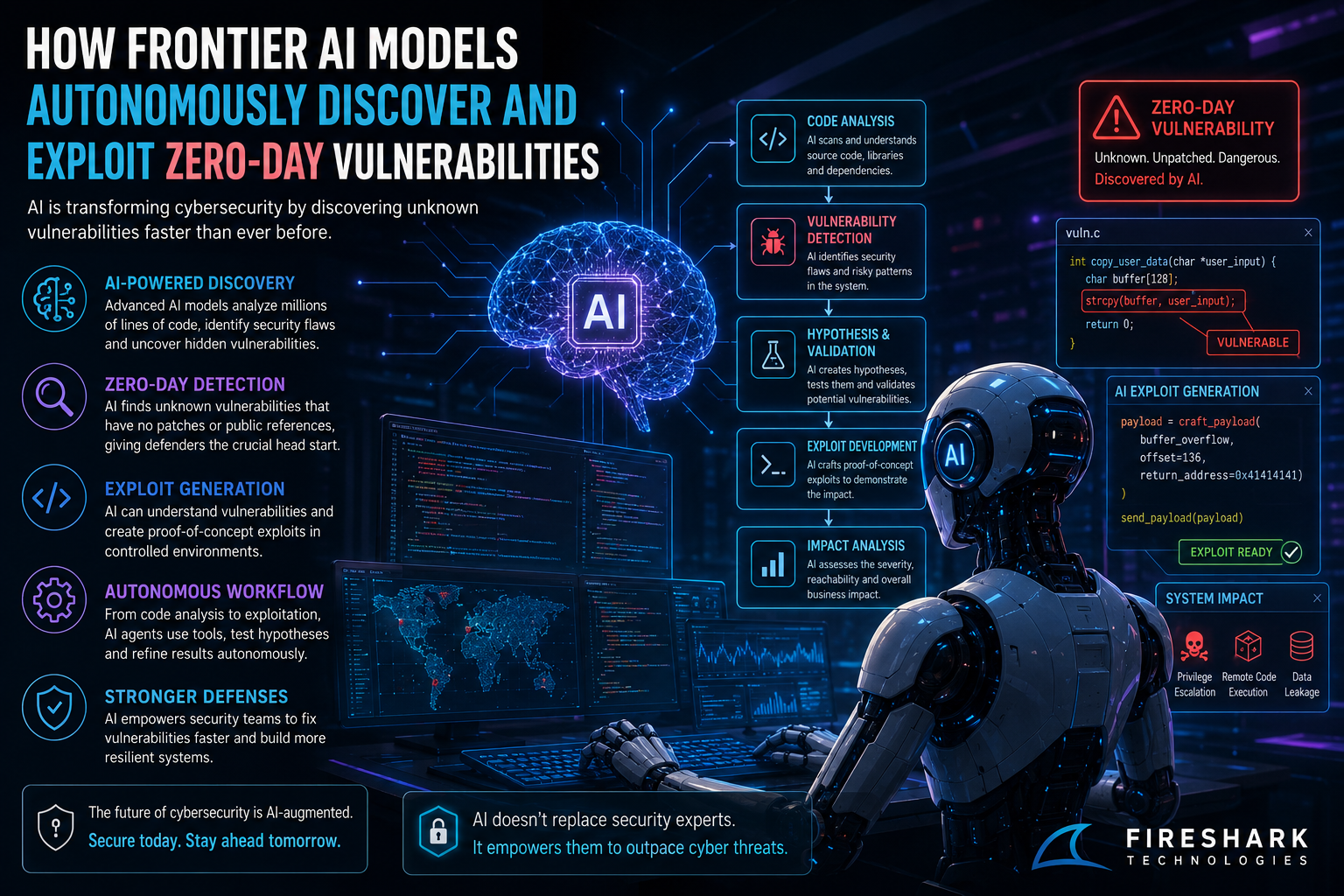
The process begins by understanding the target software. Rather than examining isolated functions, the AI constructs a mental representation of how different components communicate. It studies APIs, authentication systems, memory allocation, networking logic, encryption routines, and user privilege boundaries.
Once the architecture is understood, the model searches for security assumptions. It looks for areas where developers assume inputs will always be valid, memory will always be allocated correctly, permissions will always be enforced, or data will always follow expected formats.
The model then traces how data flows through the application. Every user input is followed across hundreds or thousands of functions to determine whether unsafe operations occur.
Instead of stopping after identifying suspicious code, advanced AI systems can propose hypotheses, test them in controlled environments, analyze failures, revise their assumptions, and continue investigating. This iterative approach resembles how experienced human security researchers work.
Why AI Finds Bugs Humans Often Miss
Human researchers are constrained by time, fatigue, and cognitive limits. Large enterprise applications may contain tens of millions of lines of code, making exhaustive manual review impractical.
Frontier AI models can rapidly inspect enormous codebases while maintaining consistent attention. They excel at identifying patterns that recur across many files, correlating seemingly unrelated functions, and exploring unusual execution paths that humans might overlook.
Because AI can generate and evaluate many hypotheses simultaneously, it often uncovers subtle interactions between software components that are difficult to detect manually.

From Vulnerability Discovery to Exploit Development
Finding a vulnerability is only the beginning. An attacker—or a defensive researcher—must determine whether the flaw is actually exploitable.
Modern AI systems can assist by reasoning about questions such as:
- Can the flaw be triggered remotely?
- Does it require authentication?
- Is memory corruption controllable?
- Can privileges be escalated?
- Are modern security mitigations likely to block exploitation?
In research settings, advanced models have demonstrated increasing capability in developing proof-of-concept exploits for some vulnerabilities, though they are not consistently able to do so across all cases and still lag expert human researchers on many tasks.
Autonomous Tool Integration
One reason frontier AI systems have improved so rapidly is that they no longer rely solely on language generation. They increasingly operate as agents that orchestrate existing cybersecurity tools.
A typical workflow may involve:
- Reading source code repositories
- Executing static analysis
- Launching dynamic testing
- Running fuzzing campaigns
- Monitoring crashes
- Examining memory dumps
- Reviewing logs
- Revising hypotheses based on new evidence
This combination of reasoning and tool use enables AI to tackle problems that previously required significant manual effort.
Can AI Really Discover Unknown Zero-Days?
The answer is increasingly yes, but with important qualifications.
Research groups and major AI laboratories have reported systems capable of identifying previously unknown, high-severity vulnerabilities in real software projects under controlled conditions. At the same time, open benchmarks show that today’s frontier models are far from perfect: they still produce false positives, miss many real issues, and often require human guidance and validation.
This means AI is best viewed today as a powerful force multiplier for security researchers rather than a complete replacement.
The Risks of AI-Driven Vulnerability Discovery
The same technology that helps defenders can also benefit attackers.
As these capabilities improve, the interval between vulnerability discovery and attempted exploitation is expected to shrink. Security researchers, governments, and industry groups increasingly view autonomous discovery of high-severity vulnerabilities as a major cyber-risk threshold that requires stronger safeguards and faster defensive practices.
Potential concerns include:
- Faster discovery of software flaws
- Shorter patch windows
- Increased automation of exploit research
- Lower barriers for less-skilled attackers
- More frequent attacks on large software ecosystems
For these reasons, many leading AI developers are restricting access to their most cyber-capable models while investing heavily in defensive applications.
How Organizations Can Defend Themselves
The emergence of AI-assisted vulnerability discovery means organizations must accelerate their own defenses rather than rely solely on traditional patch cycles.
Strong defenses include:
- Continuous vulnerability management
- Secure software development practices
- AI-assisted code reviews
- Rapid patch deployment
- Runtime monitoring
- Zero Trust architectures
- Network segmentation
- Continuous threat hunting
- Security automation
- Employee security awareness
Several vendors are already deploying AI-powered systems that help discover vulnerabilities earlier in development and assist engineers in prioritizing fixes.
The Future of Autonomous Cybersecurity
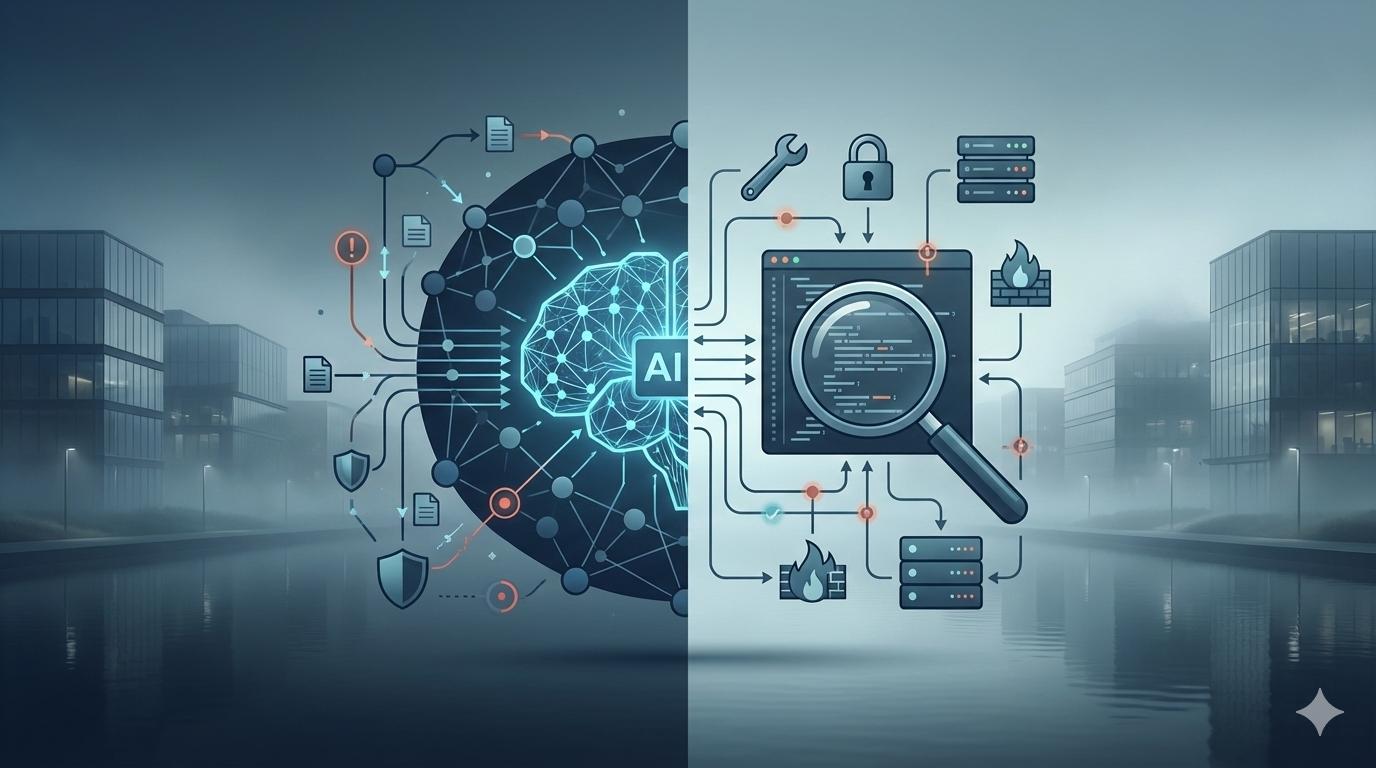
The cybersecurity industry is entering a period in which AI systems will increasingly operate on both sides of the defensive line.
Rather than replacing human experts, frontier AI models are expected to become collaborative partners that automate repetitive analysis, accelerate vulnerability discovery, and help prioritize remediation. At the same time, organizations must prepare for adversaries using similar capabilities, making rapid detection, resilient system design, and AI-assisted defense more important than ever.
Conclusion
Frontier AI models represent one of the most significant technological shifts in cybersecurity since the emergence of automated vulnerability scanners. Their ability to understand complex software, reason across enormous codebases, and assist in identifying previously unknown vulnerabilities has the potential to dramatically improve software security.
However, this progress also creates new challenges. As AI capabilities advance, the race between vulnerability discovery and remediation will become increasingly automated. Organizations that combine human expertise with AI-powered defensive tools, continuous monitoring, and rapid response processes will be better positioned to protect their systems in this evolving landscape.
The future of cybersecurity will not be defined by humans alone or by AI alone—it will be shaped by how effectively the two work together.