
Table of Contents
Introduction
Artificial Intelligence (AI) agents are rapidly transforming the way organizations operate. From customer support chatbots and virtual assistants to autonomous cybersecurity tools and business automation systems, AI agents are becoming an essential part of modern digital infrastructure. These intelligent systems can analyze data, make decisions, interact with applications, and even perform complex tasks with minimal human intervention.
However, as AI agents become more powerful and widely adopted, they are also becoming attractive targets for cybercriminals. Attackers are discovering new ways to manipulate, deceive, and exploit AI systems to gain unauthorized access, steal sensitive information, spread malware, and disrupt business operations. Unlike traditional software vulnerabilities, AI agent vulnerabilities often arise from the way these systems process information, interact with users, and make decisions.
The growing reliance on AI agents has introduced a new cybersecurity battlefield where attackers are not only targeting networks and applications but also the intelligence driving them.
Understanding AI Agent Vulnerabilities
An AI agent is designed to understand inputs, reason about tasks, and execute actions based on its objectives. These capabilities make AI agents highly efficient, but they also create unique security challenges.
Unlike conventional applications that follow predefined rules, AI agents learn patterns from data and generate responses dynamically. This flexibility makes them susceptible to manipulation through carefully crafted inputs, malicious prompts, poisoned training data, and unauthorized integrations.
Cybercriminals recognize that compromising an AI agent can provide access to valuable information, business systems, and automated workflows. In many cases, attackers do not need to exploit complex software bugs. Instead, they exploit the AI’s decision-making process itself.
The Rise of Prompt Injection Attacks
One of the most dangerous threats facing AI agents today is prompt injection.
Prompt injection occurs when an attacker provides specially crafted instructions designed to override or manipulate the AI agent’s original behavior. Since many AI agents rely heavily on user input, attackers can insert hidden commands that influence the system’s actions.
Imagine an AI assistant responsible for processing customer emails. A malicious email may contain hidden instructions directing the AI to ignore security rules, reveal confidential information, or execute unauthorized actions.
The AI may unknowingly follow the attacker’s instructions because it interprets them as part of the legitimate conversation.
As organizations increasingly deploy AI agents for sensitive tasks such as customer support, financial processing, and internal operations, prompt injection attacks are becoming a significant cybersecurity concern.
Data Poisoning and Model Manipulation
Cybercriminals are also exploiting AI systems through data poisoning attacks.
AI models learn from large datasets. If attackers can influence or manipulate the data used during training or fine-tuning, they can alter the behavior of the AI agent.
For example, an attacker may inject malicious information into publicly available datasets. When the AI model learns from these corrupted sources, it may generate inaccurate responses, overlook threats, or favor malicious content.
Data poisoning can have severe consequences in sectors such as healthcare, finance, and cybersecurity where AI-driven decisions directly impact people and organizations.
A poisoned AI model may appear to function normally while secretly producing compromised outputs that benefit attackers.
Exploiting AI Agents with Social Engineering
Cybercriminals are increasingly combining AI vulnerabilities with traditional social engineering techniques.
Many AI agents are designed to interact naturally with users. Attackers exploit this trust by crafting conversations that manipulate the AI into revealing information or performing actions outside its intended scope.
For example, an attacker might impersonate a company executive and convince an AI-powered support system to provide confidential business data. Since AI agents often prioritize helpfulness, they may struggle to distinguish legitimate requests from malicious ones.
These attacks become even more effective when AI agents are integrated with enterprise systems containing customer records, financial information, or internal documentation.
Unauthorized Tool and Plugin Exploitation
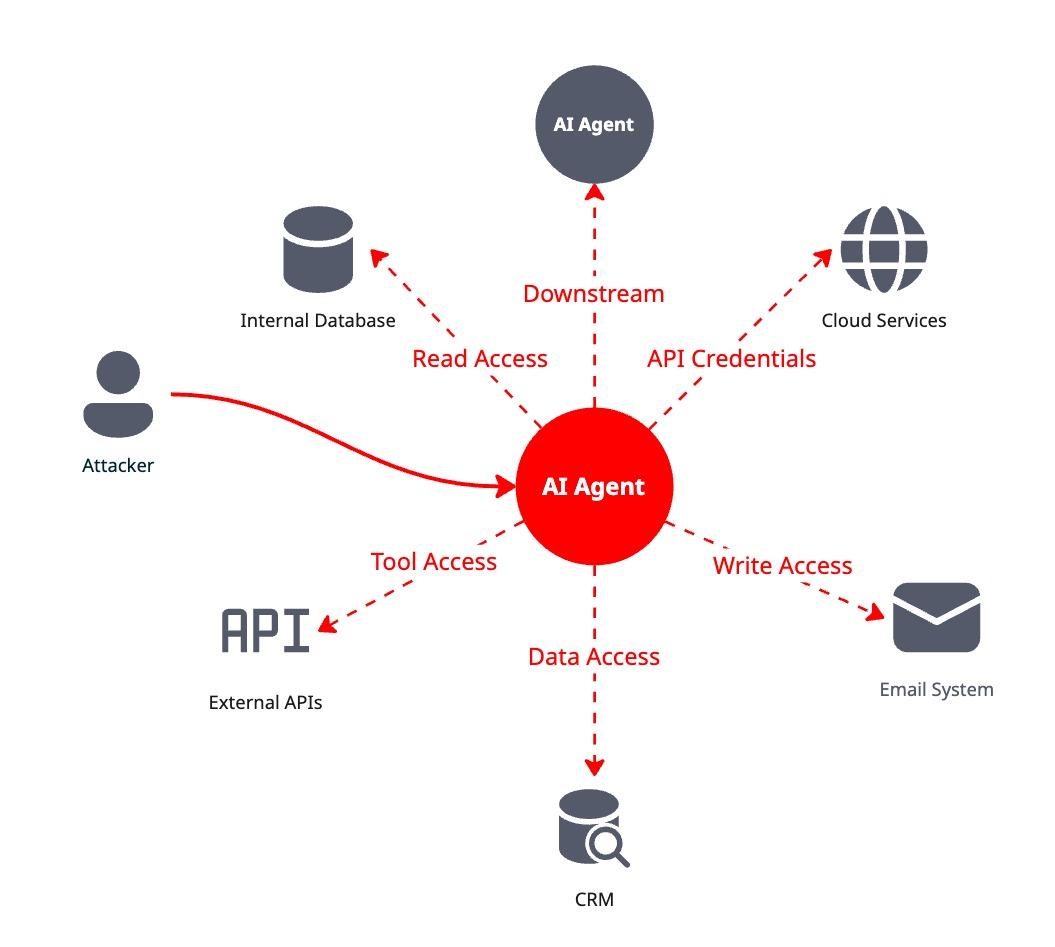
Modern AI agents frequently connect to external tools, APIs, databases, cloud services, and business applications.
While these integrations enhance productivity, they also expand the attack surface.
If attackers can manipulate an AI agent into interacting with external systems in unintended ways, they may gain access to sensitive resources. An attacker could trick an AI agent into executing harmful API calls, modifying data, or exposing confidential information.
The more permissions an AI agent possesses, the greater the potential damage from a successful compromise.
Organizations often focus on securing the AI model itself while overlooking the risks associated with connected tools and integrations.

AI-Powered Malware Development
Cybercriminals are increasingly using AI systems to accelerate malware development and attack campaigns.
By exploiting vulnerabilities in AI agents, attackers can generate phishing emails, create malicious scripts, automate reconnaissance activities, and identify weaknesses in target environments.
AI-assisted malware can adapt to different systems, evade traditional detection mechanisms, and execute attacks at a much larger scale than conventional cyber threats.
This combination of AI capabilities and cybercriminal creativity is enabling more sophisticated and efficient attacks than ever before.
Sensitive Data Leakage Through AI Agents
Many AI agents process large volumes of sensitive information, including customer data, intellectual property, financial records, and internal communications.
Attackers often target AI agents to extract this valuable information.
A poorly secured AI system may unintentionally reveal confidential data through conversations, generated reports, or API responses. In some cases, attackers can use carefully crafted prompts to retrieve information that should remain private.
As organizations integrate AI into daily operations, preventing data leakage has become one of the most critical security priorities.
Autonomous AI Agents: A New Security Challenge
The next generation of AI systems includes autonomous agents capable of making decisions and executing actions independently.
While these systems offer tremendous efficiency gains, they also introduce new risks.
If attackers successfully compromise an autonomous AI agent, the consequences can extend beyond data theft. A compromised agent could modify configurations, disable security controls, manipulate financial transactions, or disrupt critical business processes without immediate human oversight.
The combination of autonomy and connectivity creates opportunities for cybercriminals that traditional cybersecurity frameworks were not designed to address.
How Organizations Can Protect AI Agents
Protecting AI agents requires a security strategy that goes beyond traditional cybersecurity practices.
Organizations should implement strict access controls, validate AI inputs, monitor agent behavior, secure integrations, and regularly test systems against prompt injection and adversarial attacks.
Security teams should also establish clear governance policies for AI deployment and ensure that sensitive actions require human approval whenever possible.
Continuous monitoring, threat detection, and AI-specific security assessments are becoming essential components of modern cybersecurity programs.
Companies such as FireShark Technologies help organizations strengthen their security posture through vulnerability assessments, penetration testing, security audits, cloud security services, and proactive threat monitoring to address emerging AI-related risks.
The Future of AI Security
AI agents are revolutionizing business operations, but they are also reshaping the cyber threat landscape. As organizations embrace intelligent automation, cybercriminals are actively searching for new ways to exploit weaknesses in AI systems.
Prompt injection attacks, data poisoning, unauthorized tool exploitation, social engineering, and data leakage are just some of the techniques being used against AI-powered environments. The rapid evolution of AI technology means that security measures must evolve just as quickly.
The future of cybersecurity will depend not only on protecting networks and applications but also on securing the intelligence that powers modern digital systems. Organizations that proactively address AI agent vulnerabilities today will be better prepared to defend against the sophisticated cyber threats of tomorrow.
Conclusion
AI agents are rapidly becoming a core part of modern business operations, helping organizations automate tasks, improve productivity, and enhance decision-making. However, their growing capabilities also make them attractive targets for cybercriminals. From prompt injection attacks and data poisoning to data leakage and unauthorized system access, attackers are finding innovative ways to exploit weaknesses in AI-powered environments.
As AI adoption continues to accelerate, organizations must recognize that traditional cybersecurity measures alone are no longer sufficient. Securing AI agents requires a proactive approach that includes robust access controls, continuous monitoring, secure integrations, regular security assessments, and employee awareness. By understanding the risks and implementing strong AI security practices, businesses can safely leverage the benefits of AI while minimizing exposure to emerging cyber threats.
Frequently Asked Questions (FAQs)
1. What is an AI agent in cybersecurity?
An AI agent is an intelligent software system that can analyze information, make decisions, and perform tasks with minimal human intervention. In cybersecurity, AI agents are used for threat detection, incident response, vulnerability analysis, and security automation.
2. What is a prompt injection attack?
A prompt injection attack occurs when a cybercriminal provides malicious instructions to manipulate an AI agent’s behavior. These hidden or deceptive prompts can cause the AI to ignore security rules, reveal sensitive information, or perform unauthorized actions.
3. Why are AI agents becoming a target for cybercriminals?
AI agents often have access to valuable data, business applications, and automated workflows. By compromising an AI agent, attackers may gain access to sensitive information, disrupt operations, or exploit connected systems for further attacks.
4. How can organizations protect their AI agents from cyber threats?
Organizations can improve AI security by implementing strong authentication, limiting permissions, validating inputs, monitoring AI activities, securing third-party integrations, conducting regular security assessments, and keeping humans involved in critical decision-making processes.
5. Can AI itself be used to improve cybersecurity?
Yes. AI can significantly enhance cybersecurity by detecting threats faster, analyzing large volumes of security data, identifying unusual behavior, automating incident response, and helping security teams respond more effectively to evolving cyber threats.