
Table of Contents
Introduction
Artificial Intelligence has rapidly transformed the way businesses operate, from customer support chatbots and AI-powered coding assistants to document analysis and enterprise automation. Large Language Models (LLMs) such as those powering modern AI assistants have become essential tools across industries because they can understand, generate, summarize, and analyze human language with remarkable accuracy.
However, as organizations increasingly rely on these AI systems, cybersecurity researchers are discovering new attack techniques that don’t directly hack the AI model itself. Instead, attackers exploit subtle clues generated during interactions with the model to uncover confidential information. These techniques are known as LLM Side-Channel Attacks, and they represent one of the most concerning privacy challenges in modern AI security.
Unlike traditional cyberattacks that exploit software vulnerabilities or stolen credentials, side-channel attacks take advantage of indirect information such as response timing, token generation patterns, memory behavior, inference characteristics, and interaction metadata. These hidden signals can sometimes reveal sensitive user information without ever explicitly exposing protected data.
Understanding how these attacks work is becoming increasingly important for businesses, AI developers, security professionals, and anyone deploying generative AI into production environments.
What Is an LLM Side-Channel Attack?
A side-channel attack is a technique where an attacker gains information by observing indirect characteristics of a system instead of attacking the protected data directly.
With Large Language Models, these indirect characteristics may include:
- Response generation speed
- Token prediction behavior
- Output consistency
- Model confidence
- Memory usage
- Cache behavior
- Inference latency
- Prompt interaction patterns
Instead of asking an AI model, “Tell me the user’s password,” an attacker studies how the model behaves under carefully designed prompts. Tiny differences in responses may gradually reveal information that should have remained private.
Think of it like trying to determine what someone is typing behind a closed door—not by seeing the keyboard, but by listening to the rhythm of the keystrokes. Each individual clue reveals very little, but together they can expose surprisingly accurate information.
Why Side-Channel Attacks Are Different from Normal AI Attacks
Most discussions around AI security focus on prompt injection, jailbreaks, or malicious prompts. Side-channel attacks are fundamentally different because the attacker often never asks directly for protected information.
Instead, they analyze hidden behavioral patterns.
For example, if two nearly identical prompts consistently produce slightly different response times depending on whether a certain confidential document exists in the model’s context, an attacker may infer the presence of that document without ever seeing it.
This makes side-channel attacks particularly dangerous because they can bypass many traditional content filtering mechanisms.
How Large Language Models Process Information
To understand why side-channel attacks occur, it helps to understand how LLMs operate.
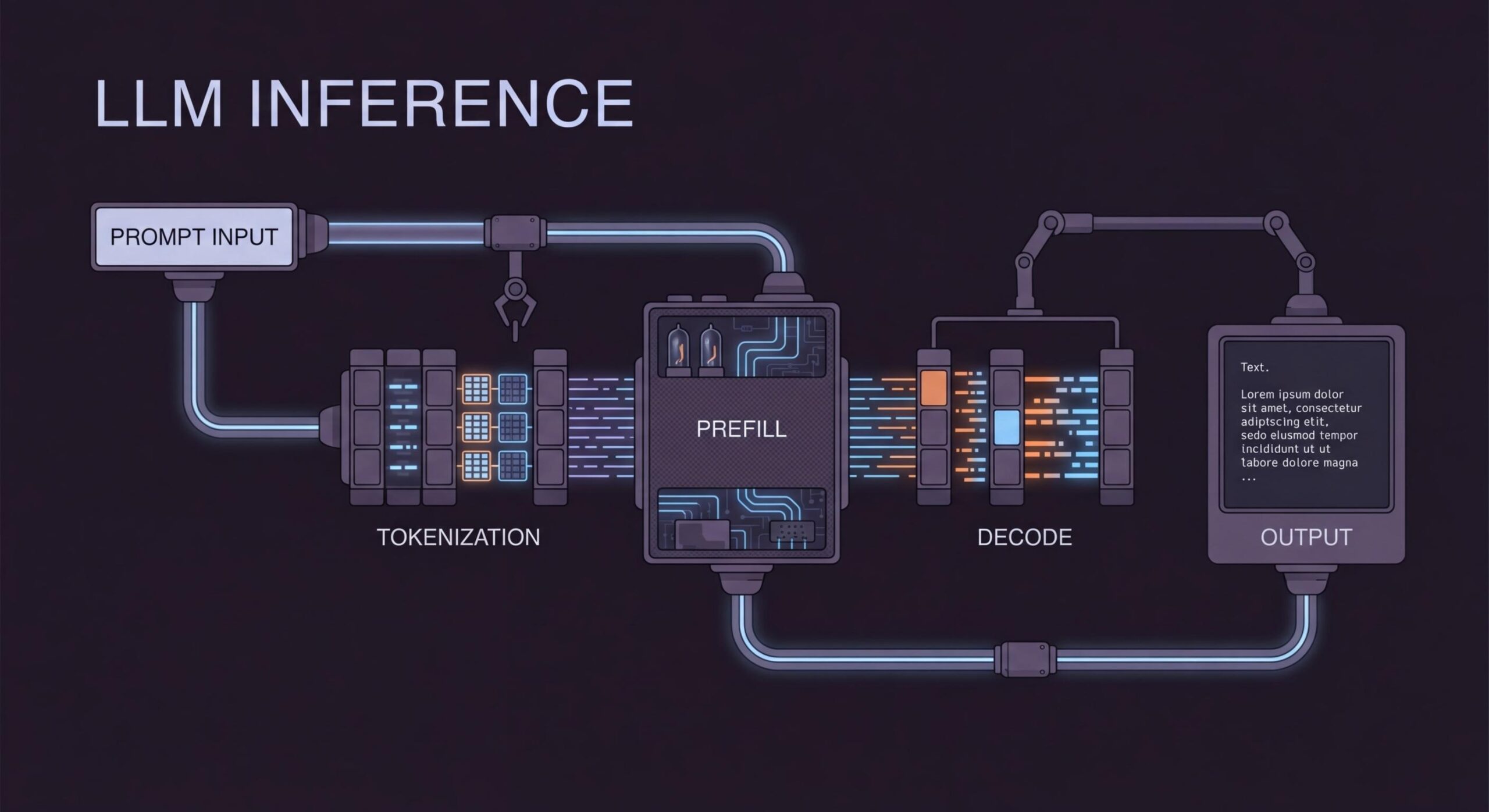
When a user enters a prompt, the AI first converts words into numerical representations known as tokens. These tokens are processed through multiple transformer layers where the model predicts the most probable next token based on billions of learned parameters.
During this process, the model performs complex mathematical operations across GPUs or specialized AI hardware. Every stage consumes computational resources, memory, and processing time.
Although users only see the final response, numerous hidden computational events occur internally. Small variations in these events may unintentionally leak information to someone carefully measuring the model’s behavior.
Where Private Information Can Leak
Many organizations assume that if an AI never prints confidential information directly, their data is safe.
Unfortunately, indirect leaks are often possible.
Imagine a company uses an AI assistant connected to internal documents containing:
- Employee records
- Financial reports
- Customer databases
- Legal contracts
- Product roadmaps
- Security documentation
Even if direct access is blocked, repeated carefully crafted interactions may reveal clues about:
Whether a document exists, approximately how large it is, whether specific names appear within internal knowledge, if certain confidential projects are active, or whether the model has previously processed particular information.
Each observation may seem insignificant on its own, but together they can expose valuable intelligence.
Common Types of LLM Side-Channel Attacks
Researchers have identified several categories of side-channel attacks affecting AI systems.
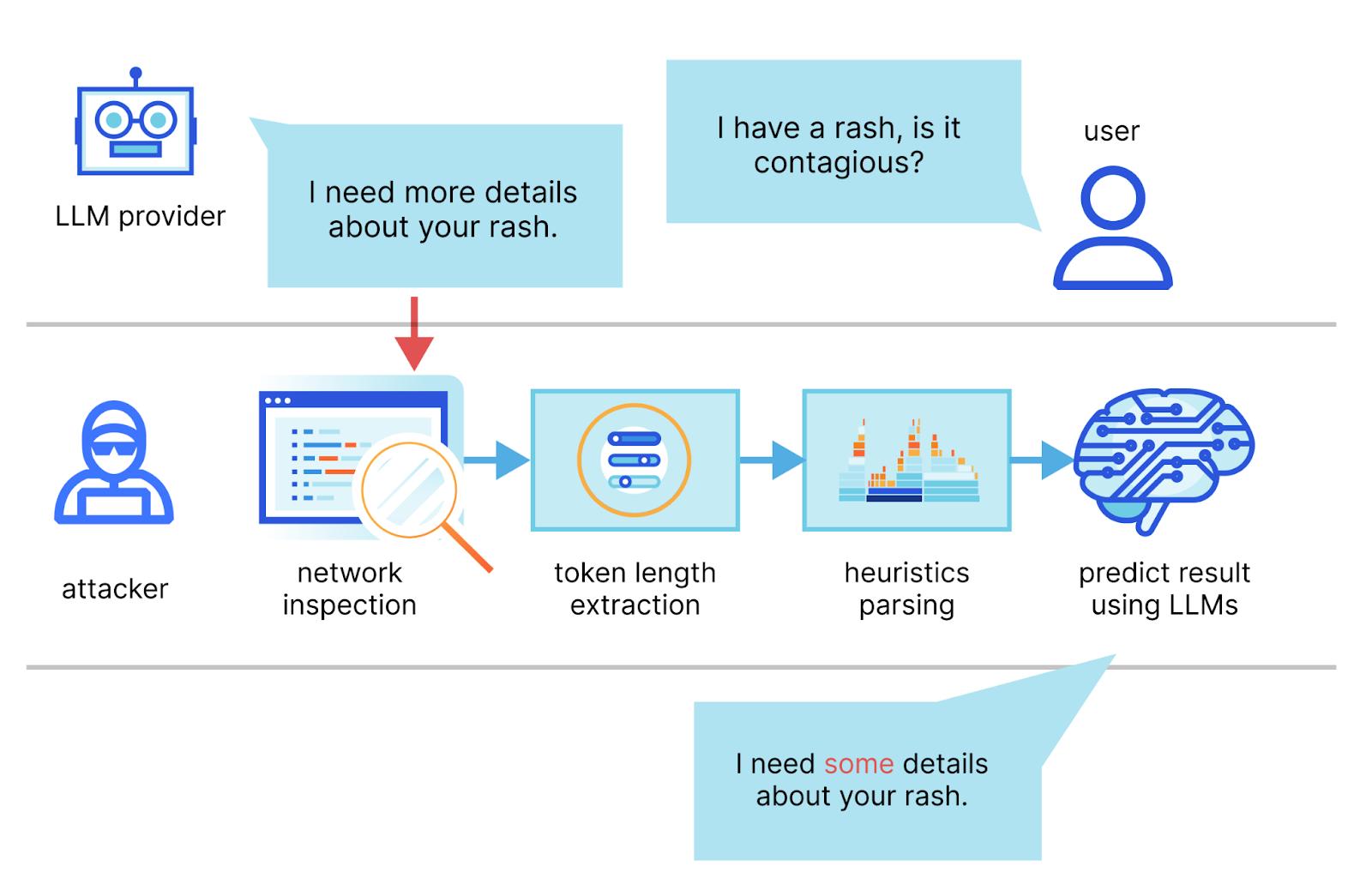
One common technique is timing analysis. Different prompts require different amounts of computation. If responses consistently take longer when certain confidential information is involved, attackers may detect patterns.
Another technique focuses on token probability analysis. Since language models assign probabilities to possible next words, repeated testing can reveal hidden relationships inside the model.
Some attacks exploit shared cache behavior in multi-tenant AI environments. If multiple users share the same infrastructure, attackers may observe hardware-level resource usage.
Researchers have also demonstrated memory inference attacks, where information about previously processed prompts can sometimes be estimated through repeated interactions.
Emerging research also explores embedding leakage, where vector representations may unintentionally preserve sensitive semantic information.
A Real-World Example
Imagine a law firm deploys an internal AI assistant trained on confidential legal documents.
The AI never reveals client information directly.
An attacker repeatedly asks carefully modified questions.
Instead of reading confidential contracts, they measure:
- Which prompts generate slower responses
- Which topics produce higher confidence
- Which wording causes longer reasoning chains
- Which document categories influence generation patterns
After thousands of interactions, statistical analysis begins revealing which legal cases exist inside the firm’s knowledge base.
No single response exposes confidential information, yet the cumulative observations leak valuable intelligence.
Why Businesses Should Be Concerned
Organizations are integrating LLMs into customer support, healthcare, finance, legal services, cybersecurity, education, and software development.
Many of these industries process highly sensitive information.
If attackers can indirectly infer customer records, intellectual property, proprietary algorithms, internal documents, or confidential business strategies, the financial and reputational damage can be severe.
Because side-channel attacks often leave very few obvious indicators, they may remain undetected for long periods.
Industries Most at Risk
Several sectors face elevated risk because they routinely process sensitive information through AI systems.
Healthcare organizations handle medical records and patient histories.
Financial institutions process banking transactions, investment data, and fraud detection models.
Government agencies manage classified reports and citizen information.
Law firms store confidential legal documents.
Technology companies use AI to analyze proprietary source code and product designs.
Cloud AI providers serving multiple customers on shared infrastructure face additional challenges because hardware resources are often shared between organizations.
How Security Researchers Detect Side-Channel Vulnerabilities
Security researchers evaluate AI systems using specialized testing methodologies.
They submit thousands of carefully controlled prompts while measuring latency, response variation, output consistency, token behavior, and statistical differences.
Advanced monitoring tools compare expected model behavior against observed behavior to identify hidden information leakage.
Hardware performance counters, inference profiling, cache analysis, and statistical testing help researchers determine whether side-channel vulnerabilities exist before attackers discover them.
How Organizations Can Prevent LLM Side-Channel Attacks
Protecting AI systems requires multiple layers of security rather than relying on a single defense.
Organizations should carefully isolate sensitive workloads so that confidential AI applications do not share hardware resources with untrusted users. Strong access controls, encryption, and strict authentication reduce the likelihood of unauthorized interactions.
Monitoring inference behavior can help identify unusual prompt patterns that resemble automated probing. Limiting repeated high-frequency queries also makes statistical attacks more difficult.
Developers should avoid exposing unnecessary confidence scores, internal reasoning details, or system metadata that could provide attackers with additional signals.
Regular AI security assessments—including adversarial testing and red teaming—can uncover side-channel weaknesses before they are exploited.
Businesses should also minimize the amount of sensitive information available to AI models by following data minimization principles and ensuring that confidential data is only accessible when absolutely necessary.
The Future of AI Privacy
As LLMs become more deeply integrated into enterprise workflows, side-channel security will become a major area of cybersecurity research.
Future AI systems are expected to include stronger isolation techniques, privacy-preserving inference methods, secure hardware execution environments, and advanced monitoring capable of detecting suspicious interaction patterns in real time.
Researchers are also exploring confidential computing technologies that protect AI workloads even while they are actively processing sensitive information.
Organizations that invest in AI security today will be better prepared for tomorrow’s increasingly sophisticated attack techniques.
Conclusion
Large Language Models have revolutionized how people interact with technology, but their growing capabilities also introduce new security challenges. LLM side-channel attacks demonstrate that sensitive information can sometimes be exposed without direct access to confidential data. By exploiting subtle behavioral signals such as timing, inference patterns, or resource usage, attackers may gradually reconstruct valuable information that organizations never intended to reveal.
As AI adoption accelerates, cybersecurity strategies must evolve beyond traditional defenses. Protecting AI systems now requires attention not only to prompts and outputs but also to the hidden computational behaviors that occur behind the scenes. Organizations that combine secure AI architecture, continuous monitoring, regular security testing, and responsible data management will be in the strongest position to safeguard user privacy while continuing to benefit from the power of generative AI.
Frequently Asked Questions (FAQs)
1. What is an LLM side-channel attack?
An LLM side-channel attack is a security technique where attackers gather sensitive information by observing indirect signals—such as response time, token generation patterns, or system behavior—instead of directly accessing confidential data.
2. Can LLM side-channel attacks expose private user data?
Yes. While they may not reveal data directly, attackers can analyze subtle behavioral patterns over many interactions to infer sensitive information, such as whether certain documents, records, or user data exist within an AI system.
3. Which organizations are most vulnerable to LLM side-channel attacks?
Organizations in healthcare, finance, legal services, government, technology, and any business using AI with sensitive customer or internal data are at the highest risk if proper AI security measures are not implemented.
4. How can businesses protect their AI systems from side-channel attacks?
Businesses should implement strong access controls, isolate AI workloads, encrypt sensitive data, limit information exposure, monitor AI interactions, perform regular security assessments, and conduct AI red teaming to identify vulnerabilities before attackers do.
5. Are LLM side-channel attacks a real-world cybersecurity concern?
Yes. Security researchers continue to demonstrate new side-channel attack techniques against AI systems. As enterprises increasingly adopt Large Language Models, mitigating these risks has become an important part of modern AI and cybersecurity strategies.