
Table of Contents
Introduction
Modern software development relies heavily on automation. Continuous Integration and Continuous Deployment (CI/CD) pipelines have become an essential part of the software development lifecycle, allowing organizations to build, test, and deploy applications faster than ever before. Among the most popular automation platforms, GitHub Actions has emerged as a favorite because of its seamless integration with GitHub repositories, flexibility, and extensive marketplace of reusable workflows.
While GitHub Actions significantly improves developer productivity, it also introduces new security challenges. Every workflow, third-party action, dependency, secret, and integration within the CI/CD pipeline becomes part of the software supply chain. Attackers increasingly target these components because compromising a build pipeline can provide access to source code, cloud environments, production servers, signing certificates, sensitive secrets, and customer data.
In recent years, software supply chain attacks have become one of the fastest-growing cybersecurity threats. Instead of attacking applications directly, adversaries compromise the tools, automation systems, and dependencies used during software development. A single vulnerable GitHub Action or insecure CI/CD integration can affect thousands of organizations simultaneously.
Understanding these risks and implementing strong security controls is essential for protecting modern development environments.
Understanding the Software Supply Chain
The software supply chain consists of every component involved in building, testing, packaging, and deploying software. This includes source code repositories, package managers, open-source libraries, build servers, automation scripts, deployment pipelines, cloud infrastructure, artifact repositories, and monitoring systems.
GitHub Actions automates many of these processes through workflows defined in YAML files. Every workflow may include multiple actions downloaded from GitHub Marketplace or external repositories. These actions often execute with elevated permissions, making them attractive targets for attackers.
If any component in this chain becomes compromised, malicious code can spread throughout the software development lifecycle without being immediately detected.
Why GitHub Actions Are Attractive Targets
GitHub Actions typically execute with permissions that allow them to read repositories, modify files, publish releases, deploy applications, and access cloud environments.
Attackers understand that compromising one workflow can provide access to valuable assets, including:
- Source code
- API keys
- Cloud credentials
- Docker registries
- Kubernetes clusters
- Deployment servers
- Signing certificates
- Production secrets
- Customer databases
Rather than attacking production systems directly, attackers increasingly focus on CI/CD environments because they provide a trusted pathway into organizations.
Common Supply Chain Security Risks in GitHub Actions
1. Untrusted Third-Party GitHub Actions
One of GitHub Actions’ biggest strengths is the ability to reuse workflows created by the community. However, many organizations include third-party actions without reviewing their source code or verifying their security.
An action may appear trustworthy while secretly containing malicious code or insecure behavior. If the maintainer’s account becomes compromised, attackers can modify future versions of the action, allowing malicious code to execute automatically during builds.
Organizations often install actions directly from GitHub Marketplace without performing security reviews, increasing supply chain exposure.
2. Dependency Confusion Attacks
Dependency confusion occurs when attackers upload malicious packages using names similar to internal packages.
If a build system accidentally downloads the malicious package instead of the intended private dependency, attacker-controlled code executes during the build process.
Because CI/CD pipelines automatically install dependencies, dependency confusion attacks can compromise production software without modifying the application’s source code.
3. Compromised Secrets
GitHub Actions frequently require credentials such as:
- AWS Access Keys
- Azure Credentials
- Google Cloud Service Accounts
- Docker Hub Tokens
- Kubernetes Tokens
- SSH Keys
- Database Passwords
- API Keys
Improper handling of these secrets creates significant security risks.
Secrets may accidentally appear in:
- Workflow logs
- Debug output
- Uploaded artifacts
- Cache files
- Error messages
Once exposed, attackers can access cloud infrastructure or production systems.
4. Excessive Workflow Permissions
Many GitHub workflows execute using default permissions that are broader than necessary.
For example, a workflow intended only to run tests may also have permission to:
- Push commits
- Create releases
- Delete branches
- Access secrets
- Modify repositories
Granting excessive permissions violates the Principle of Least Privilege and increases the impact of a compromised workflow.
5. Pull Request Injection
Public repositories often run workflows automatically whenever contributors submit pull requests.
If workflows execute untrusted code from external contributors before proper review, attackers can manipulate build environments to steal secrets or modify deployment processes.
This is particularly dangerous when workflows expose sensitive environment variables during pull request builds.
6. Compromised Self-Hosted Runners
Many organizations use self-hosted GitHub runners instead of GitHub-hosted runners.
While self-hosted runners provide flexibility, they also become high-value targets.
If attackers compromise a runner, they may gain persistent access to:
- Internal networks
- Source code
- Build artifacts
- Cloud infrastructure
- Corporate credentials
Unlike temporary GitHub-hosted runners, self-hosted runners may retain sensitive data between jobs if not properly isolated.
CI/CD Integration Risks Beyond GitHub
GitHub Actions rarely operate independently.
Organizations integrate them with:
- AWS
- Microsoft Azure
- Google Cloud Platform
- Kubernetes
- Docker Hub
- Terraform
- Slack
- Jira
- SonarQube
- Artifact repositories
- Package registries
Every integration introduces additional trust relationships.
If any connected platform becomes compromised, attackers may pivot into the CI/CD environment.
Similarly, compromised GitHub Actions can abuse trusted integrations to deploy malicious software.
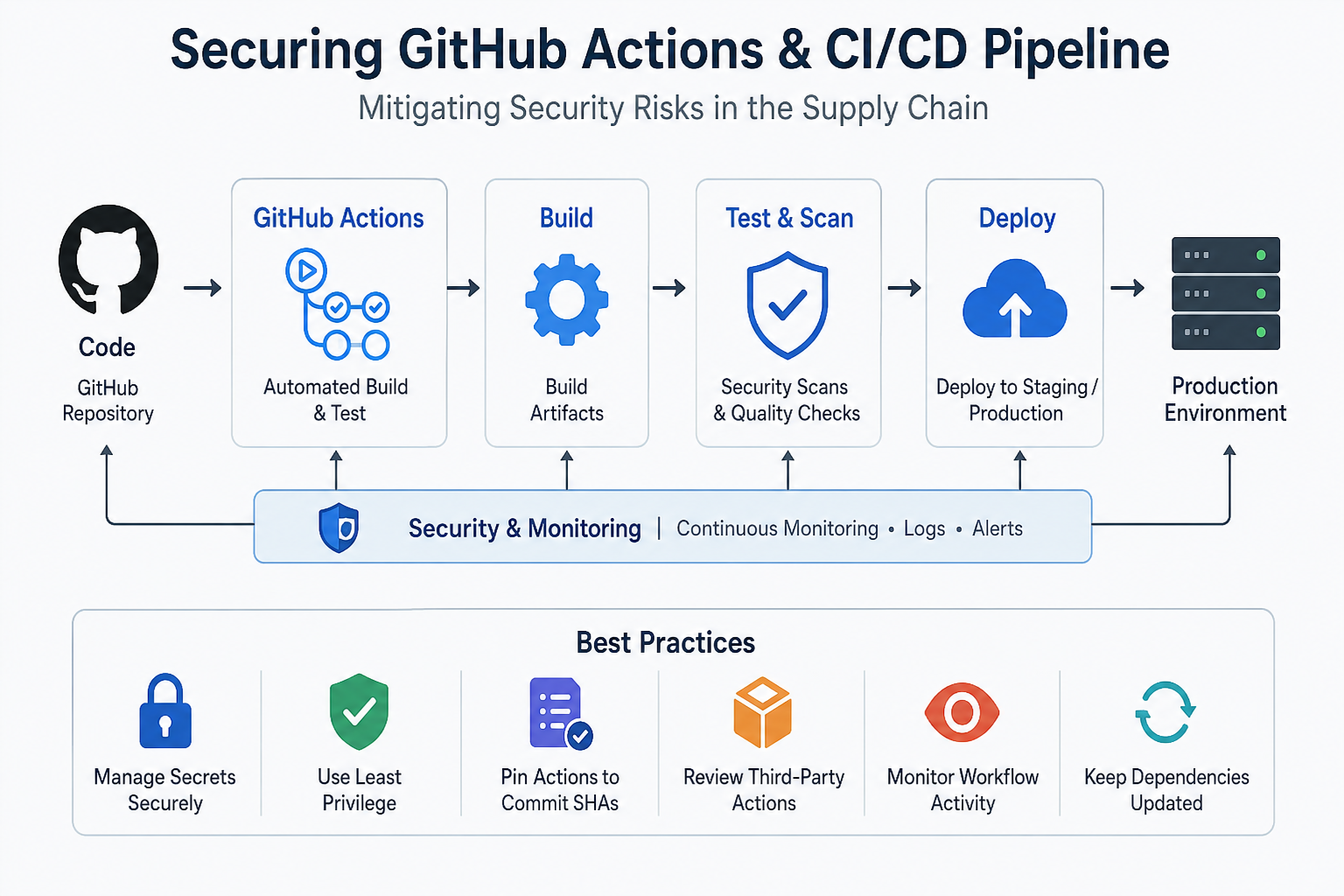
Best Practices for Securing GitHub Actions
Pin Actions to Specific Commit SHAs
Instead of referencing mutable tags like @v3 or @latest, pin actions to a specific commit SHA. This ensures the workflow always runs the exact reviewed version of an action and prevents unexpected changes if a maintainer account is compromised.
Apply the Principle of Least Privilege
Workflows should request only the permissions they actually need. Limit repository access, restrict write permissions, and grant temporary credentials whenever possible.
Protect Secrets
Store sensitive credentials using encrypted secrets or external secret managers. Avoid printing secrets in logs, rotate credentials regularly, and use short-lived authentication tokens such as OpenID Connect (OIDC) instead of long-lived static keys.
Review Third-Party Actions
Before using an external action, review its source code, maintenance history, update frequency, community reputation, and permissions. Favor well-maintained actions from trusted publishers.
Isolate Self-Hosted Runners
If self-hosted runners are required, isolate them from production networks, rebuild them regularly, and ensure each job starts with a clean environment to reduce persistence risks.
Enable Branch Protection
Require pull request reviews, status checks, and signed commits before changes to workflows or deployment configurations can be merged. This reduces the risk of unauthorized modifications.
Secure Dependencies
Use dependency scanning, verify package integrity, and automate updates for vulnerable libraries. Regularly review the Software Bill of Materials (SBOM) to understand all third-party components included in builds.
Monitor Workflow Activity
Continuously monitor workflow executions for unusual behavior, such as unexpected network connections, unauthorized deployments, changes to workflow files, or abnormal access to secrets. Logging and alerting help detect compromised pipelines quickly.
DevSecOps: Integrating Security into CI/CD
DevSecOps integrates security into every stage of the development lifecycle instead of treating it as a final step.
A secure GitHub Actions pipeline typically includes automated security controls such as:
- Static Application Security Testing (SAST)
- Dynamic Application Security Testing (DAST)
- Software Composition Analysis (SCA)
- Secret scanning
- Container image scanning
- Infrastructure as Code (IaC) scanning
- License compliance checks
- Vulnerability assessments
- Policy enforcement
- Security monitoring
By embedding these checks directly into the CI/CD pipeline, organizations can detect vulnerabilities early, reduce remediation costs, and prevent insecure code from reaching production.
Real-World Impact of Supply Chain Attacks
Several high-profile cybersecurity incidents have demonstrated how damaging software supply chain compromises can be. Rather than exploiting end-user systems directly, attackers targeted trusted development tools, update mechanisms, or build environments, allowing malicious code to spread to thousands of customers through legitimate software updates. These incidents highlight that the security of a CI/CD pipeline is as important as the security of the application itself.
Future Trends in CI/CD Security
As software development continues to evolve, CI/CD security is becoming increasingly intelligent and automated. Organizations are adopting AI-driven threat detection, policy-as-code frameworks, zero-trust architectures, workload identity federation, artifact signing, provenance verification, and stronger supply chain standards such as SLSA (Supply-chain Levels for Software Artifacts). These practices improve the integrity of software builds and reduce the likelihood of unauthorized changes reaching production environments.
Conclusion
GitHub Actions has transformed software development by enabling fast, reliable, and highly automated CI/CD workflows. However, this convenience also expands the attack surface of the software supply chain. Every third-party action, dependency, secret, runner, and integration represents a potential entry point for attackers.
Organizations can significantly reduce these risks by applying least-privilege permissions, pinning trusted actions, protecting secrets, isolating runners, validating dependencies, enforcing branch protection, and integrating automated security testing throughout the CI/CD pipeline. Building security into every stage of the development process through DevSecOps creates resilient pipelines that protect both software and the infrastructure used to deliver it.
As supply chain attacks continue to grow in sophistication, securing GitHub Actions and CI/CD integrations is no longer optional—it is a critical component of modern cybersecurity and essential for maintaining trust in software delivery.
Frequently Asked Questions (FAQs)
1. Why is GitHub Actions considered a supply chain security risk?
GitHub Actions itself is a secure automation platform, but the workflows often rely on third-party actions, external dependencies, secrets, and cloud integrations. If any of these components are compromised or misconfigured, attackers can exploit them to inject malicious code, steal sensitive credentials, or gain unauthorized access to production environments. Securing every component of the CI/CD pipeline is essential to reducing software supply chain risks.
2. How can organizations secure secrets used in GitHub Actions?
Organizations should store sensitive information such as API keys, cloud credentials, and authentication tokens in GitHub Secrets or dedicated secret management solutions like HashiCorp Vault or cloud-native secret managers. It is also recommended to use short-lived credentials through OpenID Connect (OIDC), regularly rotate secrets, and avoid exposing them in logs or workflow outputs.
3. What is the benefit of pinning GitHub Actions to a specific commit SHA?
Pinning an action to a specific commit SHA ensures that the workflow always executes the exact version that has been reviewed and approved. Unlike version tags such as @latest or @v3, which can change over time, commit SHA pinning prevents attackers from introducing malicious updates into an existing workflow through compromised or modified action releases.
4. What role does DevSecOps play in securing CI/CD pipelines?
DevSecOps integrates security into every phase of the software development lifecycle. Instead of performing security checks only before deployment, DevSecOps automates vulnerability scanning, dependency analysis, secret detection, infrastructure security testing, and compliance validation throughout the CI/CD pipeline. This proactive approach helps identify and remediate security issues early, reducing the risk of supply chain attacks.
5. What are the best practices for mitigating security risks in GitHub Actions and CI/CD integrations?
Organizations should adopt a defense-in-depth approach by applying the principle of least privilege, reviewing third-party actions before use, pinning actions to specific commit SHAs, protecting secrets with secure authentication methods, isolating self-hosted runners, enabling branch protection rules, continuously scanning dependencies for vulnerabilities, and monitoring workflow activity for suspicious behavior. Combined with regular security audits and DevSecOps practices, these measures significantly strengthen the security of GitHub Actions and CI/CD pipelines.