Table of Contents
Introduction
Cloud computing has transformed the way organizations build and deliver software. Modern Software-as-a-Service (SaaS) platforms serve thousands or even millions of customers from a shared infrastructure, making multi-tenancy the foundation of scalable cloud applications. Businesses rely on cloud APIs for everything from customer relationship management and banking to healthcare, education, and e-commerce. These APIs exchange sensitive information every second, making security one of the highest priorities in cloud application development.
To protect sensitive information, organizations invest heavily in encryption. Data is encrypted while traveling across networks using TLS, and it is encrypted again while stored in cloud databases using modern encryption algorithms such as AES-256. These protections are essential because they prevent attackers from reading intercepted communications or stolen database files.
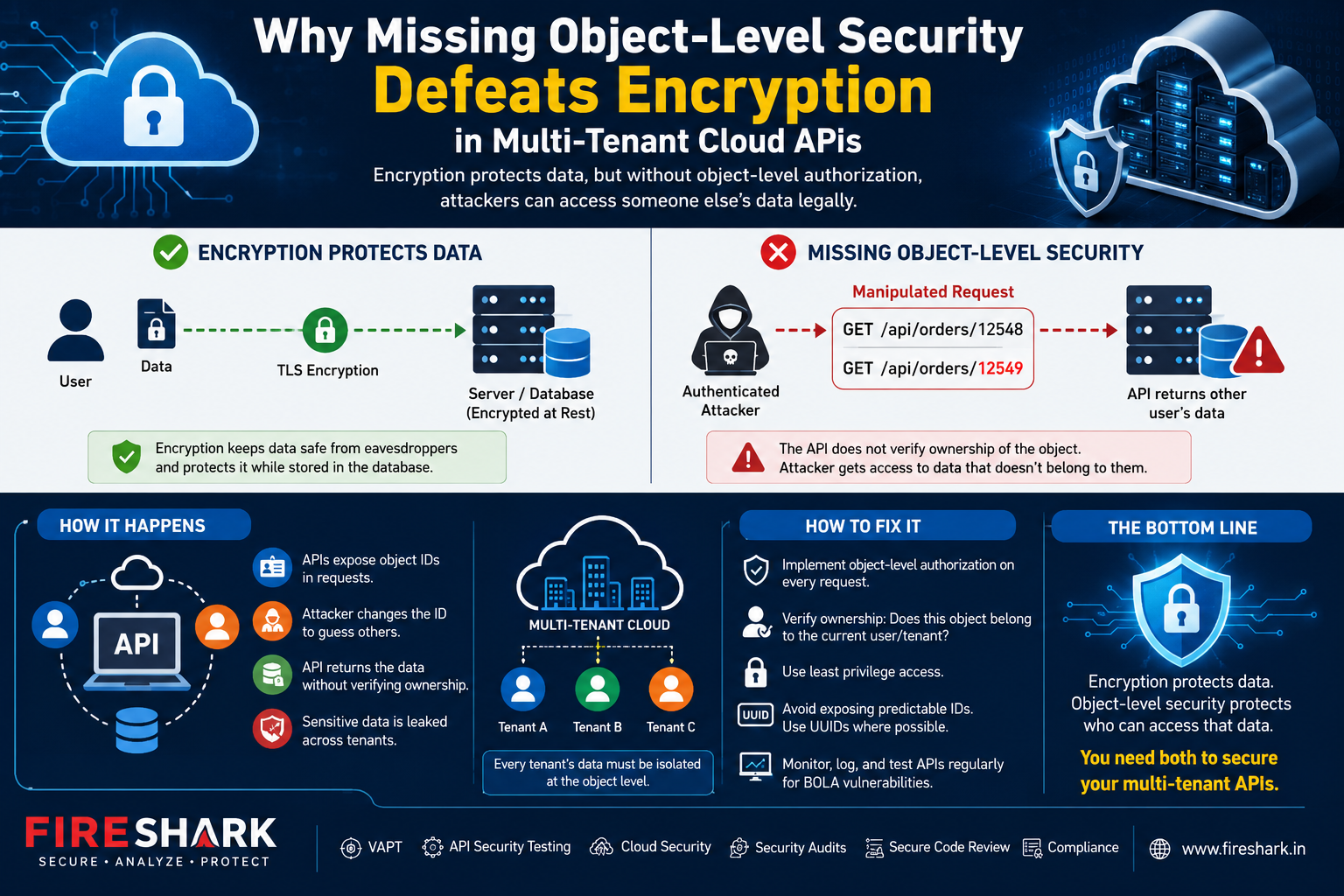
However, encryption alone cannot stop one of the most dangerous API vulnerabilities—Missing Object-Level Security, commonly known as Broken Object Level Authorization (BOLA). This vulnerability allows authenticated users to access data that belongs to other users simply by manipulating object identifiers in API requests. Even perfectly encrypted systems become vulnerable when the API fails to verify whether a user is actually authorized to access a specific resource.
In today’s cloud-first world, missing object-level security has become one of the leading causes of large-scale data breaches because it exploits flaws in authorization rather than weaknesses in encryption.
Understanding Multi-Tenant Cloud APIs
A multi-tenant architecture allows multiple customers, called tenants, to share the same cloud infrastructure while keeping their data logically separated. Instead of maintaining separate servers for every customer, cloud providers isolate customer information through software controls.
For example, imagine an online project management platform serving thousands of companies. Every organization stores employee details, projects, financial reports, and internal documents within the same cloud environment. Although the physical database may be shared, employees from Company A should never be able to view information belonging to Company B.
This separation depends almost entirely on proper authorization logic inside APIs.
When a user requests an object through an API endpoint such as:
GET /api/orders/12548the application must verify two things:
- Is the user authenticated?
- Does the authenticated user actually own or have permission to access Order 12548?
Many developers successfully implement authentication while forgetting the second requirement.
That small oversight becomes a massive security vulnerability.
Encryption Protects Data, Not Authorization
One of the biggest misconceptions in cybersecurity is believing encryption automatically prevents unauthorized access.
Encryption protects information in two major ways:
Data in Transit
TLS encrypts communications between clients and servers, preventing attackers from reading network traffic.
Data at Rest
Cloud storage encrypts databases, disks, and backups so stolen storage devices cannot expose sensitive information.
These protections work extremely well against external interception.
But encryption assumes the server has already decided the request is legitimate.
If an attacker is already authenticated and the API willingly returns another customer’s data, encryption faithfully delivers that information.
The data remains encrypted during transmission.
The server decrypts it.
Then the API sends it directly to the attacker because authorization failed.
Encryption did its job perfectly.
Authorization did not.
What Is Missing Object-Level Security?
Missing Object-Level Security occurs when APIs expose internal objects without verifying ownership.
Objects may include:
- Customer accounts
- Orders
- Medical records
- Employee profiles
- Bank transactions
- Uploaded files
- Support tickets
- Messages
- Images
- Invoices
Suppose Alice logs into an application and requests:
GET /users/1001/profileThe server returns her profile.
Now Alice changes the request to:
GET /users/1002/profileIf the application returns Bob’s profile without checking ownership, object-level authorization has completely failed.
Alice never hacked encryption.
She simply asked for another object.
The API trusted her request.
Why Attackers Love BOLA Vulnerabilities
Object-level authorization flaws are among the easiest vulnerabilities to exploit because they require little technical sophistication.
Attackers often begin by observing legitimate API requests.
They notice numeric identifiers like:
Order 5001
Order 5002
Order 5003
Instead of attacking encryption, they simply modify the identifier.
If authorization checks are missing, the API happily exposes another customer’s information.
Automation makes the situation even worse.
Attackers can write scripts that test thousands of object IDs every minute.
Within hours they may collect millions of confidential records.
Real-World Example
Imagine an online banking platform.
A customer retrieves transaction history through:
GET /api/accounts/458912/transactionsThe authenticated user owns account 458912.
Now the attacker changes the request to:
GET /api/accounts/458913/transactionsIf the API only verifies authentication and ignores ownership, another customer’s financial history becomes exposed.
Everything was encrypted.
TLS protected the network.
Database encryption protected storage.
Yet confidential banking records were still leaked.
Multi-Tenant Environments Increase the Risk
Multi-tenant systems often store millions of objects belonging to thousands of customers.
Every API request must determine:
- Which tenant owns the object?
- Which user belongs to that tenant?
- What permissions does the user possess?
- Should the operation be allowed?
Missing any of these checks breaks tenant isolation.
Instead of compromising one account, attackers may gain access to information across hundreds of organizations sharing the same cloud platform.
This is why BOLA vulnerabilities frequently appear in large SaaS breaches.
Why Developers Accidentally Introduce This Vulnerability
Object-level authorization mistakes usually arise from convenience rather than malicious intent.
Developers often focus on functionality.
They verify user login through authentication middleware.
Then they retrieve requested objects directly from the database.
For example:
order = Order.objects.get(id=request.id)
return order
The code retrieves the requested order.
But nowhere does it verify:
Does this order belong to the current user?The missing ownership check creates the vulnerability.
Common Causes of Missing Object-Level Security
Several development practices contribute to this issue.
Applications frequently trust client-supplied object identifiers without validating ownership. Some APIs assume that because a user has logged in successfully, they should automatically be trusted to access requested resources. In many cases, developers implement authentication libraries but overlook authorization logic for individual objects.
Microservices can also introduce inconsistencies when different services enforce authorization differently. Legacy APIs often contain outdated code that predates modern authorization frameworks, while rapid feature releases may prioritize functionality over security testing.
Business Consequences
Successful BOLA attacks can expose enormous volumes of confidential information.
Organizations may suffer:
- Customer data breaches
- Financial fraud
- Identity theft
- Regulatory fines
- Loss of customer trust
- Legal liability
- Competitive intelligence theft
- Reputation damage
Industries handling healthcare, finance, government, and education data face particularly severe consequences because privacy regulations require strict access controls.
Why Encryption Cannot Fix This Problem
Encryption answers one question:
Can unauthorized people read stored or intercepted data?
Authorization answers another:
Should this user receive this data at all?
These are fundamentally different security problems.
Imagine a hotel with an extremely strong vault protecting every guest room key.
The vault is perfectly secure.
But if the receptionist accidentally hands you another guest’s room key, the vault’s strength becomes irrelevant.
The mistake happened after the key was legitimately retrieved.
Object-level authorization works exactly the same way.
Best Practices for Preventing Object-Level Security Failures
Strong API security requires authorization to be enforced every time an object is accessed. Every request should validate ownership before returning data, ensuring that authenticated users can interact only with resources they are explicitly permitted to access.
Applications should implement least privilege, granting only the minimum permissions necessary. Object ownership should never be inferred from client-supplied identifiers; instead, the server should derive access rights from trusted session or token information.
Using unpredictable object identifiers, such as UUIDs, can make automated enumeration more difficult, although this should never replace proper authorization checks. Comprehensive logging, monitoring, and anomaly detection help identify unusual access patterns that may indicate enumeration attempts.
Regular penetration testing and API security assessments are equally important. Security teams should specifically test for Broken Object Level Authorization during code reviews and penetration tests, as recommended by the OWASP API Security Top 10.
The Role of Zero Trust in API Security
Modern Zero Trust architectures reinforce object-level authorization by assuming that no request should be trusted automatically, even after authentication.
Every request must continuously verify:
- User identity
- Device trust
- Session validity
- Tenant membership
- Object ownership
- Required permissions
Instead of relying on one successful login, Zero Trust evaluates authorization throughout every interaction with sensitive resources.
How FireShark Helps Secure Cloud APIs
Organizations building cloud-native applications need more than encryption—they need comprehensive API security testing. FireShark helps businesses identify vulnerabilities such as Broken Object Level Authorization before attackers can exploit them.
Its security services include:
- API Security Testing
- Web Application Penetration Testing (VAPT)
- Cloud Security Assessments
- Network Security Audits
- Secure Code Review
- Security Compliance Consulting
- Incident Response Support
- Continuous Security Monitoring
By combining penetration testing with secure development practices, organizations can ensure that encryption is backed by robust authorization controls.
Conclusion
Encryption remains one of the strongest defenses against data theft, but it was never designed to decide who should access information. In multi-tenant cloud environments, that responsibility belongs to object-level authorization. When APIs fail to verify ownership, attackers can retrieve sensitive records without breaking encryption, exploiting cryptography, or compromising servers.
As organizations continue adopting cloud-native architectures and exposing more APIs, securing every object request becomes essential. Strong authentication, rigorous authorization, least-privilege access, continuous monitoring, and regular API security testing work together to protect tenant isolation and preserve customer trust. The most resilient cloud applications recognize that encryption safeguards data from unauthorized readers, while object-level security ensures that only the right users ever receive it.
Frequently Asked Questions (FAQs)
1. What is Missing Object-Level Security (BOLA) in APIs?
Missing Object-Level Security, also known as Broken Object Level Authorization (BOLA), is an API vulnerability where an application fails to verify whether an authenticated user has permission to access a specific object, such as a user profile, order, invoice, or file. Attackers can exploit this by changing object IDs in API requests to access data belonging to other users.
2. Does encryption protect against Missing Object-Level Security?
No. Encryption protects data while it is being transmitted (TLS) and while it is stored (data at rest), but it does not control who is allowed to access the data. If an API mistakenly authorizes an unauthorized request, encrypted data will still be decrypted and returned to the attacker.
3. Why are multi-tenant cloud applications especially vulnerable?
In multi-tenant environments, multiple organizations share the same application and infrastructure while their data is logically separated. If object-level authorization is missing, a user from one tenant may gain access to another tenant’s sensitive data, leading to serious data breaches and compliance violations.
4. How can organizations prevent Broken Object Level Authorization?
Organizations should enforce authorization checks on every API request, verify object ownership before returning data, implement role-based or attribute-based access control, follow the principle of least privilege, use secure object identifiers such as UUIDs, and regularly perform API security testing and penetration testing to identify authorization flaws.
5. How can FireShark help secure cloud APIs?
FireShark helps organizations strengthen API security through comprehensive services including API Security Testing, Web Application Penetration Testing (VAPT), Cloud Security Assessments, Secure Code Reviews, Security Audits, Compliance Consulting, and Continuous Security Monitoring. These services help identify vulnerabilities like Broken Object Level Authorization before attackers can exploit them, ensuring that both encryption and authorization work together to protect sensitive cloud data.