Table of Contents
Introduction
Cybersecurity has evolved beyond protecting usernames and passwords. Modern attackers increasingly target authentication mechanisms that users trust every day, especially cloud-based identity platforms powered by OAuth 2.0. Instead of stealing passwords directly, attackers now manipulate authorization workflows to obtain legitimate access tokens that grant persistent access to sensitive corporate resources.
One of the newest examples of this trend is ConsentFix, an advanced phishing technique that abuses OAuth authorization and browser behavior to trick users into granting application permissions without realizing they are authorizing an attacker-controlled application. Unlike traditional credential phishing, ConsentFix focuses on obtaining valid OAuth tokens rather than passwords. Once these tokens are acquired, attackers can access emails, cloud storage, calendars, Teams conversations, SharePoint documents, and other cloud resources without triggering many traditional security controls.
As organizations continue migrating to Microsoft 365, Google Workspace, GitHub, Salesforce, Slack, and countless SaaS platforms, OAuth-based attacks have become one of the fastest-growing threats facing enterprise security teams.
Understanding how these attacks operate and implementing layered defensive strategies has become essential for protecting modern digital environments.
Understanding OAuth Authentication
OAuth 2.0 is an industry-standard authorization framework designed to allow third-party applications to access user resources without exposing passwords. Instead of sharing credentials, users simply authorize an application to access selected information on their behalf.
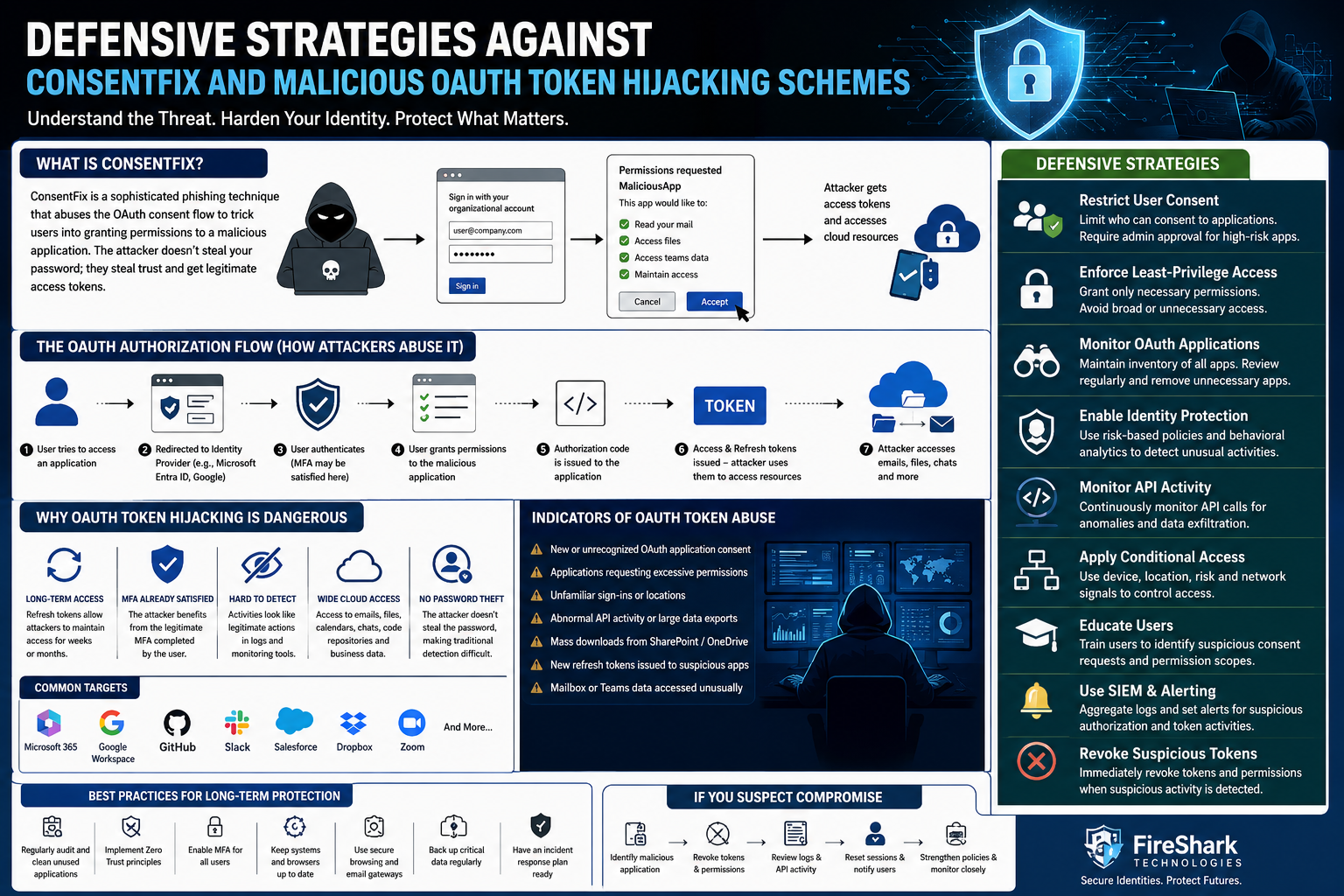
The process generally follows these steps:
- A user opens an application requesting access.
- The application redirects the user to an identity provider such as Microsoft Entra ID or Google.
- The user authenticates.
- The user grants requested permissions.
- The identity provider issues an authorization code.
- The application exchanges the code for an access token.
- The access token allows API access to cloud resources.
This model improves both usability and security. However, if attackers manipulate the authorization process, the resulting tokens become legitimate credentials that are difficult to distinguish from normal user activity.
What Is ConsentFix?
ConsentFix is a sophisticated phishing technique that abuses the OAuth consent workflow instead of targeting passwords.
Rather than stealing credentials directly, attackers convince users to authorize a malicious OAuth application. Since the authorization request appears to come from a legitimate identity provider, many users believe the process is safe.
The attack often exploits browser behavior, JavaScript manipulation, redirect chains, and deceptive user interfaces that make users unknowingly approve application permissions.
Once permission is granted, the malicious application receives OAuth tokens that provide long-term access to the victim’s cloud account.
Unlike password theft, the user’s credentials remain unchanged, making detection significantly more difficult.
How OAuth Token Hijacking Works
Attackers begin by creating a malicious OAuth application that closely resembles a trusted business application. The application requests permissions that appear reasonable but provide extensive access to cloud resources.
Victims receive phishing emails containing links that initiate the OAuth authorization flow. Since the login page belongs to a legitimate identity provider, users often trust the process.
After authentication, users are presented with a consent screen requesting permissions such as:
- Read emails
- Access files
- View calendars
- Read contacts
- Maintain offline access
- Access Teams conversations
Many users simply click Accept.
The malicious application then receives valid OAuth tokens directly from the identity provider.
Instead of logging in with stolen passwords, attackers simply use these tokens to call cloud APIs.
Because authentication occurred legitimately, security systems may record the activity as authorized user behavior.
Why OAuth Token Attacks Are So Dangerous
Traditional phishing relies on stolen passwords that users may eventually change.
OAuth attacks are fundamentally different.
The attacker never needs the password.
Instead, they receive authorization directly from the user.
This creates several security challenges.
Long-Term Persistence
Many OAuth applications receive refresh tokens that continuously generate new access tokens without requiring another login.
Attackers can maintain access for weeks or months.
Multi-Factor Authentication Is Already Satisfied
Since the victim completed MFA during authentication, the attacker benefits from the successful login.
They do not need to bypass MFA.
Difficult Detection
Security logs often show:
- Successful login
- Successful consent
- Authorized API usage
Everything appears legitimate.
Wide Cloud Access
Depending on granted permissions, attackers may access:
- Outlook emails
- SharePoint
- OneDrive
- Microsoft Teams
- Azure resources
- Google Drive
- Gmail
- Slack
- GitHub repositories
- CRM platforms
The attack surface becomes enormous.
Common Targets
Organizations using cloud identity platforms are particularly vulnerable.
Popular targets include:
- Microsoft 365
- Microsoft Entra ID
- Google Workspace
- GitHub
- Slack
- Salesforce
- Dropbox
- Zoom
- Atlassian Cloud
Every SaaS platform supporting OAuth authorization can potentially be abused if permission management is weak.
Indicators of OAuth Token Hijacking
Security teams should watch for unusual authorization events.
Common indicators include:
- New OAuth application registrations
- Unexpected consent approvals
- Excessive permission requests
- New refresh token issuance
- API activity from unfamiliar locations
- Large mailbox exports
- Mass SharePoint downloads
- Multiple Graph API requests
- Suspicious OneDrive access
These indicators may reveal token abuse even when no password compromise occurred.
Defensive Strategies Against ConsentFix Attacks
Protecting against ConsentFix requires multiple layers of security rather than relying on passwords alone.
Restrict User Consent
Many organizations allow every employee to authorize third-party applications.
This creates unnecessary risk.
Instead, organizations should require administrative approval before applications receive sensitive permissions.
Restricting consent significantly reduces opportunities for attackers.
Implement Admin Consent Workflow
Administrative approval ensures that only trusted applications receive organization-wide access.
Security teams should review:
- Application publisher
- Requested permissions
- Business necessity
- Risk level
Applications lacking clear justification should be rejected.
Enforce Least-Privilege Permissions
Applications should receive only the permissions they genuinely require.
Avoid granting:
- Full mailbox access
- Organization-wide file access
- Directory read permissions
- Offline access unless necessary
Reducing permissions minimizes the damage if an application is compromised.
Monitor OAuth Applications Continuously
Security teams should maintain a complete inventory of authorized OAuth applications.
Regular reviews help identify:
- Unused applications
- Suspicious publishers
- Overprivileged apps
- Newly registered apps
Applications that no longer serve business purposes should be removed promptly.
Enable Identity Protection
Modern identity platforms provide behavioral analytics capable of detecting unusual authorization patterns.
Machine learning can identify:
- Impossible travel
- Suspicious consent events
- Abnormal API usage
- Token misuse
- High-risk sign-ins
Identity protection significantly improves early detection.
Monitor API Activity
OAuth tokens interact with cloud APIs.
Monitoring API logs can reveal:
- Large data exports
- High-volume mailbox reads
- SharePoint enumeration
- Teams message collection
- Graph API abuse
API monitoring often detects attacks before sensitive information leaves the organization.
Apply Conditional Access Policies
Conditional Access strengthens OAuth security by evaluating contextual signals such as:
- Device compliance
- Geographic location
- User risk
- Session risk
- Network location
Suspicious sessions can be blocked automatically before tokens are issued.
Educate Users About Consent Screens
Security awareness training should extend beyond phishing emails.
Employees should learn to recognize:
- Unexpected permission requests
- Unknown publishers
- Requests for offline access
- Applications requesting excessive permissions
Users should understand that clicking Accept may authorize long-term access to sensitive company information.
Use Security Information and Event Management (SIEM)
SIEM platforms aggregate logs from identity providers, endpoints, cloud services, and APIs.
Correlation rules can detect:
- New OAuth applications
- Token creation
- API anomalies
- Privilege escalation
- Large-scale data access
Combining identity logs with endpoint telemetry improves visibility into sophisticated attacks.
Revoke Suspicious Tokens Immediately
If malicious OAuth activity is detected, organizations should revoke:
- Access tokens
- Refresh tokens
- User consent
- Application permissions
Immediate revocation limits attacker persistence.
Incident Response for OAuth Compromise
If a ConsentFix attack is suspected, organizations should:
- Identify the malicious application.
- Revoke all active OAuth tokens.
- Remove application permissions.
- Reset compromised sessions.
- Review mailbox and cloud storage activity.
- Investigate API logs for data access.
- Notify affected users.
- Update Conditional Access policies.
- Hunt for lateral movement.
- Conduct a full post-incident review.
Rapid containment reduces the likelihood of prolonged unauthorized access.
Best Practices for Long-Term Protection
Long-term resilience against OAuth-based attacks requires a comprehensive identity security strategy. Organizations should adopt a Zero Trust approach that continuously verifies users, devices, and applications instead of assuming trust after login. Regular audits of OAuth permissions, periodic removal of unused applications, and strict governance over third-party integrations reduce unnecessary exposure. Security teams should also enable detailed logging, monitor cloud APIs for abnormal behavior, and automate responses such as token revocation when suspicious activity is detected. Combining these technical controls with ongoing employee awareness training creates multiple layers of defense, making it far more difficult for attackers to exploit consent workflows or maintain unauthorized access.
Conclusion
ConsentFix demonstrates how attackers are shifting away from traditional password theft toward identity-based attacks that exploit trust in OAuth authorization. By obtaining legitimate access tokens through deceptive consent requests, adversaries can bypass many conventional security controls, including multi-factor authentication, and maintain persistent access to valuable cloud resources.
Organizations can significantly reduce this risk by enforcing least-privilege permissions, restricting user consent, requiring administrative approval for third-party applications, continuously monitoring OAuth activity, applying Conditional Access policies, and educating users about suspicious consent requests. A layered, Zero Trust approach—supported by identity protection, API monitoring, SIEM integration, and rapid token revocation—provides the strongest defense against ConsentFix and other malicious OAuth token hijacking schemes.
As cloud identities become the primary gateway to enterprise data, protecting OAuth authorization flows must be treated as a core component of every organization’s cybersecurity strategy.
Frequently Asked Questions (FAQs)
1. What is ConsentFix in cybersecurity?
ConsentFix is an advanced phishing technique that exploits the OAuth consent process instead of stealing usernames and passwords. It tricks users into authorizing a malicious application, allowing attackers to obtain legitimate OAuth access and refresh tokens for cloud services such as Microsoft 365 and Google Workspace.
2. How is OAuth token hijacking different from traditional phishing?
Traditional phishing aims to steal login credentials, whereas OAuth token hijacking focuses on obtaining authorization tokens through deceptive consent requests. Since users authenticate with the legitimate identity provider, attackers can bypass many traditional security controls, including multi-factor authentication (MFA), without ever knowing the user’s password.
3. Can Multi-Factor Authentication (MFA) prevent ConsentFix attacks?
MFA helps secure user authentication but does not fully prevent ConsentFix attacks. Because the victim completes the MFA process themselves before granting application permissions, the attacker receives valid OAuth tokens after successful authentication. This is why organizations should combine MFA with Conditional Access policies, consent restrictions, and continuous monitoring.
4. What are the warning signs of a malicious OAuth application?
Some common indicators include unexpected permission requests, applications asking for excessive access (such as reading emails or files), unfamiliar publishers, unusual API activity, new OAuth app registrations, and abnormal data downloads from cloud services. Regular auditing of authorized applications can help identify these threats early.
5. How can organizations defend against OAuth token hijacking?
Organizations should implement a layered security approach that includes restricting user consent, requiring administrator approval for high-risk applications, enforcing least-privilege permissions, monitoring OAuth applications and API activity, enabling identity protection, applying Zero Trust and Conditional Access policies, educating employees about consent phishing, and promptly revoking suspicious OAuth tokens when malicious activity is detected.