Introduction
Artificial Intelligence is rapidly transforming industries, from healthcare and finance to manufacturing and education. Organizations are integrating AI into customer support, fraud detection, cybersecurity, automation, and decision-making processes at an unprecedented pace. While these advancements improve productivity and innovation, they also introduce new security, privacy, and compliance challenges that traditional cybersecurity frameworks were never designed to address.
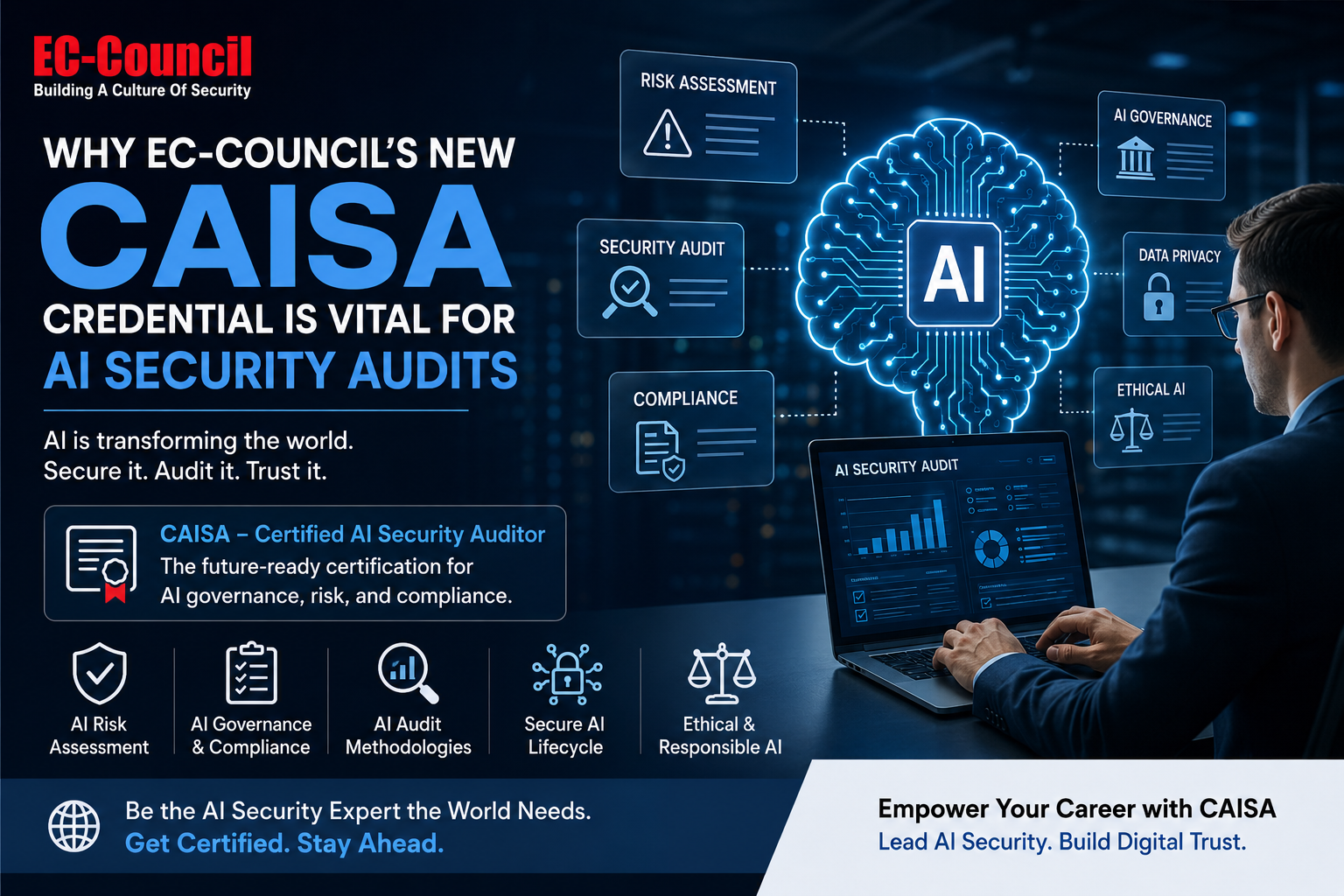
As AI adoption accelerates, businesses require professionals who understand not only cybersecurity but also the unique risks associated with AI systems. Recognizing this growing need, EC-Council introduced the Certified AI Security Auditor (CAISA) credential—a specialized certification designed to equip professionals with the knowledge and skills required to assess, audit, and secure AI environments.
Whether you’re an IT auditor, cybersecurity professional, compliance officer, or AI practitioner, CAISA provides the expertise needed to ensure AI systems remain secure, ethical, compliant, and resilient.
AI Is Changing Cybersecurity Faster Than Ever
Artificial Intelligence has become deeply integrated into modern business operations. Organizations rely on machine learning models to automate decisions, detect cyber threats, optimize supply chains, and personalize customer experiences.
However, AI systems introduce entirely new attack surfaces, including:
- Model poisoning attacks
- Prompt injection attacks
- Adversarial machine learning
- Data poisoning
- AI model theft
- Sensitive data leakage
- Hallucination risks
- Supply chain vulnerabilities
- Privacy violations
- Bias in automated decisions
Traditional penetration testing alone cannot identify many of these AI-specific risks. Specialized AI security audits are now becoming an essential component of enterprise cybersecurity programs.
What Is EC-Council CAISA?
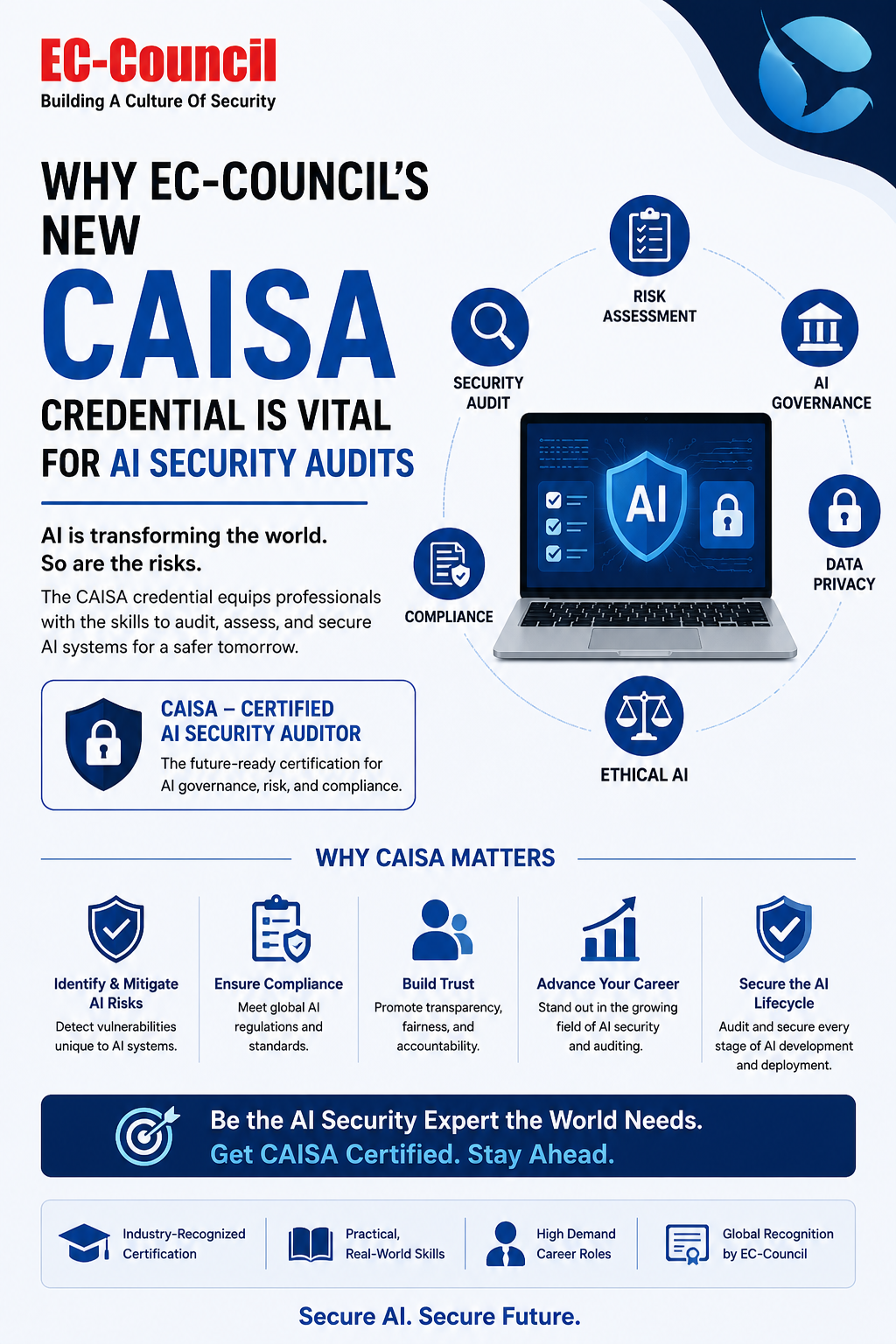
The Certified AI Security Auditor (CAISA) is an advanced certification developed by EC-Council to help professionals evaluate the security, governance, compliance, and trustworthiness of Artificial Intelligence systems.
Rather than focusing only on offensive security or ethical hacking, CAISA emphasizes:
- AI governance
- AI risk management
- AI compliance
- AI security frameworks
- AI lifecycle security
- Responsible AI
- AI auditing methodologies
- Regulatory readiness
The certification prepares professionals to assess AI systems throughout their entire lifecycle—from data collection and model training to deployment and continuous monitoring.
Why AI Security Audits Are Becoming Mandatory
Governments and regulatory agencies worldwide are introducing stricter requirements around Artificial Intelligence.
Organizations are now expected to demonstrate:
- AI transparency
- Data privacy
- Model accountability
- Risk assessments
- Ethical AI implementation
- Continuous monitoring
- Human oversight
- Security controls
Without structured AI audits, businesses may face:
- Regulatory penalties
- Financial losses
- Reputation damage
- Data breaches
- Legal liabilities
- Customer distrust
CAISA provides professionals with the framework necessary to perform these assessments effectively.
Key Skills Covered in CAISA
The certification focuses on practical knowledge required for modern AI security auditing.
AI Governance
Professionals learn how organizations should govern AI systems responsibly while maintaining accountability and transparency.
AI Risk Assessment
Candidates understand how to identify security weaknesses, operational risks, and business impacts associated with AI deployments.
AI Security Controls
The course explains security controls designed specifically for machine learning environments.
Compliance Management
Professionals gain knowledge of international AI regulations, privacy laws, and governance frameworks.
AI Lifecycle Auditing
The certification covers auditing every stage of an AI project’s lifecycle, ensuring continuous security rather than one-time assessments.
Ethical AI
CAISA teaches methods to identify bias, fairness issues, explainability challenges, and ethical concerns within AI systems.
Why Organizations Need Certified AI Security Auditors
Businesses investing heavily in AI cannot rely solely on traditional security teams.
Certified AI Security Auditors help organizations:
- Secure AI infrastructure
- Protect sensitive training datasets
- Evaluate machine learning models
- Assess AI governance programs
- Identify regulatory gaps
- Reduce business risk
- Improve customer trust
- Strengthen compliance efforts
As AI regulations become stricter, companies increasingly seek professionals capable of conducting specialized AI audits.
EC-Council Learning https://links.fireshark.in/ec-council-learning
Career Benefits of CAISA Certification
Professionals earning the CAISA credential position themselves for emerging cybersecurity roles such as:
- AI Security Auditor
- AI Governance Consultant
- AI Risk Analyst
- AI Compliance Specialist
- AI Security Engineer
- AI Assurance Consultant
- Cybersecurity Auditor
- Governance, Risk & Compliance (GRC) Professional
With organizations rapidly adopting AI technologies, demand for AI-focused cybersecurity expertise is expected to continue growing.
Who Should Pursue CAISA?
The certification is valuable for professionals working in:
- Cybersecurity
- Information Security
- IT Auditing
- Governance, Risk & Compliance
- Artificial Intelligence
- Cloud Security
- Data Privacy
- Risk Management
- Security Consulting
It also benefits professionals transitioning from traditional cybersecurity into AI security roles.
CAISA vs Traditional Cybersecurity Certifications
| Traditional Cybersecurity | EC-Council CAISA |
|---|---|
| Focuses on networks | Focuses on AI ecosystems |
| Security testing | AI auditing |
| Infrastructure security | AI governance |
| Vulnerability management | AI risk management |
| Penetration testing | AI compliance auditing |
| Traditional frameworks | AI-specific controls |
Rather than replacing existing certifications, CAISA complements them by addressing emerging AI security challenges.
The Growing Importance of AI Governance
Organizations are increasingly adopting responsible AI frameworks to ensure their systems operate securely, fairly, and transparently.
Strong AI governance includes:
- Secure model development
- Continuous monitoring
- Risk documentation
- Human oversight
- Data quality validation
- Regulatory compliance
- Ethical AI implementation
CAISA equips professionals with practical methodologies to evaluate whether these governance practices are effectively implemented.
How FireShark Technologies Supports AI Security Learning
As AI transforms cybersecurity, professionals need practical, industry-relevant training to stay ahead of emerging threats. FireShark Technologies supports cybersecurity learners through expert-led training programs, hands-on labs, certification guidance, and real-world security education. Whether you’re building foundational cybersecurity skills or preparing for advanced certifications, continuous learning is essential to securing modern AI-driven environments.
Future Outlook
AI security auditing is rapidly becoming a core requirement for organizations deploying Artificial Intelligence solutions. As governments introduce stricter regulations and enterprises expand their AI adoption, the demand for qualified AI security auditors will continue to rise.
Professionals who understand AI governance, compliance, and security auditing will be well-positioned for leadership roles in cybersecurity and risk management. The EC-Council CAISA certification offers a structured pathway to develop these specialized skills, making it a valuable credential for anyone looking to secure the next generation of intelligent systems.
Conclusion
Artificial Intelligence is reshaping every industry, but it also introduces complex security, privacy, and governance challenges that traditional cybersecurity approaches cannot fully address. Organizations need professionals who can evaluate AI systems for security, compliance, fairness, and operational resilience.
EC-Council’s Certified AI Security Auditor (CAISA) credential fills this critical skills gap by preparing professionals to audit AI systems throughout their lifecycle. As AI regulations evolve and adoption continues to grow, CAISA is poised to become one of the most valuable certifications for cybersecurity, compliance, and governance professionals seeking to lead in the era of AI security.
Frequently Asked Questions
What is the EC-Council CAISA certification?
CAISA (Certified AI Security Auditor) is an EC-Council certification that focuses on auditing AI systems, AI governance, risk assessment, compliance, and AI security best practices.
Who should earn the CAISA certification?
It is ideal for cybersecurity professionals, IT auditors, compliance specialists, governance professionals, AI practitioners, cloud security experts, and risk managers who work with AI technologies.
Why are AI security audits important?
AI systems can be vulnerable to threats such as data poisoning, adversarial attacks, prompt injection, privacy violations, and model theft. Security audits help organizations identify and mitigate these risks before they lead to security incidents.
Does CAISA require AI programming experience?
No. While a basic understanding of AI concepts is helpful, the certification primarily focuses on AI security, governance, auditing, and compliance rather than developing machine learning models.
How does CAISA improve career opportunities?
As organizations increasingly adopt AI and face stricter regulatory requirements, professionals with AI security auditing expertise are becoming highly valuable. CAISA demonstrates specialized knowledge in AI governance, risk management, and security auditing, making candidates more competitive for emerging cybersecurity and compliance roles.