Table of Contents
Introduction
As cyber threats continue to evolve, enterprise firewalls remain one of the most targeted security components within corporate networks. Cisco Secure Firewall Management Center (FMC) serves as the centralized management platform for Cisco Secure Firewalls, allowing security teams to configure policies, monitor traffic, analyze threats, and automate security operations. Because FMC manages an organization’s security infrastructure, any vulnerability affecting it can potentially expose an entire network to attackers.
Recent Cisco Secure Firewall Management Center vulnerabilities have highlighted the importance of proactive security management. Attackers actively scan the internet for vulnerable firewall management systems, looking for opportunities to gain unauthorized access, execute malicious code, escalate privileges, or disrupt business operations. Organizations that fail to apply security updates quickly increase their exposure to ransomware, advanced persistent threats (APTs), and data breaches.
This guide explains the latest Cisco Secure Firewall Management Center vulnerabilities, their impact on enterprise environments, mitigation strategies, best security practices, and how organizations can strengthen their cybersecurity posture before attackers exploit known weaknesses.
Understanding Cisco Secure Firewall Management Center
Cisco Secure Firewall Management Center is a centralized management solution that simplifies firewall administration across multiple locations. Instead of managing each firewall independently, administrators can configure security policies, intrusion prevention systems (IPS), malware protection, VPN settings, user authentication, and network visibility from a single console.
Large enterprises depend on FMC because it integrates multiple Cisco security technologies into one platform. It provides real-time monitoring, threat intelligence, event correlation, and automated security responses. However, this centralized architecture also means that a compromised FMC can potentially affect every managed firewall in the organization.
‘Why Firewall Management Vulnerabilities Are Dangerous
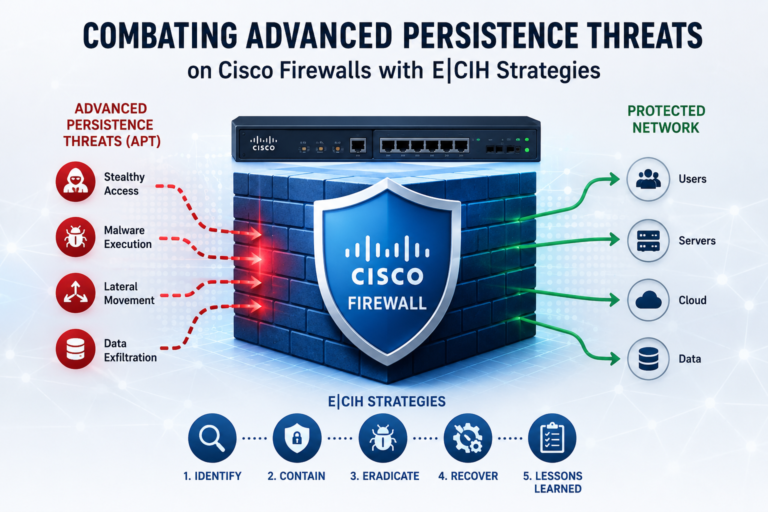
Firewall management systems contain sensitive administrative functions. If attackers exploit vulnerabilities in Cisco FMC, they may gain elevated privileges that allow them to manipulate firewall rules, disable protections, intercept traffic, or establish persistent access inside enterprise networks.
Some vulnerabilities may allow remote code execution without authentication, while others enable privilege escalation or bypass security controls. Once inside, attackers can move laterally through the network, steal sensitive information, deploy ransomware, or install malware without immediate detection.
Because Cisco firewalls often protect financial institutions, healthcare organizations, government agencies, educational institutions, and multinational enterprises, successful attacks against FMC can have severe operational and financial consequences.
Common Types of Cisco Secure Firewall Management Center Vulnerabilities
Recent Cisco security advisories have demonstrated several categories of vulnerabilities that administrators should monitor closely.
Remote Code Execution (RCE) vulnerabilities are among the most severe because they allow attackers to execute arbitrary commands on vulnerable management servers. These attacks often require little or no authentication, making them particularly attractive to cybercriminals.
Authentication bypass vulnerabilities allow unauthorized users to gain access to administrative functions without valid credentials. Attackers may exploit flaws in authentication mechanisms to control firewall management interfaces.
Privilege escalation vulnerabilities enable low-privileged users to obtain administrator-level permissions, giving attackers complete control over firewall configurations and security policies.
Cross-Site Scripting (XSS) vulnerabilities may allow attackers to inject malicious scripts into management interfaces, potentially stealing administrator session cookies or manipulating browser sessions.
Denial-of-Service (DoS) vulnerabilities can overwhelm firewall management services, preventing administrators from managing security infrastructure during critical incidents.
How Organizations Can Mitigate Cisco FMC Vulnerabilities
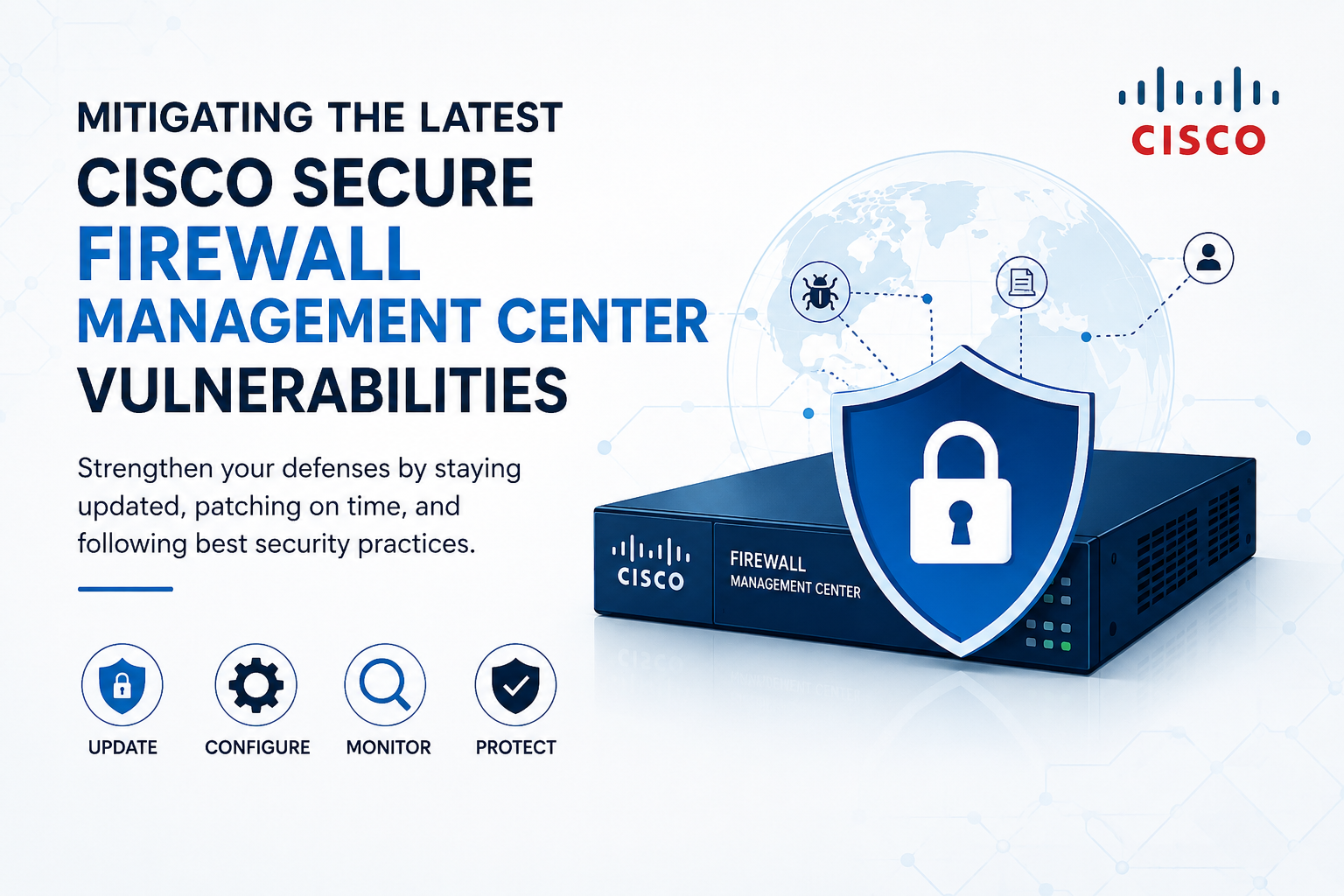
Effective mitigation begins with timely patch management. Cisco regularly releases software updates that address newly discovered vulnerabilities. Organizations should establish structured patch management processes to evaluate, test, and deploy updates as soon as practical.
Access to Cisco Secure Firewall Management Center should be restricted using multi-factor authentication, role-based access control, and strong password policies. Administrative interfaces should never be publicly accessible from the internet unless absolutely necessary.
Network segmentation significantly reduces attack surfaces. Placing FMC inside a dedicated management network with limited access prevents attackers from reaching administrative systems even if other parts of the network become compromised.
Continuous vulnerability scanning helps identify outdated software versions before attackers discover them. Security teams should regularly compare installed software against Cisco security advisories and vulnerability databases.
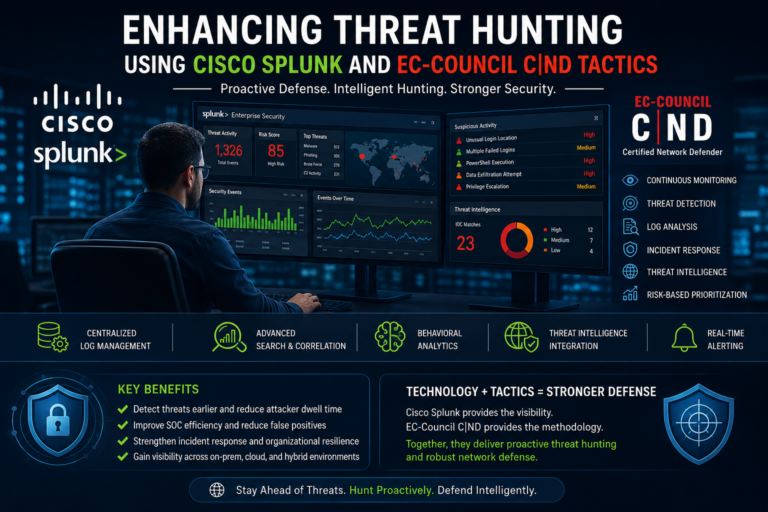
Security monitoring through SIEM platforms such as Cisco Splunk enables organizations to detect unusual administrator behavior, configuration changes, failed login attempts, and suspicious firewall activity in real time.
Regular configuration backups ensure rapid recovery if firewall management systems become compromised or corrupted during an attack.
Best Security Practices for Cisco Firewall Management
Strong cybersecurity requires more than installing updates. Organizations should implement defense-in-depth strategies that combine multiple layers of protection.
Administrative access should be limited to trusted IP addresses through network access controls. Logging and auditing should remain enabled at all times to support incident investigations.
Organizations should conduct periodic penetration testing to identify weaknesses before attackers exploit them. Security awareness training also helps administrators recognize phishing attempts that target privileged firewall accounts.
Threat intelligence feeds should be integrated with firewall management systems to automatically identify emerging attack patterns targeting Cisco infrastructure.
Security teams should regularly review firewall rules to remove outdated or unnecessary configurations that may introduce additional risks.
The Role of Threat Hunting in Firewall Security
Modern cyberattacks often bypass traditional security controls using stealth techniques. Threat hunting enables security analysts to proactively search for indicators of compromise before automated tools generate alerts.
Behavioral analysis, anomaly detection, endpoint telemetry, and network traffic inspection help identify attackers attempting to exploit Cisco firewall vulnerabilities. Combining Cisco Secure Firewall with SIEM, XDR, endpoint protection, and threat intelligence platforms creates a stronger security ecosystem capable of detecting sophisticated attacks.
Organizations that continuously monitor their firewall infrastructure are more likely to detect exploitation attempts early and reduce overall incident response time.
How FireShark Technologies Helps Organizations Stay Secure
FireShark Technologies supports organizations in strengthening enterprise cybersecurity through vulnerability assessments, penetration testing (VAPT), firewall security reviews, cloud security assessments, incident response, SOC monitoring, security awareness programs, and compliance consulting.
By combining proactive vulnerability management with continuous monitoring, organizations can reduce the likelihood of successful attacks targeting Cisco Secure Firewall Management Center and other critical security infrastructure.
Conclusion
Cisco Secure Firewall Management Center plays a critical role in protecting enterprise networks, making it an attractive target for cybercriminals. As attackers increasingly exploit newly disclosed vulnerabilities, organizations must adopt a proactive security strategy that includes rapid patch deployment, continuous monitoring, strong access controls, network segmentation, vulnerability assessments, and ongoing threat hunting.
Cybersecurity is not a one-time implementation but an ongoing process of identifying risks, applying security improvements, and adapting to evolving threats. Organizations that invest in proactive firewall security significantly reduce their exposure to ransomware, data breaches, and sophisticated cyberattacks while maintaining business continuity and regulatory compliance.
Frequently Asked Questions (FAQs)
1. What is Cisco Secure Firewall Management Center?
Cisco Secure Firewall Management Center (FMC) is a centralized security management platform that allows administrators to configure, monitor, and manage multiple Cisco Secure Firewalls from a single interface. It provides policy management, intrusion prevention, malware detection, reporting, and security analytics.
2. Why are Cisco FMC vulnerabilities considered high risk?
Because FMC controls enterprise firewall infrastructure, attackers who successfully exploit vulnerabilities may gain administrative access, modify firewall policies, disable security protections, or execute malicious code across an organization’s network.
3. How can organizations protect Cisco Secure Firewall Management Center?
Organizations should install Cisco security updates promptly, enable multi-factor authentication, restrict administrative access, segment management networks, monitor security logs, perform regular vulnerability assessments, and continuously review firewall configurations.
4. How often should Cisco firewalls be updated?
Security updates should be evaluated immediately after Cisco publishes advisories. Critical vulnerabilities should be patched as quickly as operationally feasible after appropriate testing to minimize exposure.
5. Can vulnerability assessments help prevent firewall attacks?
Yes. Regular vulnerability assessments identify outdated software, configuration weaknesses, exposed services, and security gaps before attackers can exploit them. Combined with penetration testing and continuous monitoring, they form an essential part of an enterprise cybersecurity strategy.