Table of Contents
Introduction
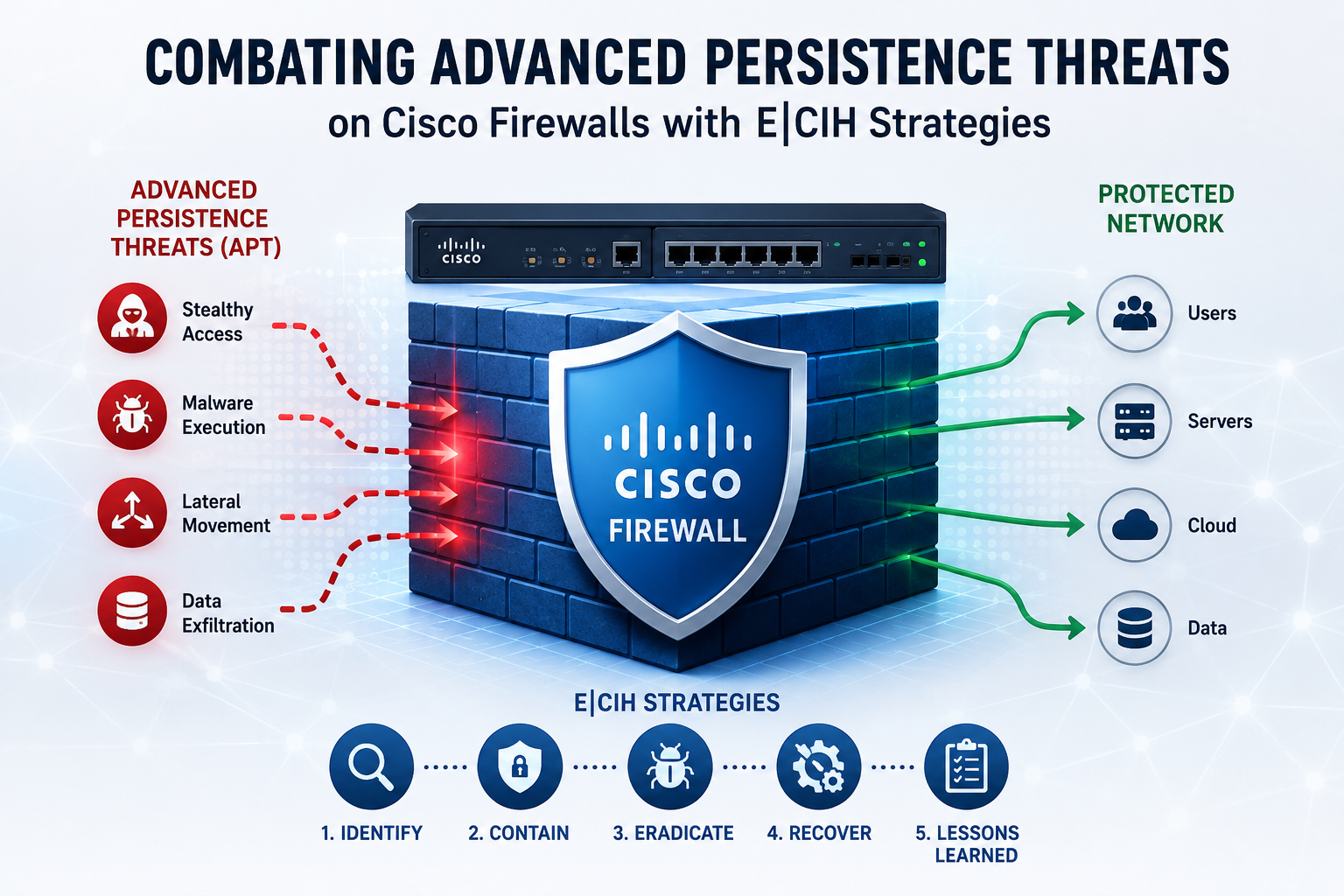
As cybercriminals adopt increasingly sophisticated attack techniques, organizations can no longer rely solely on traditional firewall rules to defend their networks. One of the most dangerous forms of cyberattacks today is the Advanced Persistent Threat (APT)—a stealthy, long-term attack designed to infiltrate, remain undetected, and continuously extract sensitive information.
Although Cisco Firewalls provide industry-leading network protection, even the most advanced security infrastructure requires skilled professionals capable of detecting, investigating, and responding to persistent threats. This is where EC-Council Certified Incident Handler (E|CIH) strategies become invaluable.
Combining Cisco’s enterprise firewall technologies with structured incident handling methodologies enables organizations to minimize damage, reduce attacker dwell time, and strengthen their overall cybersecurity posture.
Understanding Advanced Persistent Threats (APTs)
An Advanced Persistent Threat is a carefully planned cyberattack in which attackers gain unauthorized access to an organization’s network and remain hidden for weeks, months, or even years.
Unlike ransomware or opportunistic malware attacks, APTs focus on long-term espionage, data theft, financial fraud, and intellectual property compromise.
Common targets include:
- Government agencies
- Financial institutions
- Healthcare organizations
- Manufacturing companies
- Cloud service providers
- Large enterprises
- Critical infrastructure
The primary objective isn’t immediate disruption—it’s persistence.
Why Cisco Firewalls Alone Are Not Enough
Modern Cisco Secure Firewalls include powerful capabilities such as:
- Deep Packet Inspection (DPI)
- Intrusion Prevention System (IPS)
- Application Visibility
- URL Filtering
- Malware Protection
- SSL Inspection
- Threat Intelligence Integration
- Network Segmentation
Despite these advanced features, attackers constantly evolve their techniques by using:
- Zero-day exploits
- Living-off-the-land attacks
- Encrypted communications
- Credential theft
- Lateral movement
- Privilege escalation
Technology must therefore be complemented by effective incident response strategies.
What is E|CIH?
The EC-Council Certified Incident Handler (E|CIH) certification prepares cybersecurity professionals to detect, analyze, contain, eradicate, and recover from cyber incidents.
Instead of focusing solely on prevention, E|CIH teaches organizations how to respond effectively when prevention fails.
Core E|CIH competencies include:
- Incident preparation
- Threat hunting
- Malware analysis
- Digital evidence collection
- Log analysis
- Network forensics
- Root cause analysis
- Recovery planning
- Post-incident reporting
How Attackers Maintain Persistence
Understanding attacker persistence techniques is the first step toward eliminating them.
Credential Theft
Attackers steal administrator credentials and create hidden privileged accounts to maintain access.
Malware Persistence
Malicious software modifies registry entries, startup services, scheduled tasks, or system processes to survive system reboots.
Command and Control Channels
Encrypted outbound communications allow attackers to remotely control compromised devices while avoiding detection.
Lateral Movement
After compromising one endpoint, attackers spread across servers, workstations, Active Directory, and cloud environments.
Log Manipulation
Sophisticated attackers erase or modify security logs to hide evidence of their activities.
Using Cisco Firewalls to Detect Persistent Threats
Cisco Secure Firewalls offer several features that support proactive threat detection.
Intrusion Prevention System (IPS)
Cisco IPS identifies known exploits before attackers gain persistence.
Benefits include:
- Signature-based detection
- Behavioral monitoring
- Automatic blocking
- Exploit prevention
(CEHv13 AI) Elite Voucher https://links.fireshark.in/ceh-elite-v13
Application Visibility and Control
Applications frequently abused by attackers can be monitored or restricted.
Examples include:
- Remote desktop applications
- Unauthorized VPN software
- File-sharing tools
- Command-line utilities
Threat Intelligence Integration
Cisco continuously updates its threat intelligence database to detect:
- Malicious IP addresses
- Known malware domains
- Command-and-control servers
- Phishing infrastructure
SSL/TLS Inspection
Since most malicious traffic is encrypted, SSL inspection allows security teams to identify hidden threats without leaving blind spots.
Advanced Logging
Cisco firewalls generate detailed logs for:
- Authentication events
- VPN sessions
- Configuration changes
- Blocked connections
- Malware detections
- Suspicious outbound traffic
These logs are essential during incident investigations.
Applying E|CIH Incident Response Strategies
Phase 1: Preparation
Organizations should establish:
- Incident response plans
- Asset inventories
- Backup strategies
- Security monitoring
- Team responsibilities
- Communication procedures
Phase 2: Identification
Security teams analyze:
- Firewall logs
- SIEM alerts
- Network anomalies
- Endpoint alerts
- User activity
- Authentication failures
Rapid identification significantly reduces attacker dwell time.
Phase 3: Containment
Once a compromise is confirmed:
- Block malicious IP addresses
- Disable compromised accounts
- Isolate infected systems
- Restrict lateral movement
- Update firewall access rules
Cisco Firewalls play a critical role during containment.
Phase 4: Eradication
Security analysts remove:
- Malware
- Backdoors
- Unauthorized user accounts
- Malicious scripts
- Persistence mechanisms
System vulnerabilities should also be patched.
Phase 5: Recovery
Recovery includes:
- Restoring clean backups
- Validating firewall configurations
- Monitoring systems for reinfection
- Verifying application functionality
Phase 6: Lessons Learned
Every incident should improve future security by documenting:
- Attack timeline
- Root cause
- Security gaps
- Detection delays
- Response effectiveness
- Policy improvements
Best Practices for Cisco Firewall Security
Organizations should implement:
- Zero Trust Network Architecture
- Multi-Factor Authentication (MFA)
- Regular firewall rule audits
- Firmware updates
- Network segmentation
- Continuous log monitoring
- Threat hunting
- Vulnerability assessments
- Least privilege access
- Security awareness training
The Role of Security Operations Centers (SOC)
A mature SOC enhances firewall security by continuously:
- Monitoring network traffic
- Investigating alerts
- Hunting hidden threats
- Correlating events
- Performing malware analysis
- Coordinating incident response
When Cisco Firewalls integrate with SIEM and XDR platforms, security teams gain greater visibility and faster response capabilities.
Why E|CIH Complements Cisco Firewall Security
Firewalls prevent many attacks, but incident handling determines how effectively an organization responds when attackers succeed.
Professionals trained in E|CIH can:
- Investigate sophisticated cyber incidents
- Perform forensic analysis
- Coordinate response teams
- Reduce business downtime
- Preserve digital evidence
- Improve regulatory compliance
- Strengthen enterprise resilience
This combination of prevention and response creates a comprehensive cybersecurity defense strategy.
Building a Resilient Cybersecurity Program
Organizations should move beyond perimeter security and adopt a layered defense approach.
An effective program combines:
- Cisco Secure Firewalls
- Endpoint Detection and Response (EDR)
- SIEM platforms
- Threat Intelligence
- Security Awareness Training
- Vulnerability Management
- Incident Response Planning
- Regular Security Audits
For businesses looking to strengthen their cybersecurity posture, FireShark provides services such as Vulnerability Assessment & Penetration Testing (VAPT), Network Security Assessments, Web Application & API Security Testing, Cloud Security Hardening, Security Monitoring, Incident Response Consulting, and Cybersecurity Training to help organizations detect, respond to, and recover from evolving cyber threats.
Conclusion
Advanced Persistent Threats continue to challenge organizations worldwide by exploiting weaknesses and maintaining long-term access to sensitive environments. While Cisco Secure Firewalls provide robust network defense, combating sophisticated persistence techniques requires a well-prepared incident response capability.
By implementing E|CIH strategies, organizations can detect threats earlier, contain incidents more effectively, eliminate attacker persistence, and recover with minimal operational impact. The combination of advanced firewall technologies, continuous monitoring, skilled analysts, and structured incident response creates a resilient security framework capable of defending against modern cyber threats.
Frequently Asked Questions (FAQs)
1. What is an Advanced Persistent Threat (APT)?
An APT is a sophisticated cyberattack in which attackers gain unauthorized access to a network and remain hidden for an extended period to steal data, conduct espionage, or disrupt operations.
2. How do Cisco Firewalls help prevent persistent threats?
Cisco Firewalls provide features such as intrusion prevention, deep packet inspection, malware detection, application visibility, SSL inspection, and threat intelligence to identify and block malicious activity before attackers establish persistence.
3. What is E|CIH, and why is it important?
E|CIH (EC-Council Certified Incident Handler) equips cybersecurity professionals with the knowledge to prepare for, detect, contain, eradicate, and recover from cyber incidents, making it essential for effective incident response.
4. Can Cisco Firewalls stop all cyberattacks?
No. While Cisco Firewalls offer advanced protection, no security solution can block every attack. Organizations should combine firewall security with incident response, endpoint protection, continuous monitoring, and employee awareness training.
5. How can organizations improve their defenses against APTs?
Organizations can strengthen their defenses by deploying Cisco Secure Firewalls, implementing Zero Trust principles, enabling multi-factor authentication, conducting regular security assessments, monitoring logs continuously, training incident response teams, and following E|CIH best practices.