Introduction
Artificial Intelligence has rapidly evolved from answering simple questions to making decisions, executing tasks, collaborating with other AI agents, and interacting with enterprise systems. This new generation of autonomous systems is commonly known as Agentic AI.
Unlike traditional AI chatbots, Agentic AI systems can independently perform multi-step tasks such as retrieving confidential business information, interacting with cloud applications, scheduling operations, writing code, deploying infrastructure, and communicating with multiple APIs without constant human intervention.
While this innovation dramatically improves productivity, it also introduces entirely new cybersecurity risks.
To address these growing concerns, Cisco introduced its Foundry Security Specification, a modern framework designed specifically to secure Agentic AI workflows operating across enterprise environments.
This article explores why Agentic AI requires a completely different security approach, how Cisco’s Foundry Security Spec works, and what organizations should implement to protect AI-driven operations.
Understanding Agentic AI Workflows
Traditional AI typically waits for a prompt and generates a response.
Agentic AI behaves differently.
Instead of completing one isolated task, it can:
- Plan objectives
- Break work into multiple steps
- Call external APIs
- Access enterprise databases
- Coordinate with other AI agents
- Make autonomous decisions
- Learn from previous actions
- Continue working until objectives are completed
For example, an AI assistant inside an enterprise may receive the instruction:
“Prepare our quarterly cybersecurity compliance report.”
Instead of simply generating text, the AI agent might:
- Collect security logs
- Query cloud infrastructure
- Review endpoint alerts
- Access vulnerability scanners
- Summarize findings
- Generate reports
- Email executives
This level of autonomy dramatically expands the attack surface.
(CEHv13-AI) https://links.fireshark.in/ceh-exam
Why Agentic AI Creates New Security Risks
The more authority AI agents receive, the more damage attackers can potentially cause.
Modern AI threats include:
Prompt Injection
Attackers manipulate prompts so AI agents ignore security rules or perform unauthorized actions.
Data Leakage
AI agents often access confidential information stored across enterprise systems.
Poor controls can expose:
- Customer records
- Financial data
- Source code
- Intellectual property
- API credentials
Excessive Permissions
Many AI systems receive broader permissions than necessary.
If compromised, attackers gain access to critical infrastructure.
Malicious Tool Usage
Agentic AI frequently connects with:
- GitHub
- Cloud platforms
- Email systems
- CRM software
- Databases
- Internal APIs
Improper validation allows attackers to abuse these integrations.
Multi-Agent Compromise
In collaborative AI systems, compromising one agent may allow attacks to spread throughout the workflow.
Why Traditional Security Controls Are No Longer Enough
Traditional cybersecurity was designed around protecting human users.
Agentic AI introduces non-human identities making autonomous decisions at machine speed.
Conventional protections like:
- Password policies
- Network firewalls
- Manual approvals
- User authentication
cannot fully secure autonomous AI workflows.
Organizations now require security controls built specifically for AI behavior.
This is where Cisco’s Foundry Security Specification becomes important.
What Is Cisco’s Foundry Security Specification?
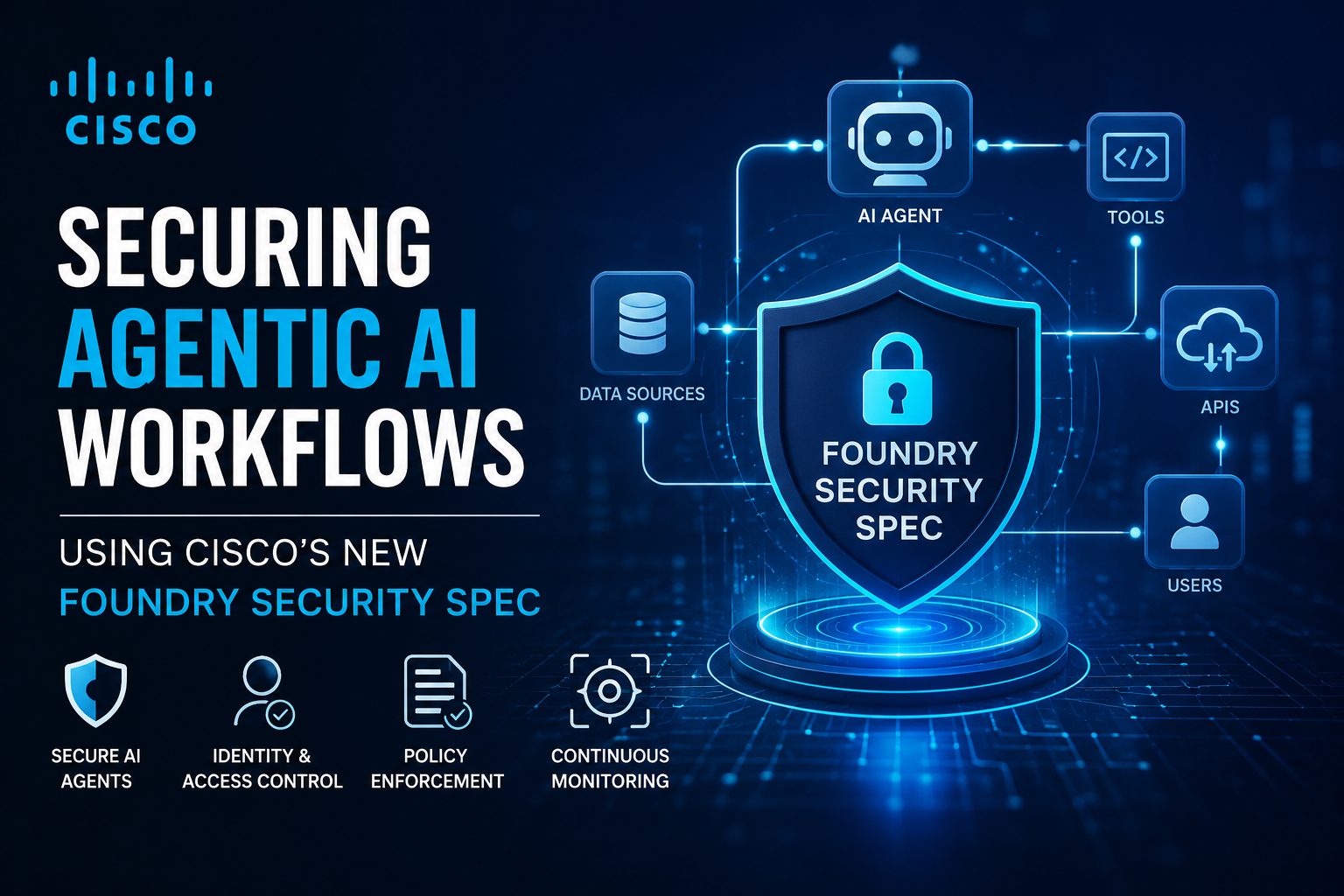
Cisco’s Foundry Security Specification is a security architecture designed to establish standardized protections for Agentic AI systems operating inside enterprise environments.
Rather than securing only AI models, the specification focuses on securing the complete AI workflow, including:
- AI agents
- Tool usage
- External APIs
- Data access
- Agent communication
- Identity verification
- Authorization
- Continuous monitoring
- Trust validation
The goal is to ensure AI agents operate only within clearly defined security boundaries.
Core Security Principles Behind Cisco’s Foundry Security Spec
Identity Verification for Every AI Agent
Every AI agent receives a verified digital identity.
Before interacting with systems or other agents, identities are authenticated.
This prevents unauthorized or rogue AI agents from entering workflows.
Least Privilege Access
AI agents receive only the permissions required for their assigned tasks.
Instead of granting full administrative access, permissions remain tightly scoped.
This greatly reduces potential damage during compromise.
Secure Tool Invocation
Before AI agents access tools or external services, every request is validated.
Security checks confirm:
- Tool legitimacy
- User authorization
- Context
- Requested action
- Data sensitivity
Continuous Policy Enforcement
Security policies remain active throughout the workflow.
Even after an AI process begins, every action is evaluated against organizational policies.
If violations occur, actions can be blocked immediately.
Full Workflow Visibility
Every AI action generates audit logs.
Organizations can track:
- Which AI agent acted
- What tools were used
- Which data was accessed
- Which decisions were made
- Policy evaluations
- Security events
These logs simplify compliance and incident investigations.
How Cisco’s Security Specification Protects Enterprise AI
Instead of relying on one defensive layer, Cisco applies security throughout the AI lifecycle.
Protection includes:
Secure Authentication
Only trusted AI agents may participate.
Authorization Controls
Each action requires permission validation.
Runtime Monitoring
AI behavior is continuously monitored.
Policy Enforcement
Risky actions are automatically blocked.
Threat Detection
Suspicious AI behavior generates immediate alerts.
Workflow Auditing
Every AI decision becomes traceable.
Agentic AI Security Best Practices
Organizations implementing Agentic AI should follow several foundational practices.
Implement Zero Trust Principles
Never assume an AI agent is trustworthy simply because it exists within the network.
Every request should be verified continuously.
Limit AI Permissions
Grant AI agents only the minimum access necessary to perform their responsibilities.
Protect Sensitive Data
Classify enterprise information and restrict AI access according to data sensitivity.
Validate External APIs
Every external service connected to AI workflows should undergo security verification.
Monitor AI Behavior
Use continuous monitoring to identify:
- Unusual requests
- Excessive API usage
- Privilege escalation
- Unexpected workflow changes
Secure Prompt Handling
Validate user inputs to reduce prompt injection risks.
Maintain Audit Trails
Record every AI decision for forensic analysis and regulatory compliance.
Benefits of Cisco’s Foundry Security Spec
Organizations adopting the specification gain multiple security advantages.
These include:
- Reduced AI attack surface
- Better compliance readiness
- Stronger identity management
- Protection against prompt injection
- Improved AI governance
- Secure API integrations
- Reduced insider threats
- Better enterprise visibility
- Continuous policy enforcement
- Scalable AI security architecture
Industries That Benefit Most
Cisco’s AI security framework is especially valuable for organizations managing sensitive information.
Examples include:
- Banking
- Healthcare
- Government
- Cybersecurity
- Manufacturing
- Telecommunications
- Retail
- Cloud Service Providers
- Financial Technology
- Critical Infrastructure
The Future of Agentic AI Security
As AI becomes increasingly autonomous, securing only the language model will no longer be sufficient.
Future enterprise security will focus on securing complete AI ecosystems rather than isolated AI applications.
Emerging priorities include:
- Secure AI identities
- AI governance frameworks
- Autonomous policy enforcement
- Explainable AI decisions
- Multi-agent trust validation
- Runtime AI protection
- Secure AI supply chains
Cisco’s Foundry Security Specification represents an important step toward creating trusted AI ecosystems capable of operating safely inside enterprise environments.
Conclusion
Agentic AI is transforming how businesses automate operations, accelerate decision-making, and improve productivity. However, greater autonomy also increases cybersecurity risks.
Cisco’s Foundry Security Specification addresses these challenges by applying identity verification, least-privilege access, continuous policy enforcement, secure tool usage, and comprehensive monitoring across AI workflows. Rather than protecting only AI models, it secures the entire lifecycle of autonomous AI operations.
Organizations adopting frameworks like this will be better prepared to defend against emerging AI threats while building trustworthy, compliant, and resilient AI-powered systems.
As enterprises continue embracing autonomous AI, security must evolve alongside innovation. Implementing strong AI governance, runtime protection, and secure workflow design today will help organizations confidently deploy the next generation of intelligent agents.
Frequently Asked Questions
1. What is Agentic AI?
Agentic AI refers to autonomous AI systems capable of planning, making decisions, using external tools, and completing multi-step tasks with minimal human involvement.
2. What is Cisco’s Foundry Security Specification?
It is a security framework designed to protect Agentic AI workflows by enforcing identity verification, least-privilege access, policy enforcement, secure tool usage, and continuous monitoring.
3. Why is Agentic AI security important?
Agentic AI can access enterprise systems, APIs, cloud services, and sensitive data. Without proper security, attackers may exploit these capabilities to steal data or perform unauthorized actions.
4. What are the biggest threats to Agentic AI?
Common threats include prompt injection attacks, data leakage, excessive permissions, malicious API usage, identity spoofing, and multi-agent compromise.
5. How can organizations secure AI workflows?
Organizations should implement Zero Trust principles, verify AI identities, enforce least-privilege access, validate tool usage, monitor AI behavior continuously, maintain audit logs, and adopt comprehensive AI governance frameworks like Cisco’s Foundry Security Specification.