Introduction
Modern organizations no longer rely solely on traditional office networks. Employees work remotely, applications run in multiple cloud environments, and sensitive data constantly moves between users, devices, and services. This shift has significantly expanded the attack surface, making traditional perimeter-based security insufficient.
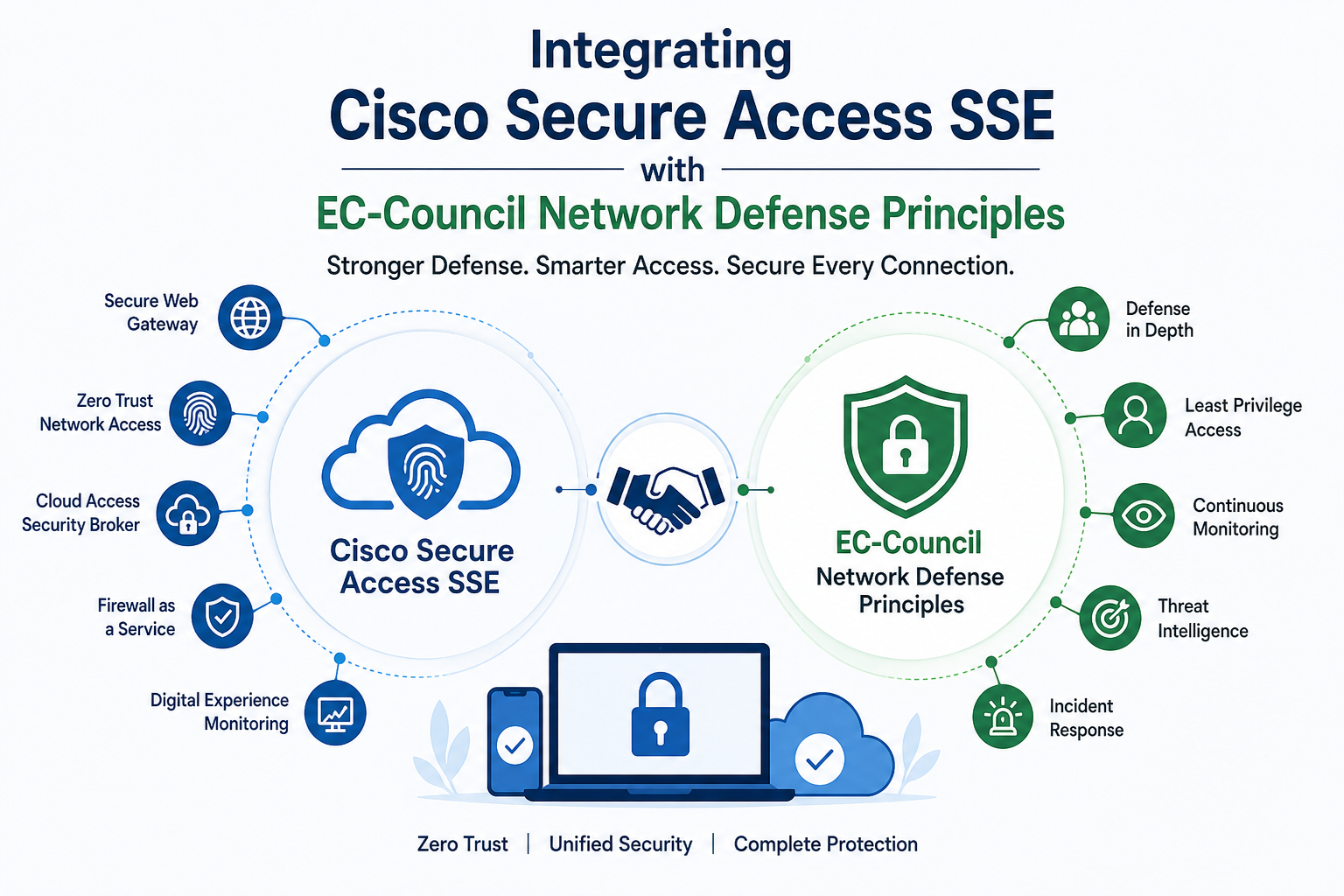
To address these evolving threats, organizations are adopting Secure Service Edge (SSE) solutions that provide cloud-delivered security regardless of user location. One of the leading platforms in this space is Cisco Secure Access SSE, which combines Zero Trust Network Access (ZTNA), Secure Web Gateway (SWG), Cloud Access Security Broker (CASB), Firewall-as-a-Service (FWaaS), and Digital Experience Monitoring into a unified security platform.
At the same time, cybersecurity professionals continue to rely on proven defensive methodologies taught through EC-Council Network Defense training. These principles emphasize proactive monitoring, layered security, risk assessment, threat detection, access control, and incident response.
When Cisco Secure Access SSE is implemented according to EC-Council Network Defense principles, organizations gain a comprehensive security framework capable of protecting modern hybrid infrastructures while maintaining visibility, compliance, and operational efficiency.
Understanding Cisco Secure Access SSE
Cisco Secure Access is Cisco’s cloud-native Security Service Edge platform designed to secure users, applications, and internet access from anywhere.
Unlike legacy VPN-based architectures, Cisco Secure Access verifies every connection before granting access. Instead of trusting users because they are inside the corporate network, every access request is continuously evaluated using Zero Trust principles.
The platform protects:
- Remote employees
- Branch offices
- Cloud applications
- SaaS platforms
- Hybrid workforces
- Third-party contractors
- Mobile devices
This approach reduces attack surfaces while improving user experience.
What are EC-Council Network Defense Principles?
EC-Council’s Network Defense framework teaches organizations how to build secure infrastructures capable of resisting modern cyberattacks.
Core principles include:
- Defense in Depth
- Zero Trust Security
- Least Privilege Access
- Continuous Monitoring
- Network Segmentation
- Threat Intelligence
- Risk Assessment
- Incident Response
- Vulnerability Management
- Security Awareness
These principles help security teams prevent attacks before they become major incidents.
Why Integrate Cisco Secure Access SSE with Network Defense Principles?
Traditional security often focuses on protecting the network perimeter. However, cloud computing and remote work have dissolved traditional boundaries.
Cisco Secure Access SSE complements EC-Council’s defensive philosophy by extending security controls directly to users, devices, and cloud services.
Benefits include:
- Stronger identity verification
- Continuous risk evaluation
- Reduced lateral movement
- Better visibility into user activity
- Simplified security management
- Improved compliance
- Faster threat detection
Zero Trust: The Foundation of Modern Network Defense
One of the strongest connections between Cisco Secure Access SSE and EC-Council Network Defense is the Zero Trust model.
Instead of assuming internal users are trustworthy, every access request must be verified.
Cisco Secure Access evaluates:
- User identity
- Device health
- Geographic location
- Login behavior
- Risk score
- Authentication strength
Only after successful verification is access granted.
This directly supports EC-Council’s recommendation of minimizing trust while continuously validating identities.
Secure Web Gateway (SWG) Enhances Network Defense
A Secure Web Gateway protects users from malicious websites, phishing attacks, malware downloads, and risky web content.
Cisco Secure Access SWG offers:
- URL filtering
- Malware detection
- SSL inspection
- DNS security
- Web content filtering
- Threat intelligence integration
These capabilities reduce the likelihood of successful phishing campaigns and malware infections.

Cloud Access Security Broker (CASB) Protects SaaS Applications
Many organizations now use cloud services like Microsoft 365, Google Workspace, Salesforce, Dropbox, and hundreds of SaaS applications.
Without visibility, sensitive corporate information can easily leak.
Cisco CASB helps organizations:
- Discover shadow IT
- Monitor cloud application usage
- Prevent sensitive data exposure
- Detect risky behavior
- Enforce security policies
- Improve compliance
This aligns perfectly with EC-Council’s emphasis on protecting organizational assets.
Zero Trust Network Access (ZTNA)
Traditional VPNs provide broad network access once users authenticate.
ZTNA changes this completely.
Instead of granting network-wide access, Cisco Secure Access provides:
- Application-specific access
- Identity verification
- Continuous authentication
- Risk-based decisions
- Least privilege enforcement
This significantly reduces lateral movement during cyberattacks.
Continuous Monitoring and Threat Detection
One of EC-Council’s most important principles is continuous monitoring.
Cisco Secure Access continuously collects security telemetry from:
- Users
- Devices
- Applications
- Network traffic
- Cloud services
- Authentication events
Machine learning analyzes this data to detect unusual activity.
Examples include:
- Impossible travel logins
- Suspicious downloads
- Unusual file sharing
- Privilege abuse
- Compromised credentials
Security teams receive alerts before attackers can cause significant damage.
Identity-Centric Security
Traditional firewalls mainly inspect IP addresses and ports.
Cisco Secure Access focuses on identities.
Every decision is based on:
- Who is accessing?
- Which device is being used?
- What application is requested?
- Where is the request coming from?
- What is the user’s risk score?
This greatly strengthens organizational security.
Data Protection and Compliance
Modern regulations require organizations to protect customer information.
Cisco Secure Access assists compliance with:
- GDPR
- HIPAA
- ISO 27001
- PCI DSS
- SOC 2
Data Loss Prevention (DLP) policies help prevent confidential information from leaving the organization.
Defense in Depth Through SSE
Defense in Depth means deploying multiple security layers instead of relying on a single technology.
Cisco Secure Access combines:
- Secure Web Gateway
- CASB
- ZTNA
- Firewall-as-a-Service
- DNS Protection
- Identity Verification
- Threat Intelligence
- DLP
Even if one layer fails, additional controls continue protecting the organization.
Supporting Hybrid Workforces
Remote work has become a permanent part of modern business.
Employees now connect from:
- Home networks
- Hotels
- Airports
- Client locations
- Mobile devices
Cisco Secure Access delivers consistent security regardless of user location.
This eliminates the need to route all traffic through centralized VPN concentrators while maintaining enterprise-grade protection.
Threat Intelligence Integration
Cisco Talos Threat Intelligence enhances Cisco Secure Access with real-time threat intelligence.
Security teams benefit from:
- Updated malware indicators
- Malicious domain detection
- IP reputation analysis
- Phishing detection
- Emerging threat visibility
Combining intelligence with EC-Council Network Defense practices enables proactive security instead of reactive incident handling.
Benefits for Security Professionals
Organizations implementing Cisco Secure Access with EC-Council Network Defense principles gain:
- Better visibility
- Faster incident response
- Improved access control
- Reduced attack surface
- Enhanced compliance
- Simplified cloud security
- Better user experience
- Stronger identity protection
- Reduced ransomware risk
- Scalable enterprise security
How FireShark Helps Organizations Strengthen Network Defense
Organizations looking to implement modern security strategies often require expert guidance beyond technology deployment. FireShark supports businesses through services such as Vulnerability Assessment and Penetration Testing (VAPT), Web Application & API Security Testing, Cloud Security & Infrastructure Hardening, Security Audits, Security Awareness Training, and cybersecurity consulting. These services complement network defense best practices by helping organizations identify vulnerabilities, improve security posture, and strengthen resilience against evolving cyber threats.
Conclusion
The cybersecurity landscape continues to evolve as organizations embrace cloud computing, remote work, and digital transformation. Traditional perimeter-based defenses alone can no longer provide adequate protection against sophisticated attacks.
Integrating Cisco Secure Access SSE with EC-Council Network Defense principles creates a modern, identity-driven security architecture built on Zero Trust, layered defense, continuous monitoring, and cloud-native protection. By combining technologies such as Secure Web Gateway, CASB, ZTNA, and Data Loss Prevention with proven network defense strategies, organizations can reduce risk, improve visibility, and secure users, applications, and data wherever they operate. This integration not only strengthens enterprise security but also prepares businesses for the challenges of today’s dynamic threat landscape.
Frequently Asked Questions (FAQs)
1. What is Cisco Secure Access SSE?
Cisco Secure Access SSE is a cloud-delivered security platform that combines Zero Trust Network Access (ZTNA), Secure Web Gateway (SWG), Cloud Access Security Broker (CASB), Firewall-as-a-Service (FWaaS), and Data Loss Prevention (DLP) to protect users, applications, and data from anywhere.
2. How does Cisco Secure Access support Zero Trust Security?
It continuously verifies user identity, device posture, location, and risk before granting application access. This “never trust, always verify” approach minimizes unauthorized access and aligns with Zero Trust security principles.
3. Why is Cisco Secure Access important for hybrid work environments?
It provides consistent security for employees working from home, branch offices, or public networks without relying solely on traditional VPNs, ensuring secure access to cloud and on-premises applications.
4. How does Cisco Secure Access align with EC-Council Network Defense principles?
It supports key network defense concepts such as defense in depth, least privilege access, continuous monitoring, network segmentation, identity-centric security, threat intelligence, and proactive risk management.
5. Who should learn about Cisco Secure Access SSE and Network Defense?
Cybersecurity professionals, SOC analysts, network administrators, security engineers, IT managers, cloud security specialists, and students pursuing cybersecurity certifications can all benefit from understanding how Cisco Secure Access SSE enhances modern network defense.