Table of Contents
Introduction
Modern organizations rely heavily on cloud-based applications, remote workforces, and distributed networks. While these technologies improve flexibility and productivity, they also expand the attack surface that cybercriminals exploit. Traditional perimeter-based security models are no longer sufficient to protect users accessing corporate resources from multiple locations and devices.
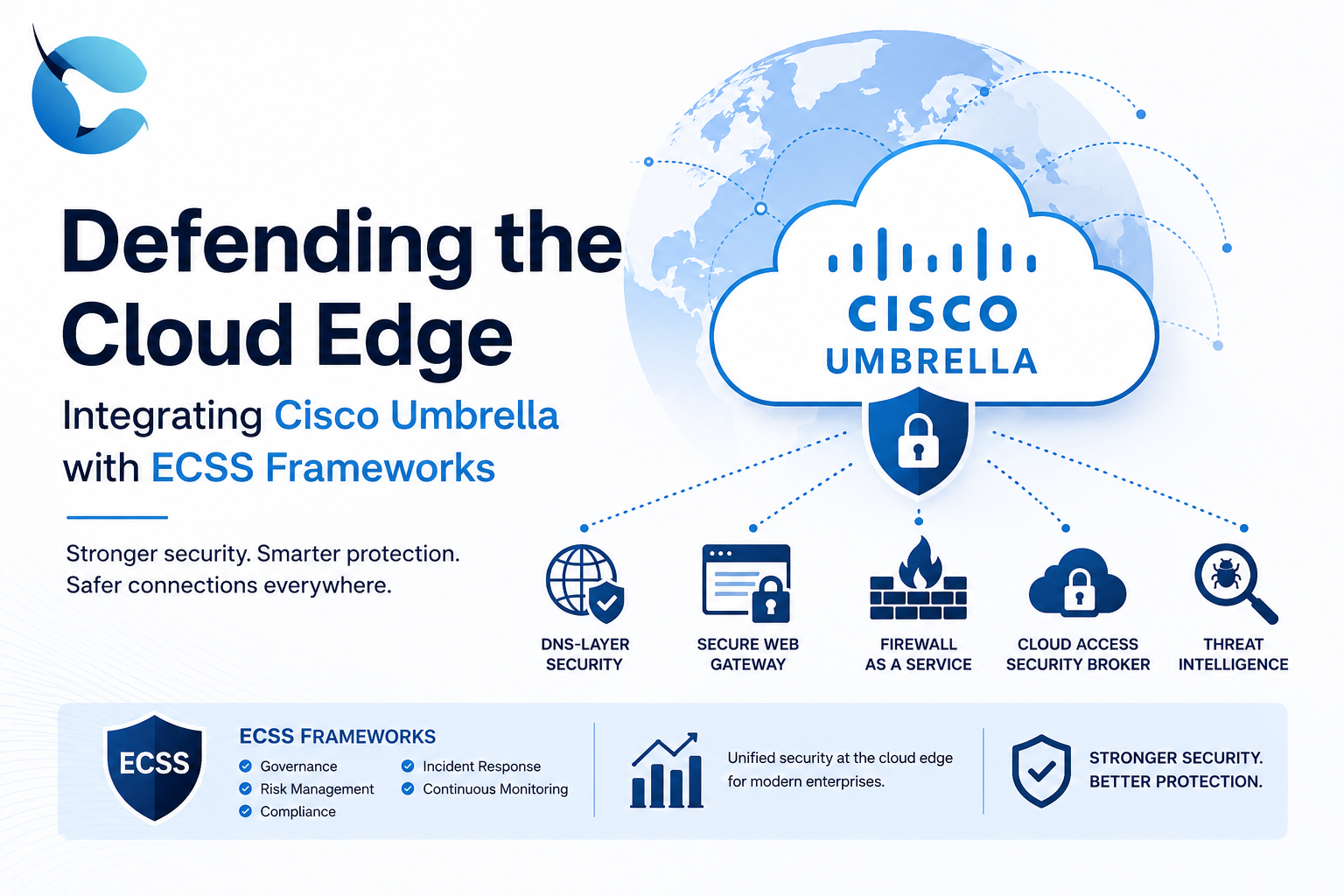
Cisco Umbrella has emerged as one of the industry’s leading cloud-delivered security platforms by providing DNS-layer protection, Secure Web Gateway (SWG), Firewall-as-a-Service (FWaaS), Cloud Access Security Broker (CASB), and threat intelligence capabilities. When integrated with ECSS frameworks, organizations can create a more resilient cloud-edge defense strategy capable of detecting, preventing, and responding to modern cyber threats.
This article explores how integrating Cisco Umbrella with ECSS frameworks improves cloud security, strengthens Zero Trust architecture, and enhances enterprise cyber resilience.
Understanding Cloud Edge Security
Cloud edge security focuses on protecting users, devices, applications, and data that operate beyond traditional network boundaries. As organizations increasingly adopt Software-as-a-Service (SaaS), Infrastructure-as-a-Service (IaaS), and hybrid cloud environments, security controls must extend beyond physical offices.
Instead of relying solely on perimeter firewalls, cloud-edge security verifies every request, continuously monitors user activity, and blocks threats before they reach enterprise resources.
Major cloud-edge risks include:
- Phishing attacks
- Malware infections
- DNS tunneling
- Ransomware
- Data exfiltration
- Insider threats
- Shadow IT
- Malicious websites
Cisco Umbrella addresses many of these risks through cloud-native security services that operate before connections are established.
What is Cisco Umbrella?
Cisco Umbrella is Cisco’s cloud-delivered cybersecurity platform that protects users wherever they connect to the internet.
Key security services include:
DNS-Layer Security
Every internet request begins with DNS. Cisco Umbrella blocks malicious domains before a connection is established, preventing malware downloads, phishing attempts, and command-and-control communications.
Secure Web Gateway (SWG)
The Secure Web Gateway filters web traffic, inspects encrypted connections, blocks malicious websites, and enforces browsing policies.
Firewall-as-a-Service (FWaaS)
Umbrella extends firewall protection into the cloud, allowing organizations to enforce network policies without relying on traditional hardware appliances.
Cloud Access Security Broker (CASB)
CASB provides visibility into cloud application usage, detects risky SaaS activity, and helps organizations control Shadow IT.
Threat Intelligence
Cisco Talos continuously feeds Cisco Umbrella with one of the world’s largest commercial threat intelligence datasets, enabling rapid detection of emerging cyber threats.
Understanding ECSS Frameworks
ECSS frameworks provide structured cybersecurity methodologies that help organizations strengthen their overall security posture. These frameworks emphasize prevention, detection, incident response, governance, continuous monitoring, and risk management.
When organizations align Cisco Umbrella with ECSS principles, security controls become standardized, measurable, and easier to manage across hybrid environments.
ECSS implementation typically focuses on:
- Security governance
- Risk assessment
- Threat intelligence
- Continuous monitoring
- Access management
- Incident response
- Compliance management
- Security awareness
This layered approach complements Cisco Umbrella’s cloud-native security capabilities.
Why Integrate Cisco Umbrella with ECSS Frameworks?
The combination delivers stronger protection than deploying individual security technologies independently.
Enhanced Threat Prevention
Cisco Umbrella blocks malicious domains at the DNS layer before malware reaches endpoints. ECSS governance ensures preventive controls are consistently applied across the organization.
Improved Visibility
Security teams gain centralized visibility into user activity, DNS requests, cloud applications, and internet traffic, allowing faster identification of suspicious behavior.
Faster Incident Response
Cisco Umbrella generates detailed security events that can feed Security Information and Event Management (SIEM) platforms. ECSS incident response processes help analysts investigate and contain threats more efficiently.
Zero Trust Security
Modern ECSS implementations promote Zero Trust principles by continuously verifying users, devices, and applications. Cisco Umbrella strengthens this model through identity-aware access policies and cloud-delivered enforcement.
Simplified Remote Workforce Protection
Employees working remotely receive the same level of DNS protection regardless of their location, reducing security gaps introduced by hybrid work environments.
Cisco Umbrella Features That Strengthen ECSS
Intelligent DNS Security
DNS requests are analyzed in real time against Cisco Talos threat intelligence. Known malicious domains are blocked instantly.
Benefits include:
- Early threat detection
- Reduced malware infections
- Protection against phishing
- Command-and-control disruption
Secure Internet Gateway
Cisco Umbrella combines DNS security, Secure Web Gateway, CASB, and Firewall-as-a-Service into a unified security platform that protects internet-bound traffic.
Threat Intelligence Integration
Continuous intelligence updates help organizations respond to new attack campaigns without waiting for manual signature updates.
Identity-Based Policies
Organizations can enforce different security policies based on users, departments, locations, or device types.
Cloud Application Visibility
Administrators gain insight into SaaS usage, helping reduce Shadow IT while improving compliance.
Architecture of Cisco Umbrella Integrated with ECSS
A typical deployment includes:
- Remote users connecting through secure DNS.
- Cisco Umbrella inspecting internet requests.
- Secure Web Gateway filtering web traffic.
- Firewall-as-a-Service enforcing security policies.
- Threat intelligence identifying malicious activity.
- SIEM collecting logs for monitoring.
- ECSS governance coordinating risk management and incident response.
This architecture delivers end-to-end protection across cloud, branch offices, and remote users.
Benefits for Modern Enterprises
Organizations integrating Cisco Umbrella with ECSS frameworks gain several strategic advantages.
Reduced Attack Surface
Malicious websites, phishing domains, and malware servers are blocked before users establish connections.
Better Compliance
Organizations can demonstrate stronger security controls while supporting compliance initiatives through centralized policy enforcement and reporting.
Operational Efficiency
Cloud-native security reduces dependence on multiple hardware appliances, simplifying deployment and management.
Improved User Experience
Security operates in the background without requiring VPN connectivity for every internet request.
Business Continuity
Early threat detection reduces downtime caused by ransomware, phishing attacks, and malware outbreaks.
IT Networking and Cybersecurity Consulting fireshark.ai
Best Practices for Implementation
Organizations should consider the following recommendations:
- Deploy Cisco Umbrella across all endpoints.
- Enable Secure Web Gateway inspection.
- Integrate identity providers such as Azure AD or Okta.
- Connect Cisco Umbrella logs to SIEM platforms.
- Regularly review DNS activity.
- Update security policies based on threat intelligence.
- Conduct periodic security awareness training.
- Align cloud security policies with ECSS governance.
Common Cyber Threats Prevented
Cisco Umbrella effectively mitigates numerous threats, including:
- Ransomware
- Phishing campaigns
- Malware downloads
- DNS hijacking
- Botnet communication
- Command-and-control traffic
- Cryptojacking
- Malicious advertisements
- Drive-by downloads
- Domain Generation Algorithm (DGA) attacks
Future of Cloud Edge Security
Cloud security continues evolving toward AI-powered detection, automated response, Zero Trust networking, and Secure Access Service Edge (SASE). Cisco Umbrella is well-positioned to support these trends by combining cloud-native protection with continuous threat intelligence. Organizations that integrate such platforms with structured ECSS frameworks can build scalable, resilient defenses against increasingly sophisticated cyber threats.
How FireShark Technologies Can Help
As organizations strengthen cloud-edge security, partnering with experienced cybersecurity professionals is essential. FireShark Technologies provides services including Vulnerability Assessment and Penetration Testing (VAPT), cloud security assessments, security awareness training, compliance consulting, and enterprise cybersecurity solutions. By combining proven frameworks with modern security platforms such as Cisco Umbrella, businesses can improve resilience against evolving cyber threats and maintain a stronger overall security posture.
Conclusion
Defending the cloud edge requires more than traditional firewalls and antivirus software. By integrating Cisco Umbrella with ECSS frameworks, organizations gain proactive DNS-layer protection, secure web filtering, advanced threat intelligence, and structured security governance. This combination helps reduce cyber risk, supports Zero Trust strategies, simplifies cloud security management, and protects users wherever they work. As cyber threats continue to evolve, adopting an integrated cloud security approach is becoming a critical component of enterprise cybersecurity.
Frequently Asked Questions
What is Cisco Umbrella?
Cisco Umbrella is a cloud-delivered cybersecurity platform that provides DNS-layer security, Secure Web Gateway, Firewall-as-a-Service, CASB, and threat intelligence to protect users from internet-based threats.
How does Cisco Umbrella improve cloud edge security?
It blocks malicious domains before connections are established, filters web traffic, enforces cloud security policies, and protects remote users regardless of their location.
What are ECSS frameworks in cybersecurity?
ECSS frameworks provide structured cybersecurity practices for governance, risk management, incident response, continuous monitoring, and compliance, helping organizations build a consistent and resilient security program.
Why should organizations integrate Cisco Umbrella with ECSS frameworks?
Integration enhances threat prevention, improves visibility into cloud activity, supports Zero Trust architectures, streamlines incident response, and strengthens overall enterprise security.
Is Cisco Umbrella suitable for remote and hybrid work environments?
Yes. Because Cisco Umbrella is cloud-delivered, it protects users on and off the corporate network, making it well suited for organizations with remote or hybrid workforces.