
Table of Contents
Introduction
GraphQL has transformed the way modern applications exchange data. Introduced by Facebook, GraphQL provides developers with a flexible query language that allows clients to request exactly the data they need, reducing over-fetching and improving performance. Today, GraphQL APIs power countless web and mobile applications, from e-commerce platforms to social media networks and enterprise systems.
However, the flexibility that makes GraphQL attractive also creates unique security challenges. Unlike traditional REST APIs, GraphQL exposes a single endpoint capable of executing complex queries, nested requests, and introspection operations. If not properly secured, attackers can exploit these features to perform denial-of-service attacks, extract sensitive information, bypass authorization mechanisms, and abuse application resources.
Understanding GraphQL vulnerabilities and implementing proper security measures is essential for protecting modern applications from increasingly sophisticated cyber threats.
Why GraphQL APIs Require Special Security Considerations
Traditional REST APIs use multiple endpoints with predefined responses. GraphQL, on the other hand, allows users to specify exactly what information they want through custom queries. While this flexibility improves efficiency, it also gives attackers more opportunities to abuse the system.
Improperly configured GraphQL implementations may expose internal schemas, allow unauthorized access to sensitive fields, and become vulnerable to resource exhaustion attacks. Since GraphQL APIs often serve as the backbone of critical applications, compromising them can lead to data breaches and service disruptions.
Organizations must therefore adopt security practices specifically designed for GraphQL environments.
Understanding Common GraphQL Vulnerabilities
Excessive Data Exposure
One of the most common GraphQL risks is excessive data exposure. Developers may unintentionally expose fields containing confidential information such as passwords, API keys, internal identifiers, or customer details.
Attackers can simply query these fields if access control mechanisms are missing or improperly implemented.
For example, a query intended to retrieve user profiles might also reveal email addresses, account status, or administrative permissions if field-level authorization is absent.
Introspection Abuse
GraphQL introspection enables developers to explore the API schema, making development and debugging easier. However, leaving introspection enabled in production environments allows attackers to map the entire API structure.
Through introspection queries, cybercriminals can discover:
- Available queries and mutations
- Hidden objects and fields
- Data relationships
- Internal naming conventions
This information can be used to launch more targeted attacks.
Denial-of-Service Through Complex Queries
GraphQL supports nested and recursive queries. Attackers can exploit this capability by sending deeply nested requests that consume excessive CPU, memory, and database resources.
A single malicious query can trigger thousands of database calls and severely impact server performance.
For example:
{
 user{
   posts{
      comments{
         author{
             posts{
                comments{
                    author{
                        posts{
                           comments{
                              text
                           }
                        }
                    }
                }
             }
         }
      }
   }
 }
}
Without limitations, such queries may overwhelm the server.
Broken Authorization
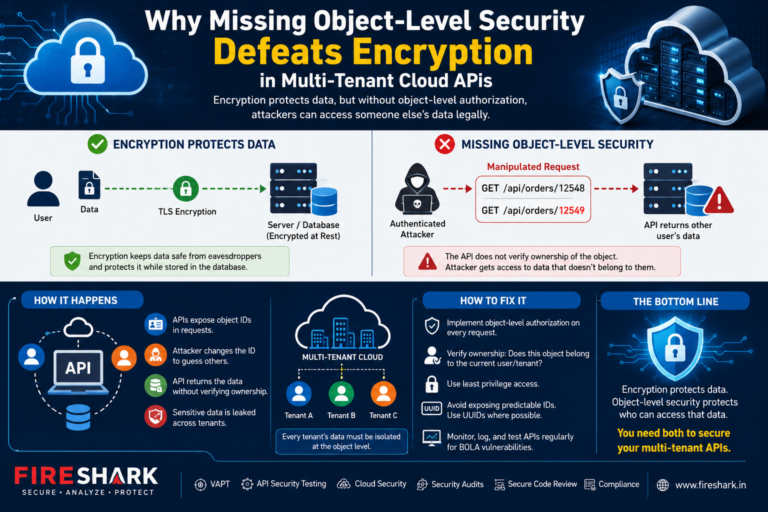
Authentication verifies who a user is, while authorization determines what they can access.
Many developers secure the API endpoint but fail to implement field-level authorization. As a result, attackers may access sensitive data simply by modifying queries.
For example, a normal user might query:
{
 user(id: "100"){
    salary
    bankDetails
}
If authorization checks are missing, confidential information becomes accessible.
Injection Attacks
GraphQL applications remain vulnerable to traditional injection attacks, including:
- SQL Injection
- NoSQL Injection
- Command Injection
- XPath Injection
Unsanitized user input inside resolvers can allow attackers to manipulate backend databases and execute malicious commands.
Batch Query Abuse
GraphQL allows multiple operations in a single request. Attackers can exploit batch queries to perform:
- Credential stuffing attacks
- Password brute-force attempts
- Enumeration attacks
This enables thousands of requests to be executed while bypassing rate limits.
Best Practices for Securing GraphQL APIs
Disable Introspection in Production
Schema introspection is useful during development but should be disabled in production environments.
Removing introspection prevents attackers from easily discovering the API structure and reduces reconnaissance opportunities.
Many GraphQL frameworks support disabling introspection through configuration settings.
Implement Strong Authentication
Every GraphQL endpoint should enforce secure authentication mechanisms such as:
- JWT tokens
- OAuth 2.0
- OpenID Connect
- Multi-factor authentication
Authentication tokens should be validated before processing queries to ensure only legitimate users can access resources.
Enforce Field-Level Authorization
Authorization should not only be implemented at the endpoint level but also at the field and resolver levels.
Different users should have access only to the data necessary for their roles.
Examples include:
- Customers viewing their own profiles.
- Employees accessing department information.
- Administrators managing privileged operations.
Role-based access control (RBAC) significantly reduces unauthorized data exposure.
Limit Query Depth
Restricting query depth prevents excessively nested queries from consuming system resources.
For example:
- Maximum depth = 5
- Maximum depth = 8
Requests exceeding these limits should be rejected automatically.
This prevents denial-of-service attacks caused by recursive requests.
Apply Query Complexity Analysis
Not all queries have equal computational cost.
GraphQL complexity analysis assigns scores based on:
- Number of fields requested
- Nested relationships
- Database operations involved
Queries exceeding a predefined threshold should be blocked.
Complexity analysis helps protect backend systems from abuse while maintaining performance.
Enable Rate Limiting
Rate limiting restricts the number of requests a client can send within a specified timeframe.
Common limits include:
- 100 requests per minute
- 1000 requests per hour
Rate limiting helps defend against:
- Brute-force attacks
- Credential stuffing
- API abuse
- Automated bots
Combining IP-based and user-based rate limiting provides stronger protection.
Validate and Sanitize User Inputs
User-supplied data should always be validated before processing.
Proper input validation prevents:
- SQL injection
- NoSQL injection
- Cross-site scripting
- Command injection
Parameterized queries and ORM frameworks add additional layers of security.
Restrict Batch Requests
Limiting the number of operations per request reduces abuse opportunities.
Many GraphQL security frameworks allow administrators to define:
- Maximum operations per request
- Request size limits
- Mutation restrictions
These controls help prevent automated attacks and credential stuffing campaigns.
Use Persisted Queries
Persisted queries allow only pre-approved queries stored on the server.
Instead of sending complete query strings, clients send query identifiers.
Benefits include:
- Reduced attack surface.
- Improved performance.
- Protection against malicious query manipulation.
- Better caching capabilities.
Persisted queries are particularly useful for mobile and enterprise applications.
Secure Error Messages
Detailed error messages often reveal sensitive information such as:
- Database structures
- File paths
- Stack traces
- Internal server configurations
Instead of exposing technical details, production APIs should return generic responses like:
{
 "error":"Request failed"
}
Detailed logs should remain accessible only to administrators.
Monitor and Log API Activity
Continuous monitoring helps detect suspicious behavior early.
Organizations should log:
- Failed authentication attempts
- Unusual query patterns
- Excessive request volumes
- Authorization failures
- Mutation activities
Security Information and Event Management (SIEM) platforms can automate threat detection and incident response.
Encrypt Communications Using HTTPS
GraphQL traffic should always be encrypted using TLS.
HTTPS prevents attackers from intercepting:
- Authentication tokens
- Session cookies
- User credentials
- Sensitive API responses
Without encryption, man-in-the-middle attacks become possible.
Regular Security Testing
Security assessments should include:
- Vulnerability scanning
- Penetration testing
- API fuzzing
- Dependency analysis
- Source code reviews
Tools commonly used for GraphQL security testing include:
- Burp Suite
- GraphQL Voyager
- InQL
- OWASP ZAP
- Postman
Regular testing helps identify weaknesses before attackers exploit them.
The Role of API Gateways and Web Application Firewalls
API gateways provide centralized security controls for GraphQL services.
Capabilities include:
- Authentication enforcement
- Request validation
- Rate limiting
- Traffic monitoring
- Access control
Web Application Firewalls (WAFs) can detect and block malicious GraphQL requests before they reach backend systems.
Combining API gateways with WAF protection significantly improves overall security posture.
How FireShark Helps Secure Modern APIs
As GraphQL adoption grows, organizations need specialized security expertise to protect their APIs from evolving threats. FireShark provides services such as:
- Web Application and API Security Testing
- Vulnerability Assessment and Penetration Testing (VAPT)
- Cloud Security and Infrastructure Hardening
- Security Audits and Compliance Services
- Incident Response and Threat Intelligence
Through comprehensive assessments and continuous monitoring, FireShark helps businesses identify GraphQL vulnerabilities before attackers can exploit them.
Conclusion
GraphQL offers tremendous flexibility and efficiency, making it a preferred technology for modern applications. However, its powerful features also introduce security risks that differ from traditional REST APIs. Excessive data exposure, introspection abuse, denial-of-service attacks, broken authorization, and injection vulnerabilities can all threaten application security if left unaddressed.
By implementing strong authentication, field-level authorization, query depth limits, complexity analysis, rate limiting, persisted queries, and continuous monitoring, organizations can significantly reduce their attack surface and ensure their GraphQL APIs remain resilient against cyber threats.
As APIs continue to become the backbone of digital services, securing GraphQL environments is no longer optional—it is a fundamental requirement for protecting sensitive data and maintaining trust in today’s interconnected world.
FAQs
1. Why are GraphQL APIs more vulnerable than REST APIs?
GraphQL APIs allow flexible queries and nested requests, which can expose sensitive data and increase the risk of denial-of-service attacks if proper security controls are not implemented.
2. Should GraphQL introspection be disabled?
Yes. Introspection should be disabled in production environments because it can reveal the API schema and help attackers map application structures.
3. What is query depth limiting in GraphQL?
Query depth limiting restricts how deeply nested a query can be, preventing resource exhaustion and denial-of-service attacks.
4. How do persisted queries improve GraphQL security?
Persisted queries allow only pre-approved requests, reducing the possibility of malicious query manipulation and improving performance.
5. Which tools are commonly used for GraphQL security testing?
Popular tools include Burp Suite, OWASP ZAP, InQL, Postman, and GraphQL Voyager for identifying vulnerabilities and analyzing API behavior.