
Table of Contents
Introduction
APIs have become the backbone of modern applications. Whether you are using online banking, shopping on an e-commerce platform, booking a ride, or accessing a cloud application, APIs silently power almost every interaction behind the scenes. As organizations continue adopting microservices, mobile applications, cloud computing, and AI-powered services, the number of APIs exposed to the internet has grown dramatically.
However, this rapid API expansion has introduced a new generation of security challenges. Among them, Broken Object Level Authorization (BOLA) has consistently remained the most dangerous and commonly exploited vulnerability affecting APIs. Year after year, security researchers and penetration testers continue to discover BOLA vulnerabilities across organizations of every size—from startups to multinational enterprises.
Unlike sophisticated zero-day exploits that require advanced technical skills, BOLA attacks often involve nothing more than changing an object identifier in an API request. This simplicity makes the vulnerability particularly attractive to attackers while making it surprisingly difficult for organizations to detect before damage occurs.
Understanding why Broken Object Level Authorization continues to dominate API security rankings requires looking beyond technical implementation errors. It reflects deeper issues in application architecture, development practices, identity management, and the growing complexity of modern software ecosystems.
Understanding Object-Level Authorization
Before understanding the vulnerability, it’s important to understand what an object is in an API.
Every API manages resources or objects such as:
- User profiles
- Orders
- Payment records
- Medical reports
- Documents
- Messages
- Customer accounts
- Images
- Employee information
Each object belongs to a specific user or organization.
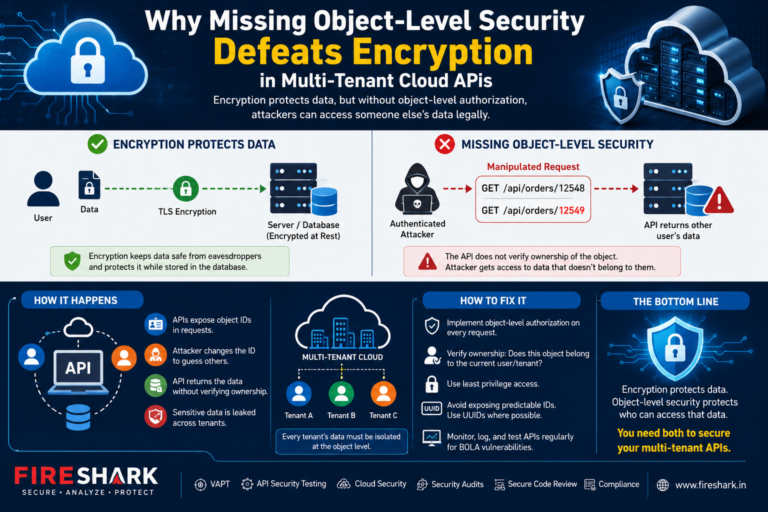
For example, imagine an API endpoint:
GET /api/users/2458/profileThe object here is the user profile with ID 2458.
If the logged-in user owns profile 2458, the API should return the data.
However, if another user changes the request to:
GET /api/users/2459/profilethe server must verify whether the requester actually owns or has permission to access object 2459.
If the server returns the data without checking ownership, Broken Object Level Authorization exists.
The vulnerability occurs because the application trusts the object identifier instead of validating the user’s authorization.
Why BOLA Is So Dangerous
Unlike SQL injection or malware attacks, BOLA does not exploit software bugs in the traditional sense.
Instead, it exploits missing business logic.
The application may correctly authenticate users through:
- Username and password
- OAuth tokens
- JWT authentication
- Multi-factor authentication
Yet authentication alone does not guarantee authorization.
A user may be completely authenticated while still accessing someone else’s information.
This distinction makes BOLA particularly dangerous because organizations often assume authentication automatically provides sufficient security.
Attackers simply ask:
“Can I access another object’s data?”
If the answer is yes, the API is vulnerable.
A Simple Real-World Example
Imagine an online banking application.
A logged-in customer accesses their account:
GET /accounts/10025The API returns:
{
  "Account":"10025",
  "Balance":"₹85,000"
}
Now suppose the attacker changes the URL:
GET /accounts/10026If the API returns another customer’s account details without verifying ownership, confidential financial information becomes exposed.
No passwords were stolen.
No malware was installed.
No encryption was broken.
The attacker simply changed one number.
This illustrates why BOLA is often considered one of the easiest yet most devastating API vulnerabilities.
Why APIs Are Particularly Vulnerable
Traditional web applications often hide internal identifiers behind user interfaces.
APIs expose them directly.
Developers frequently use identifiers like:
User IDs

Invoice Numbers

Order IDs

Product IDs

Customer IDs

UUIDs

Employee IDs
Attackers inspect API traffic using tools such as browser developer tools, API clients, or proxy tools.
Once they identify the API structure, they begin testing different identifiers.
For example:
/api/orders/101
/api/orders/102
/api/orders/103
/api/orders/104
If authorization is missing, each request may reveal another user’s data.
Because APIs are designed for automation, attackers can enumerate thousands of object IDs within minutes.
How Attackers Discover BOLA Vulnerabilities
Attackers rarely begin by launching sophisticated attacks.
Instead, they observe normal API communication.
Typical steps include:
- Logging into the application.
- Capturing API requests.
- Identifying object identifiers.
- Modifying those identifiers.
- Observing server responses.
- Automating successful requests.
For example:
Original request:
GET /api/documents/5101Modified request:
GET /api/documents/5102If the server responds successfully, authorization checks are likely missing.
The simplicity of this process explains why BOLA vulnerabilities are frequently discovered during penetration testing.
Common Industries Affected
Broken Object Level Authorization affects virtually every industry because APIs power almost every digital service.
Financial Services
Banks and fintech companies expose APIs for:
- Accounts
- Loans
- Credit cards
- Investments
- Transactions
A BOLA vulnerability may expose confidential financial records.
Healthcare
Healthcare APIs manage:
- Patient records
- Medical history
- Prescriptions
- Laboratory reports
- Insurance information
Unauthorized access can violate patient privacy and regulatory requirements.
E-Commerce
Online stores expose:
- Orders
- Shipping addresses
- Payment history
- Customer profiles
- Loyalty points
Attackers may view or modify another customer’s purchases.
Education
Educational platforms store:
- Student grades
- Attendance
- Assignments
- Certificates
- Personal information
Improper authorization may expose sensitive student data.
SaaS Platforms
Software-as-a-Service applications often support multiple customers within one environment.
Missing tenant isolation can expose one company’s confidential information to another organization.
Why Developers Accidentally Create BOLA
Most developers understand authentication.
Authorization is far more complicated.
Common mistakes include:
Assuming Authentication Is Enough
Developers verify that a JWT token is valid but forget to verify object ownership.
The request becomes:
Valid user
+
Valid token
=
Access granted
Ownership verification never occurs.
Trusting Client-Side Data
Some applications assume the client will only request authorized objects.
Attackers never follow these assumptions.
Every request can be modified.
Reusing Generic Endpoints
Large applications often share authorization middleware across dozens of APIs.
If one endpoint bypasses the middleware, the vulnerability appears.
Complex Business Rules
Modern applications include:
- Administrators
- Managers
- Customers
- Vendors
- Support staff
- Third-party integrations
Each role has unique permissions.
Managing thousands of authorization rules becomes increasingly difficult.
The Business Impact
Organizations often underestimate the consequences of BOLA.
The damage can include:
- Customer data breaches
- Financial fraud
- Regulatory penalties
- GDPR compliance violations
- HIPAA violations
- Loss of customer trust
- Brand reputation damage
- Legal action
- Intellectual property theft
Because attackers access legitimate API endpoints, traditional security monitoring may not immediately detect the activity.
Why Traditional Security Tools Miss BOLA
Firewalls cannot determine whether a user owns an object.
Intrusion Detection Systems see normal API traffic.
Encryption protects data in transit but not against unauthorized access.
Even Web Application Firewalls may allow the requests because they appear perfectly legitimate.
The problem lies inside the application’s authorization logic—not the network layer.
Preventing Broken Object Level Authorization
Preventing BOLA requires enforcing authorization on every request rather than trusting user authentication alone.
Organizations should:
- Verify object ownership before returning any resource.
- Apply server-side authorization checks for every endpoint.
- Implement role-based or attribute-based access control consistently.
- Avoid exposing predictable sequential identifiers where practical; opaque identifiers can reduce casual enumeration but do not replace authorization.
- Perform regular API security testing and code reviews.
- Maintain an inventory of all APIs, including shadow APIs.
- Log and monitor access to sensitive objects, looking for unusual patterns such as sequential ID access attempts.
- Include authorization testing in the software development lifecycle.
Security testing should specifically verify that a user cannot access another user’s resources simply by changing an identifier.
The Role of API Security Testing
Modern API security assessments should go beyond checking authentication.
Security teams should validate:
- Horizontal privilege escalation
- Vertical privilege escalation
- Tenant isolation
- Object ownership
- Resource permissions
- Business logic flaws
- Access control consistency
Automated scanners can help identify potential issues, but manual testing remains essential because authorization rules are often tied to business logic that automated tools may not fully understand.
Why BOLA Continues to Rank as the Top API Security Risk
Despite advances in API gateways, identity providers, and security platforms, BOLA remains widespread because it stems from application design rather than infrastructure.
Modern systems expose thousands of endpoints across mobile apps, web applications, partner integrations, and microservices. As these ecosystems grow, ensuring that every endpoint performs correct authorization checks becomes increasingly challenging.
Attackers know this. They do not need advanced exploits when a simple change to an object identifier can reveal sensitive information. As long as applications continue to rely on incomplete authorization logic, BOLA will remain one of the most critical API security risks organizations face.
Conclusion
Broken Object Level Authorization is more than a coding mistake—it is a fundamental access control failure that allows authenticated users to reach resources they should never see. Because it exploits business logic rather than technical weaknesses, it often slips past traditional security tools and remains difficult to detect without focused testing.
As organizations expand their API footprint to support cloud services, mobile applications, AI integrations, and connected ecosystems, robust object-level authorization must become a core design principle rather than an afterthought. By validating authorization on every request, continuously testing APIs, and embedding secure access control into the development lifecycle, businesses can significantly reduce the risk of data breaches and build APIs that users can trust.
Frequently Asked Questions (FAQs)
1. What is Broken Object Level Authorization (BOLA)?
Broken Object Level Authorization (BOLA) is an API security vulnerability that occurs when an application fails to verify whether an authenticated user is authorized to access a specific object or resource. As a result, attackers can manipulate object identifiers (such as user IDs or order IDs) to access data belonging to other users.
2. Why is BOLA considered the most critical API security vulnerability?
BOLA is considered the most critical API security flaw because it directly exposes sensitive data without requiring attackers to bypass authentication. A simple modification to an API request can grant unauthorized access to customer information, financial records, medical data, or business documents if proper authorization checks are missing.
3. How is Broken Object Level Authorization different from authentication?
Authentication verifies who the user is, while authorization determines what the user is allowed to access. A user may successfully log in with valid credentials but still should not be able to view or modify resources owned by other users. BOLA occurs when the application authenticates the user but fails to enforce proper authorization.
4. How can organizations prevent Broken Object Level Authorization?
Organizations can reduce the risk of BOLA by enforcing server-side authorization checks for every API request, validating object ownership before returning data, implementing Role-Based Access Control (RBAC) or Attribute-Based Access Control (ABAC), conducting regular API security testing, and continuously monitoring API activity for suspicious access patterns.
5. Can API gateways or Web Application Firewalls (WAFs) prevent BOLA attacks?
Not completely. API gateways and Web Application Firewalls can help secure APIs by filtering malicious traffic and enforcing authentication policies, but they cannot determine whether a user is authorized to access a specific object. Since BOLA is a business logic vulnerability, effective protection requires proper authorization checks within the application’s backend code.