Introduction
Cyber threats have become more sophisticated than ever before. Modern attackers no longer rely solely on simple malware or phishing emails; they employ advanced persistent threats (APTs), fileless attacks, ransomware, insider threats, and AI-assisted cyberattacks that can evade traditional security tools. Because of this evolution, organizations can no longer depend solely on reactive security measures. Instead, proactive threat hunting has become an essential component of modern cybersecurity operations.
Threat hunting is the process of actively searching enterprise environments for hidden threats that have bypassed automated detection systems. Rather than waiting for alerts, security analysts investigate suspicious behaviors, unusual patterns, and indicators of compromise before attackers can cause significant damage.
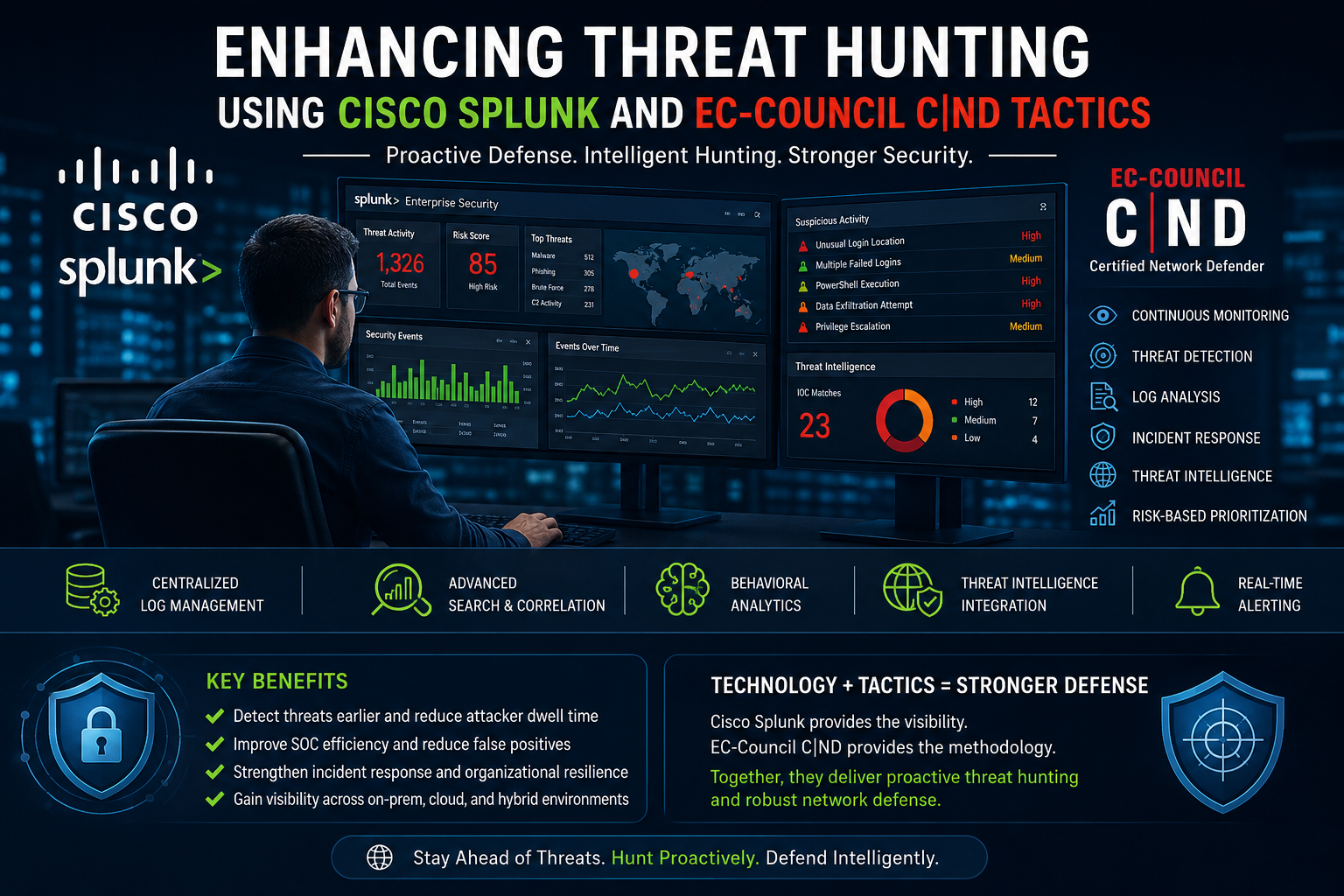
Cisco Splunk provides one of the industry’s most powerful Security Information and Event Management (SIEM) platforms for collecting, correlating, and analyzing security logs in real time. When combined with the methodologies taught in the EC-Council Certified Network Defender (C|ND) program, organizations gain a structured approach for detecting, investigating, and responding to cyber threats effectively.
This article explores how Cisco Splunk and EC-Council C|ND tactics work together to enhance threat hunting capabilities while improving overall cyber resilience.
Understanding Modern Threat Hunting
Threat hunting goes beyond responding to alerts generated by antivirus software or firewalls. It involves continuously searching for hidden malicious activities that automated detection mechanisms may overlook.
Unlike traditional monitoring systems that rely on known signatures, threat hunters use behavioral analytics, anomaly detection, threat intelligence, and historical log analysis to uncover sophisticated attacks.
Modern threat hunting focuses on identifying:
- Advanced Persistent Threats (APTs)
- Insider threats
- Credential theft
- Privilege escalation
- Lateral movement
- Data exfiltration
- Ransomware activity
- Command and Control (C2) communication
Organizations adopting proactive hunting strategies significantly reduce attacker dwell time and minimize business impact.
Why Cisco Splunk is Powerful for Threat Hunting
Cisco Splunk serves as the central nervous system of many Security Operations Centers (SOC). It collects logs from firewalls, endpoints, cloud services, identity platforms, applications, and network devices into a centralized environment for advanced analysis.
Some of its major capabilities include real-time log ingestion, behavioral analytics, custom dashboards, machine learning, automated alerting, and threat intelligence integration.
Security analysts can correlate millions of daily events across multiple data sources to identify attack patterns that would otherwise remain invisible.
Key capabilities include:
Real-Time Log Correlation
Splunk correlates logs from different systems to identify suspicious sequences of events, helping analysts detect attacks spanning multiple devices or users.
Behavioral Analytics
Instead of relying only on signatures, Splunk analyzes user and device behavior to detect anomalies such as unusual login times, abnormal file access, or unexpected privilege changes.
Threat Intelligence Integration
Cisco Splunk integrates external threat intelligence feeds containing malicious IP addresses, domains, hashes, and Indicators of Compromise (IOCs), allowing security teams to quickly identify known threats.
Advanced Search Using SPL
Security analysts use Splunk Processing Language (SPL) to investigate suspicious activity, search historical logs, and uncover hidden attack chains.
EC-Council C|ND Tactics That Strengthen Threat Hunting
The EC-Council Certified Network Defender (C|ND) certification emphasizes practical defensive security techniques required by modern SOC teams.
Rather than focusing solely on penetration testing, C|ND teaches defenders how to continuously monitor, detect, investigate, and respond to attacks.
Some important tactics include:
Continuous Network Monitoring
C|ND promotes continuous monitoring instead of periodic security reviews. Continuous visibility helps organizations detect malicious activities much earlier.
Log Analysis
Effective defenders understand how to analyze authentication logs, firewall logs, endpoint telemetry, DNS records, VPN logs, and server activity to identify attack patterns.
Incident Response
Threat hunting is only valuable if organizations know how to respond effectively. C|ND teaches structured incident response processes including containment, eradication, recovery, and lessons learned.
Threat Intelligence
Analysts learn how to enrich investigations with external intelligence sources to validate suspicious indicators.
Risk-Based Prioritization
Not every alert deserves equal attention. C|ND teaches analysts how to prioritize incidents based on business risk and potential impact.

Combining Cisco Splunk with EC-Council C|ND
The real strength comes from combining Cisco Splunk’s analytical capabilities with C|ND’s defensive methodologies.
For example, Splunk may identify multiple failed login attempts from different geographic locations. A C|ND-trained analyst would correlate these logs with authentication records, VPN activity, endpoint telemetry, and privilege changes to determine whether a credential attack is underway.
Similarly, abnormal PowerShell execution detected by Splunk can be investigated using C|ND methodologies to determine whether it represents legitimate administration or malicious lateral movement.
This combination transforms raw security data into actionable intelligence.
Common Threat Hunting Scenarios
Organizations using Cisco Splunk frequently investigate scenarios such as ransomware infections, insider threats, suspicious PowerShell execution, privilege escalation attempts, lateral movement, data exfiltration, unusual DNS activity, phishing attacks, cloud account compromise, and unauthorized administrative access.
Each investigation begins with data collection, followed by hypothesis creation, log correlation, behavioral analysis, threat validation, and incident response.
Benefits for Security Operations Centers
Security Operations Centers benefit from this integrated approach in multiple ways.
Threats are detected earlier before significant damage occurs. Security teams experience fewer false positives because investigations rely on multiple correlated data sources rather than isolated alerts. Analysts also become more efficient through automation, dashboards, and standardized investigative procedures.
Organizations additionally improve compliance, strengthen incident response, enhance visibility across hybrid environments, and reduce attacker dwell time.
Best Practices for Effective Threat Hunting
Successful threat hunting requires more than deploying technology. Organizations should establish clear hunting hypotheses, continuously collect high-quality logs, maintain updated threat intelligence feeds, automate repetitive tasks, validate alerts through multiple data sources, conduct regular threat hunting exercises, and train analysts on evolving attacker techniques.
Continuous improvement is essential because cyber threats constantly evolve.
How FireShark Helps Organizations Improve Threat Hunting
Organizations looking to strengthen their cybersecurity posture can benefit from comprehensive security services that complement proactive threat hunting strategies. FireShark Technologies provides solutions such as Vulnerability Assessment and Penetration Testing (VAPT), Web Application and API Security Testing, Network Security Assessments, Cloud Security, Security Awareness Training, Incident Response Support, and Cybersecurity Consulting.
In addition, cybersecurity professionals can build practical defensive skills through training programs aligned with industry-recognized certifications such as EC-Council C|ND, helping teams better understand modern detection, monitoring, and response techniques.
Future of Threat Hunting
Artificial Intelligence, Machine Learning, User Behavior Analytics, Extended Detection and Response (XDR), Security Orchestration Automation and Response (SOAR), and cloud-native security platforms are reshaping threat hunting.
Cisco Splunk continues integrating AI-driven analytics that help analysts prioritize alerts and identify hidden attack patterns faster.
Meanwhile, defensive training frameworks like EC-Council C|ND ensure security professionals understand the methodologies required to investigate increasingly sophisticated cyber threats.
Organizations adopting both advanced technology and skilled personnel will remain significantly better prepared against future attacks.
Conclusion
Threat hunting has evolved into one of the most important cybersecurity practices for modern enterprises. Reactive security alone is no longer sufficient against advanced attackers who continuously adapt their techniques to bypass traditional defenses.
Cisco Splunk provides powerful visibility, analytics, and investigation capabilities, while EC-Council C|ND delivers structured defensive methodologies that help analysts identify and respond to sophisticated threats efficiently.
Together, these technologies and practices create a proactive security strategy capable of reducing cyber risk, improving incident response, and strengthening organizational resilience. As cyber threats continue to evolve, investing in advanced threat hunting capabilities and continuous defender training is essential for every organization seeking long-term security.
Frequently Asked Questions (FAQs)
1. What is threat hunting in cybersecurity?
Threat hunting is the proactive process of searching networks, endpoints, cloud environments, and security logs to identify hidden cyber threats that may have bypassed automated security controls. Instead of waiting for alerts, security analysts investigate suspicious behaviors using threat intelligence, behavioral analytics, and historical log analysis to detect attacks at an early stage.
2. How does Cisco Splunk improve threat hunting?
Cisco Splunk enhances threat hunting by centralizing logs from multiple security devices and applications into a single platform where analysts can perform real-time monitoring, behavioral analysis, custom searches, and correlation of events. This helps security teams detect sophisticated attacks such as ransomware, insider threats, credential theft, and lateral movement much faster than traditional monitoring methods.
3. What is the EC-Council C|ND certification?
The EC-Council Certified Network Defender (C|ND) certification focuses on defensive cybersecurity skills. It teaches professionals how to monitor networks, analyze logs, detect attacks, investigate incidents, respond to cyber threats, and implement security controls that strengthen enterprise defense. It is designed for SOC analysts, network administrators, and cybersecurity professionals responsible for protecting organizational infrastructure.
4. Can beginners learn Cisco Splunk and EC-Council C|ND together?
Yes. Beginners with a basic understanding of networking and cybersecurity concepts can learn both technologies together. Cisco Splunk provides practical experience in security monitoring and log analysis, while EC-Council C|ND builds foundational knowledge of network defense, threat detection, incident response, and security operations. Learning both creates a strong pathway toward a career in Security Operations Centers (SOC).
5. Why are Cisco Splunk and EC-Council C|ND effective together?
Cisco Splunk supplies the technical platform for collecting and analyzing security data, whereas EC-Council C|ND provides the investigative methodologies needed to interpret that data and respond effectively. Together, they enable organizations to detect threats proactively, reduce attacker dwell time, improve incident response efficiency, and strengthen overall cybersecurity resilience.