Introduction
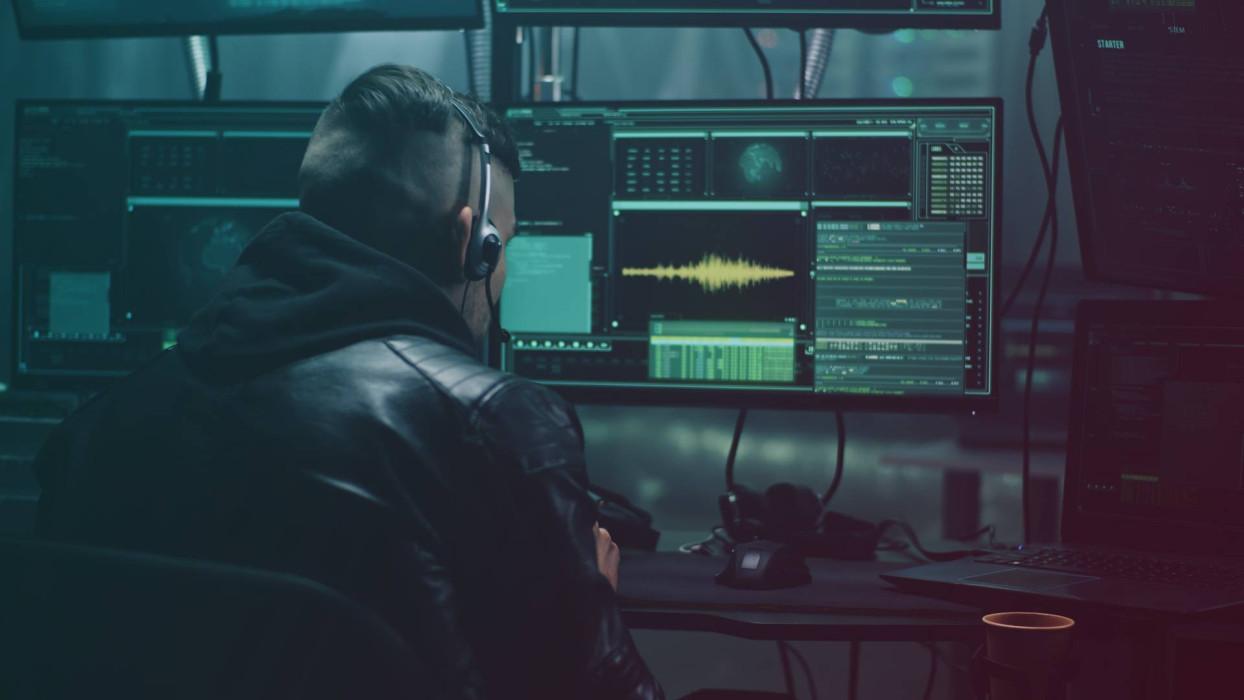
Artificial Intelligence has transformed businesses by automating customer support, enhancing accessibility, and improving communication. However, the same technology is now being weaponized by cybercriminals. Among the fastest-growing threats is AI voice cloning, a technology capable of replicating a person’s voice with astonishing accuracy after analyzing only a few seconds of recorded speech.
What once required sophisticated audio studios and professional impersonators can now be accomplished using publicly available AI tools. This has introduced a dangerous new attack vector against enterprise help desks, where identity verification often depends on spoken conversations, security questions, or familiarity with an employee’s voice.
Modern organizations invest heavily in firewalls, endpoint security, multi-factor authentication, and employee awareness training. Yet attackers increasingly target the weakest link—the human element. Help desk personnel are trusted to solve employee problems quickly, making them attractive targets for social engineering. When AI-generated voices are added to traditional social engineering tactics, even experienced support agents may struggle to distinguish genuine employees from sophisticated impostors.
This article explores how AI voice cloning works, why enterprise help desks are particularly vulnerable, how attackers execute these campaigns, the real-world risks businesses face, and the security measures organizations should implement to defend against this rapidly evolving threat.
Understanding AI Voice Cloning
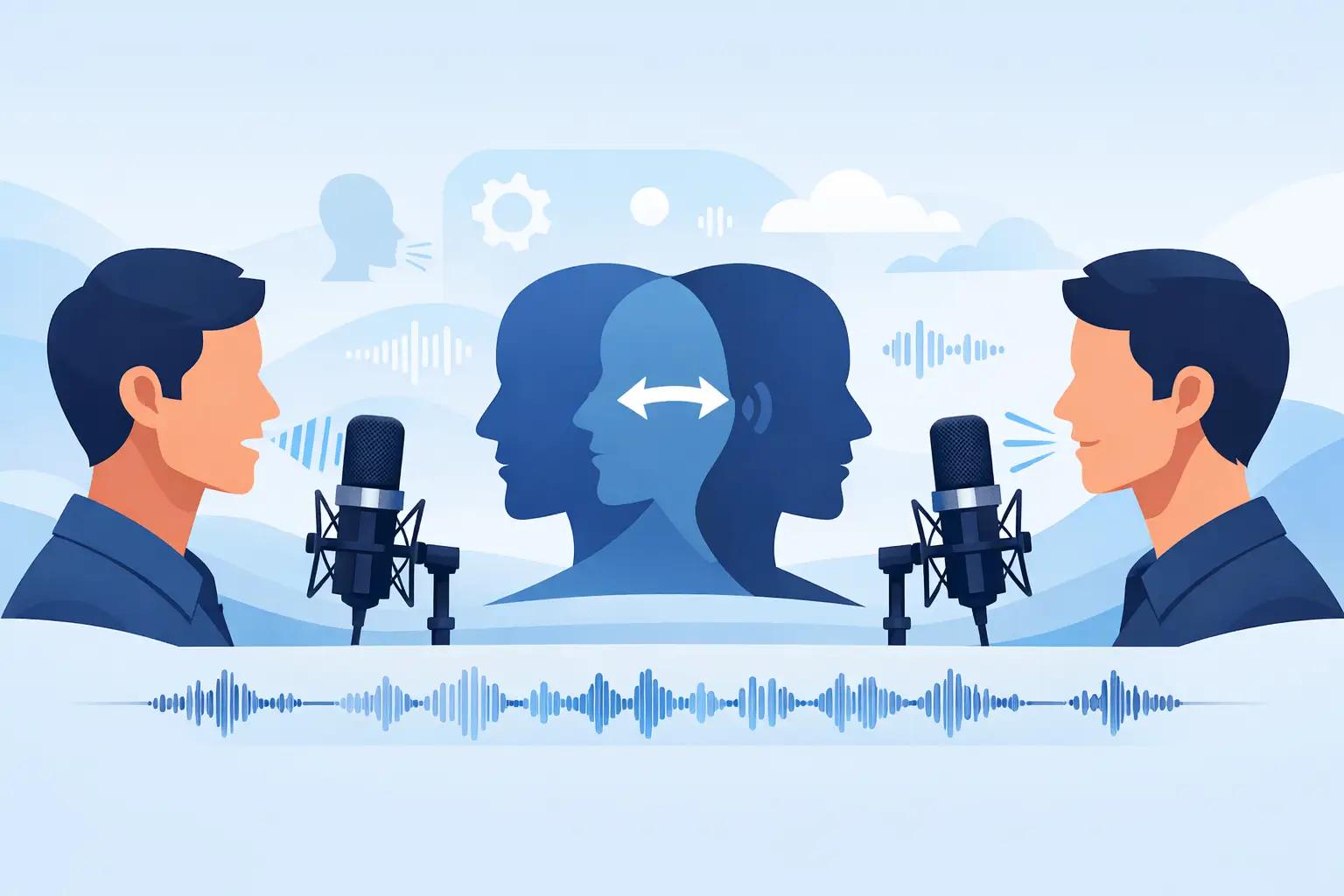
AI voice cloning is a branch of generative artificial intelligence that recreates a person’s unique speaking style, tone, pronunciation, accent, and emotional expression using deep learning models.
Unlike older text-to-speech systems that sounded robotic, modern voice cloning platforms produce speech that is nearly indistinguishable from real human voices.
The technology generally works by:
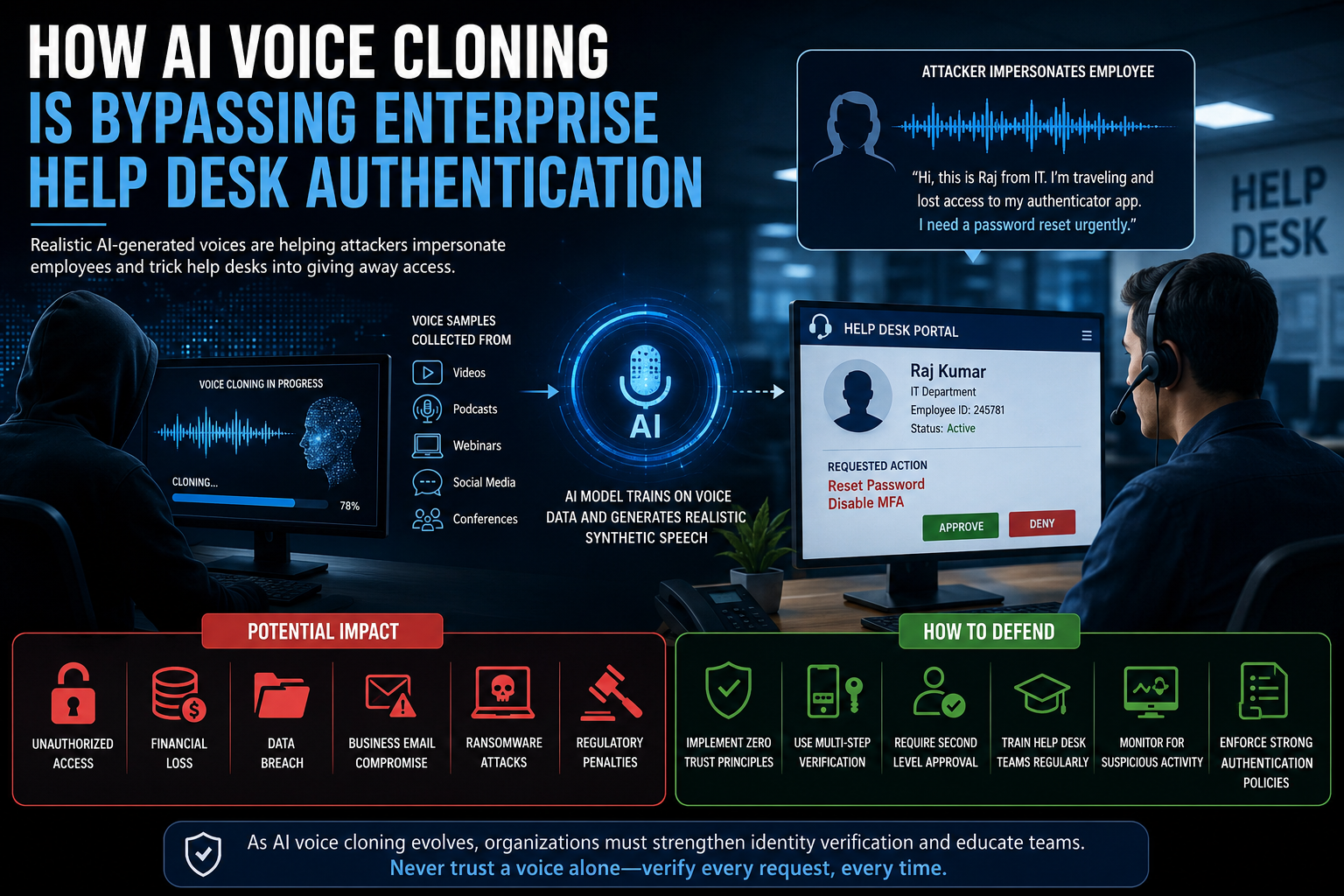
- Collecting voice samples from videos, podcasts, meetings, webinars, or social media.
- Training AI models to recognize vocal characteristics.
- Generating synthetic speech from typed text.
- Producing realistic conversations in real time.
Many employees unknowingly publish hours of high-quality voice recordings online through company presentations, YouTube videos, LinkedIn interviews, podcasts, webinars, virtual conferences, and training sessions. Every recording becomes valuable training material for cybercriminals.
Why Enterprise Help Desks Are Prime Targets
Enterprise help desks perform numerous privileged operations every day. Support agents regularly reset passwords, unlock accounts, modify authentication methods, update contact information, and provide access to sensitive systems.
Their primary objective is helping employees regain productivity quickly. Because of this customer-service mindset, help desk teams often prioritize speed and convenience over extensive verification.
Attackers understand this.
If they successfully impersonate an employee, they may convince the help desk to:
- Reset Active Directory passwords
- Disable Multi-Factor Authentication (MFA)
- Register a new authentication device
- Update recovery phone numbers
- Change email addresses
- Unlock privileged accounts
- Issue temporary credentials
- Provide VPN access
- Modify identity verification settings
A single successful help desk interaction can provide attackers with full access to an organization’s internal infrastructure.
How Attackers Gather Voice Samples
Voice cloning attacks rarely begin with technical hacking. Instead, attackers perform extensive reconnaissance.
They search for publicly available recordings from:
- Company webinars
- LinkedIn videos
- YouTube channels
- Conference presentations
- Podcasts
- Earnings calls
- Online interviews
- Corporate training sessions
- Social media stories
- Internal recordings leaked online
Executives, IT administrators, HR managers, and sales leaders are particularly attractive targets because they frequently speak publicly.
Even a short recording lasting under a minute may be sufficient for today’s AI systems to generate convincing voice clones.
A Typical Voice Cloning Attack Against an Enterprise Help Desk
The attack often unfolds in carefully planned stages.
First, attackers collect information about the organization through LinkedIn, company websites, press releases, employee directories, and social media.
Next, they clone the voice of a targeted employee using publicly available AI tools.
Before calling the help desk, they gather additional personal information such as job title, manager’s name, office location, recent projects, and employee ID from open-source intelligence.
When the call begins, the cloned voice sounds authentic. The attacker creates urgency by claiming they have lost their phone, are traveling, or are unable to access their authentication application.
A typical conversation might sound like this:
“Hi, this is Michael from Finance. I’m traveling and my phone was stolen. I urgently need my VPN account reset before today’s board meeting.”
The support representative hears the familiar voice and receives correct answers to several verification questions.
Believing the caller is genuine, the help desk resets credentials or disables MFA.
Within minutes, the attacker gains access to corporate resources.
Why Traditional Authentication Methods Are Failing
Many organizations still rely on outdated identity verification techniques during phone support.
These commonly include:
- Voice recognition by the support agent
- Employee ID
- Date of birth
- Manager’s name
- Department
- Office location
- Security questions
- Last login information
Unfortunately, much of this information is publicly available or can be obtained through phishing, data breaches, or social engineering.
When combined with AI-generated speech, these methods become significantly less reliable.
Voice familiarity—which humans naturally trust—becomes a weakness rather than a security measure.
Psychological Manipulation Makes These Attacks More Dangerous
Voice cloning alone is rarely enough.
Attackers combine it with classic social engineering techniques.
They deliberately create stress by mentioning urgent deadlines, executive meetings, customer emergencies, or system outages.
Support agents often experience pressure to resolve issues quickly.
An attacker may also:
- Mention internal terminology.
- Refer to actual colleagues.
- Discuss recent company announcements.
- Mimic speaking habits.
- Reproduce emotional expressions.
- Pretend to be frustrated or anxious.
These psychological elements reduce suspicion and increase the likelihood of successful account compromise.
Business Impact of Successful Voice Cloning Attacks
Unauthorized System Access
Compromised credentials provide attackers with access to sensitive corporate resources.
Financial Fraud
Attackers may initiate fraudulent transactions after gaining privileged access.
Data Theft
Customer records, intellectual property, source code, contracts, and confidential documents become exposed.
Business Email Compromise
Attackers frequently use compromised accounts to launch internal phishing campaigns.
Ransomware Deployment
Administrative credentials obtained through help desk impersonation may enable ransomware operators to spread malware across enterprise networks.
Regulatory Penalties
Organizations handling regulated data may face compliance violations, legal action, and financial penalties following successful attacks.
Industries at Greatest Risk
Although every organization faces some level of exposure, several industries are particularly attractive targets:
- Banking and Financial Services
- Healthcare
- Government Agencies
- Insurance Companies
- Technology Firms
- Telecommunications
- Cloud Service Providers
- Manufacturing Enterprises
- Legal Organizations
- Educational Institutions
These sectors frequently handle sensitive information and maintain large help desk operations supporting thousands of employees.
Detecting AI Voice Cloning Attacks
Security teams should watch for unusual indicators, including:
- Requests involving extreme urgency
- Multiple authentication reset attempts
- Calls originating from unexpected locations
- Employees requesting MFA removal
- Recently changed recovery information
- Multiple failed identity verification attempts
- Repeated password reset requests
- Suspicious timing outside normal working hours
Behavioral monitoring often reveals attacks that voice analysis alone cannot detect.
Best Practices for Defending Enterprise Help Desks
The most effective defense is adopting a Zero Trust approach to identity verification. Every caller should be treated as unverified until proven otherwise, regardless of how familiar their voice sounds.
Organizations should replace voice-based trust with stronger verification methods such as identity verification through secure mobile applications, cryptographic authentication, hardware security keys, or verified self-service identity portals.
Help desk agents should never disable MFA or reset privileged accounts solely based on information provided during a phone call. High-risk requests should require secondary approval or manager verification through an independent communication channel.
Security awareness training should also evolve. Employees and support staff must understand that a familiar voice is no longer reliable evidence of identity. Regular simulations involving AI-assisted social engineering can help teams recognize modern attack techniques.
Continuous monitoring, detailed logging, and anomaly detection can further reduce risk by identifying unusual authentication requests, repeated account recovery attempts, or unexpected changes to authentication settings.
Organizations can also implement voice biometric systems that analyze characteristics beyond audible speech, though even these should not be used as the sole authentication factor.
The Future of Voice-Based Social Engineering
AI voice cloning technology continues to improve rapidly. Future attacks are expected to include real-time multilingual conversations, emotional adaptation, background noise simulation, and integration with AI chat systems that can conduct convincing interactive dialogues.
As these capabilities advance, traditional phone-based identity verification will become increasingly vulnerable. Enterprises that continue relying on voice recognition, personal knowledge questions, or agent intuition alone are likely to face greater security risks.
The future of enterprise authentication lies in layered identity verification, strong cryptographic methods, continuous authentication, and adaptive risk-based access controls rather than trust in what a caller sounds like.
Conclusion
AI voice cloning has fundamentally changed the landscape of social engineering. What was once a simple phone conversation can now become the starting point for a major cybersecurity incident. Enterprise help desks, designed to assist employees efficiently, have become attractive targets because attackers exploit human trust instead of technical vulnerabilities.
Defending against this threat requires organizations to rethink authentication processes, strengthen verification procedures, train help desk personnel to recognize AI-enabled deception, and adopt modern identity security frameworks. By assuming that voices can be cloned and implementing layered security controls, businesses can significantly reduce the likelihood of successful impersonation attacks and better protect their critical systems, sensitive data, and digital identities.
FAQ
1. What is AI voice cloning in cybersecurity?
AI voice cloning uses artificial intelligence to create highly realistic synthetic speech that mimics a person’s voice, allowing attackers to impersonate employees during phone-based authentication.
2. Why are enterprise help desks vulnerable to voice cloning attacks?
Help desks often prioritize quick assistance and may rely on voice recognition or easily obtainable personal information, making them susceptible to sophisticated impersonation attempts.
3. Can AI voice cloning bypass multi-factor authentication?
AI voice cloning cannot directly break MFA, but attackers may use it to convince help desk agents to reset passwords, disable MFA, or enroll a new authentication device.
4. How can organizations protect against AI voice cloning attacks?
Organizations should implement Zero Trust identity verification, require multi-step verification for sensitive requests, train help desk staff on AI-enabled social engineering, and monitor for suspicious authentication activities.
5. Which industries are most at risk from AI voice cloning?
Industries such as banking, healthcare, government, technology, telecommunications, legal services, manufacturing, and cloud providers are especially vulnerable because they manage sensitive data and maintain large help desk operations.