Introduction
Artificial Intelligence has transformed the cybersecurity landscape. While organizations are rapidly adopting AI to improve threat detection and automate security operations, cybercriminals are leveraging the same technology to launch faster, smarter, and more sophisticated attacks. From AI-generated phishing campaigns to intelligent malware capable of adapting in real time, today’s cyber threats are becoming increasingly difficult to detect using traditional security methods.
This shift has created a growing demand for cybersecurity professionals who understand both offensive and defensive applications of AI. Organizations no longer seek professionals who simply know networking or vulnerability scanning; they require security teams capable of identifying AI-assisted attacks before they compromise critical infrastructure.
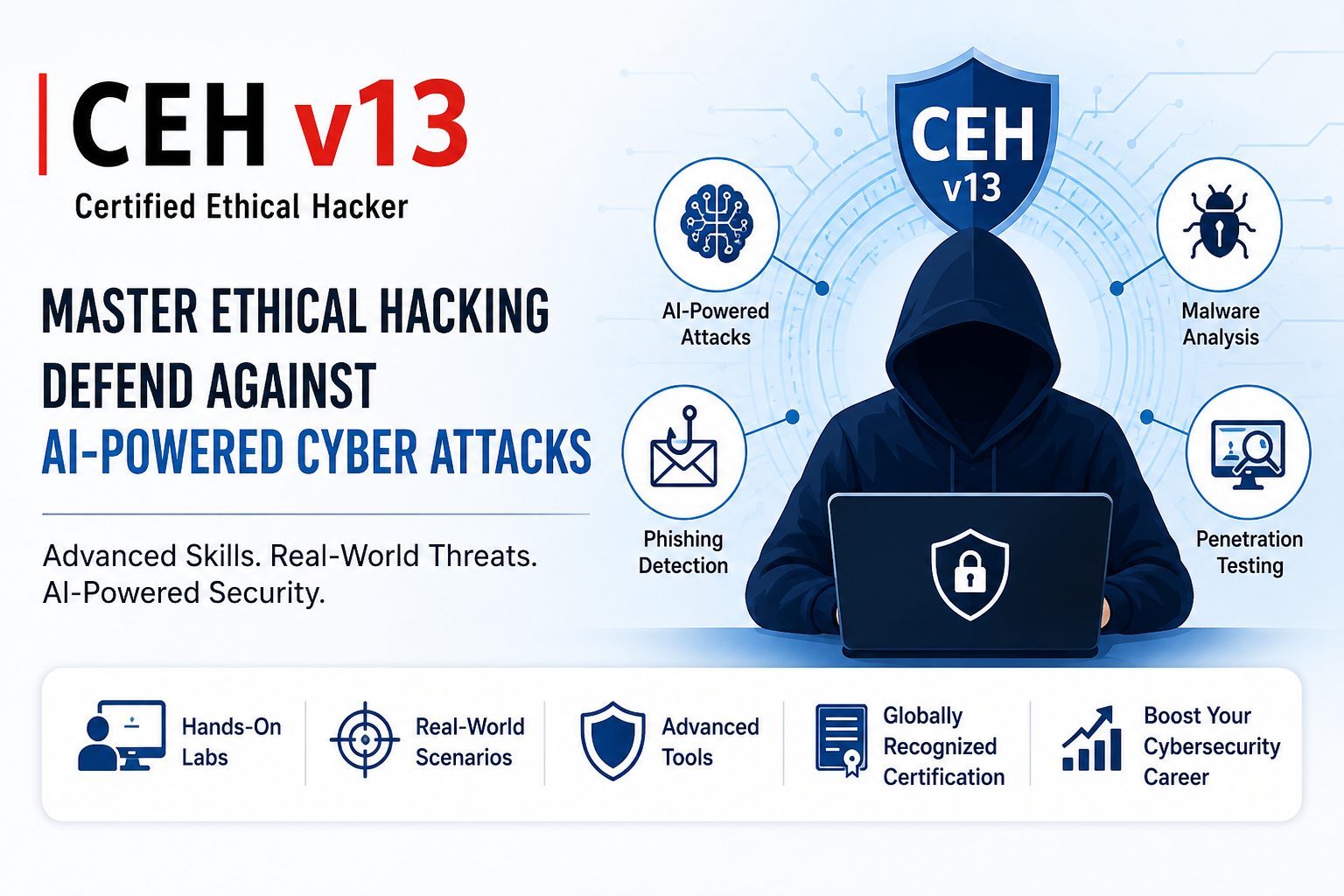
This is where Certified Ethical Hacker (CEH v13) becomes highly valuable. Unlike traditional cybersecurity courses, CEH v13 integrates Artificial Intelligence into ethical hacking methodologies, enabling learners to understand how attackers use AI and how defenders can counter these advanced threats.
Whether you’re an aspiring ethical hacker, penetration tester, SOC analyst, security engineer, or IT professional, CEH v13 provides practical skills designed specifically for the modern cyber battlefield.
The Rise of AI-Powered Cyber Attacks
Why AI Has Changed Cybersecurity Forever
Cyber attacks today are no longer entirely manual. AI enables attackers to automate reconnaissance, generate convincing phishing emails, write malicious scripts, discover vulnerabilities faster, and even evade security solutions.
Instead of spending weeks preparing an attack, attackers can now use generative AI and machine learning tools to significantly reduce preparation time while increasing the chances of success.
Some examples include:
- AI-generated phishing emails
- Deepfake voice impersonation
- AI-assisted malware
- Automated password attacks
- Intelligent vulnerability discovery
- AI-powered social engineering
- Adaptive ransomware
- AI botnets
These threats evolve rapidly, making continuous cybersecurity education essential.
Why Traditional Security Training Is No Longer Enough
Traditional security courses often focus on known attack techniques and static defenses. However, AI-powered attacks constantly evolve, requiring security professionals to think like modern adversaries.
Organizations now expect cybersecurity teams to:
- Detect sophisticated attacks
- Analyze AI-assisted malware
- Perform advanced penetration testing
- Understand attacker methodologies
- Secure cloud environments
- Respond to AI-enhanced phishing
- Use AI-based security tools effectively
CEH v13 addresses these modern requirements through updated modules and practical labs.
What Makes CEH v13 Different?
CEH v13 is the latest version of EC-Council’s globally recognized ethical hacking certification. One of its biggest improvements is the integration of Artificial Intelligence into ethical hacking practices.
Instead of only teaching classic penetration testing techniques, CEH v13 introduces learners to AI-assisted cybersecurity workflows that reflect today’s threat landscape.
The course combines theory with practical experience, helping students understand both attack methodologies and defensive strategies.
Key areas include:
- Ethical hacking methodologies
- Network security
- Web application security
- Cloud security
- Wireless security
- Malware analysis
- Threat intelligence
- AI-assisted reconnaissance
- Incident response
- Vulnerability assessment
Certified Ethical Hacker (CEHv13 AI) I-Lab (6 Months)- https://links.fireshark.in/ceh-i-lab
Understanding AI from an Attacker’s Perspective
One of the strongest aspects of CEH v13 is teaching professionals how attackers actually use AI.
Rather than simply discussing Artificial Intelligence conceptually, the course demonstrates realistic scenarios where AI improves offensive capabilities.
Students learn how attackers:
- Collect OSINT faster
- Automate reconnaissance
- Generate phishing content
- Create malicious scripts
- Analyze targets
- Discover vulnerabilities
- Evade detection
- Improve persistence
Understanding these tactics allows defenders to build stronger security controls.

Hands-On Labs Build Real Skills
One major reason CEH v13 remains valuable is its emphasis on practical learning.
Instead of memorizing concepts, learners perform realistic cybersecurity exercises inside controlled environments.
These labs simulate:
- Network penetration testing
- Vulnerability scanning
- Web application exploitation
- Password attacks
- Malware investigation
- Wireless attacks
- Cloud assessments
- Social engineering simulations
Hands-on practice helps security professionals respond confidently during real incidents.
AI Helps Attackers—So Defenders Must Use AI Too
Modern cybersecurity increasingly relies on AI-driven detection systems.
Security teams today work with technologies capable of:
- Detecting anomalies
- Identifying malicious behavior
- Automating threat hunting
- Prioritizing vulnerabilities
- Accelerating incident response
CEH v13 introduces professionals to these evolving concepts, helping them understand how AI enhances defensive security operations.
Preparing Security Teams for Real-World Incidents
Cybersecurity is not just about finding vulnerabilities—it is about responding effectively when attacks occur.
CEH v13 strengthens incident response capabilities by helping learners understand:
- Attack lifecycle
- Threat intelligence
- Indicators of compromise
- Malware behavior
- Lateral movement
- Privilege escalation
- Persistence mechanisms
- Digital evidence collection
These skills improve coordination between penetration testers, SOC analysts, and incident response teams.
Building a Strong Ethical Hacking Mindset
Technical skills alone do not create effective security professionals.
CEH v13 encourages analytical thinking, problem-solving, and ethical decision-making. Learners are trained to approach systems as attackers would while maintaining professional and legal standards.
This mindset helps organizations proactively identify weaknesses before cybercriminals exploit them.
Certified Ethical Hacker Exam Voucher – CEHv13 AI- https://links.fireshark.in/cehv13-exam-voucher
Career Opportunities After CEH v13
Organizations across industries are investing heavily in cybersecurity talent with ethical hacking expertise.
Professionals completing CEH v13 often pursue roles such as:
- Ethical Hacker
- Penetration Tester
- Security Analyst
- SOC Analyst
- Vulnerability Assessment Engineer
- Cybersecurity Consultant
- Incident Response Analyst
- Threat Hunter
- Security Engineer
- Red Team Specialist
As AI-powered cyber threats continue to grow, these roles are expected to remain in high demand.

Why Businesses Should Invest in CEH v13 Training
Organizations benefit significantly when their security teams possess modern ethical hacking skills.
A well-trained team can:
- Detect attacks earlier
- Reduce incident response time
- Improve vulnerability management
- Strengthen compliance efforts
- Enhance security awareness
- Perform proactive assessments
- Minimize financial losses
- Build stronger cyber resilience
Investing in cybersecurity training is often far less expensive than recovering from a successful cyberattack.
FireShark Technologies: Supporting Modern Cybersecurity Training
Organizations seeking practical cybersecurity learning often complement certifications with real-world security services and hands-on exposure. Providers such as FireShark Technologies offer training programs, vulnerability assessment and penetration testing (VAPT), cloud security assessments, SOC monitoring, incident response support, and cybersecurity consulting. Combining structured certification like CEH v13 with practical industry experience helps security teams translate theory into operational skills.
Conclusion
Artificial Intelligence has fundamentally changed the nature of cyber threats. Attackers now use automation, machine learning, and generative AI to launch increasingly advanced attacks that traditional security approaches often struggle to detect.
To defend against these evolving risks, organizations require professionals who understand both ethical hacking and AI-assisted cybersecurity techniques.
CEH v13 bridges this gap by combining modern ethical hacking methodologies, practical penetration testing, hands-on labs, AI-focused concepts, and real-world attack simulations into one comprehensive certification. It prepares individuals not only to identify vulnerabilities but also to anticipate how intelligent attackers think and operate.
As businesses continue embracing digital transformation, cloud computing, and AI technologies, investing in advanced cybersecurity education such as CEH v13 is becoming an essential step toward building resilient and future-ready security teams.
Frequently Asked Questions (FAQs)
1. What is CEH v13?
CEH v13 (Certified Ethical Hacker Version 13) is an advanced ethical hacking certification that teaches professionals how to identify, test, and secure systems against modern cyber threats, including AI-assisted attacks.
2. Does CEH v13 include Artificial Intelligence topics?
Yes. CEH v13 introduces AI concepts relevant to cybersecurity, including how attackers leverage AI and how defenders can use AI-enhanced security practices to improve threat detection and response.
3. Is CEH v13 suitable for beginners?
Individuals with a basic understanding of networking, operating systems, and cybersecurity fundamentals can benefit from CEH v13. The course progresses from foundational concepts to advanced ethical hacking techniques.
4. What jobs can I get after earning CEH v13?
Common career paths include Ethical Hacker, Penetration Tester, SOC Analyst, Security Analyst, Cybersecurity Consultant, Threat Hunter, Incident Response Analyst, and Security Engineer.
5. Why is CEH v13 important for AI-powered cyber attacks?
Because cybercriminals increasingly use Artificial Intelligence to automate reconnaissance, phishing, malware development, and evasion techniques, CEH v13 equips security professionals with practical knowledge and hands-on experience to recognize, analyze, and defend against these evolving threats.