Introduction
Cyber threats have become more sophisticated than ever before. Organizations are no longer dealing with isolated malware attacks or simple phishing campaigns. Modern attackers use multi-stage techniques that target endpoints, cloud environments, email systems, identities, and networks simultaneously. Traditional security tools often struggle to correlate these events, resulting in delayed detection and slower incident response.
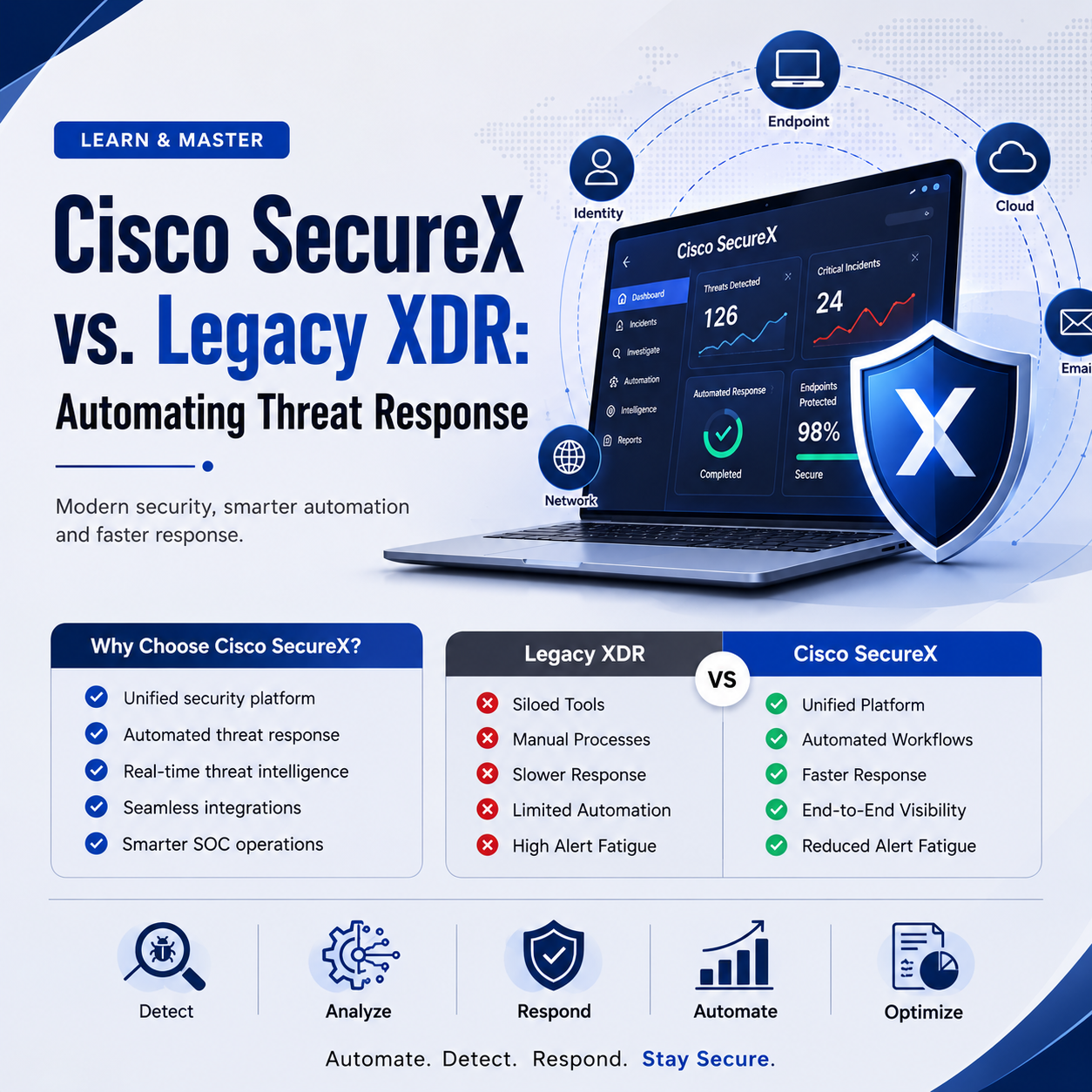
This is where Extended Detection and Response (XDR) platforms have transformed enterprise cybersecurity. While traditional or legacy XDR solutions focused primarily on collecting alerts from different security products, modern platforms such as Cisco SecureX go several steps further by integrating automation, orchestration, threat intelligence, and AI-assisted workflows into a single ecosystem.
Understanding the differences between Cisco SecureX vs Legacy XDR is essential for organizations planning to modernize their Security Operations Center (SOC), reduce alert fatigue, and improve overall cyber resilience.
Understanding Legacy XDR
Legacy XDR emerged as an improvement over standalone Endpoint Detection and Response (EDR) solutions. Instead of monitoring only endpoints, it attempted to combine telemetry from multiple security products.
Typical capabilities included:
- Endpoint monitoring
- Basic alert correlation
- Threat detection
- Centralized event collection
- Limited reporting
While this represented a significant advancement over isolated security tools, many organizations soon discovered several limitations.
Legacy XDR often required manual investigation after alerts were generated. Security analysts needed to switch between different dashboards, verify threat intelligence manually, and coordinate response actions separately. As organizations expanded their cloud infrastructure, remote workforce, and SaaS applications, these manual processes became increasingly inefficient.
What is Cisco SecureX?
Cisco SecureX is Cisco’s cloud-native security platform designed to unify visibility across an organization’s security infrastructure while automating repetitive security tasks.
Rather than acting as another standalone security tool, SecureX connects multiple Cisco and third-party security solutions into one centralized operational platform.
Its primary objectives include:
- Unified security visibility
- Automated incident response
- Threat intelligence integration
- Cross-platform orchestration
- Workflow automation
- Faster SOC operations
Instead of forcing analysts to investigate alerts manually, SecureX automatically gathers context from multiple security products, enriches alerts with threat intelligence, and launches predefined response workflows.
The Biggest Difference: Automation
The largest distinction between Cisco SecureX and traditional XDR platforms lies in automation.
Legacy XDR mainly focuses on identifying suspicious behavior and notifying analysts.
Cisco SecureX goes much further by helping organizations respond automatically.
For example, if a malicious attachment is detected:
Legacy XDR Process
- Detect malware
- Generate alert
- Analyst investigates
- Analyst validates
- Analyst isolates endpoint
- Analyst blocks IP
- Analyst updates firewall
This process may take hours.
Cisco SecureX Process
- Detect malware
- Automatically enrich threat data
- Identify affected devices
- Isolate endpoint
- Block malicious domains
- Update firewall rules
- Notify SOC team
- Create incident ticket
The same workflow can often be completed within minutes.
Explore- academy.fireshark.in
Unified Security Visibility
Modern enterprises use numerous security solutions, including:
- Firewalls
- Email security
- Endpoint protection
- Cloud security
- Identity management
- DNS security
- Vulnerability scanners
Legacy XDR platforms frequently struggle to present a unified operational picture because integrations may be limited or require custom configurations.
Cisco SecureX aggregates data from multiple security technologies into a centralized dashboard.
Security analysts gain visibility into:
- User activity
- Device health
- Threat indicators
- Network traffic
- Email attacks
- Cloud workloads
- Security incidents
This comprehensive visibility helps analysts understand the complete attack chain rather than isolated alerts.
Threat Intelligence Integration
Threat intelligence is essential for determining whether an alert represents a genuine attack or a false positive.
Legacy XDR platforms may rely on limited threat feeds or require analysts to manually verify suspicious indicators.
Cisco SecureX continuously enriches alerts using global threat intelligence, providing information such as:
- Known malicious IP addresses
- Malicious domains
- File reputation
- Malware families
- Attack techniques
- Threat actor associations
This contextual information enables security teams to prioritize high-risk incidents more effectively.
Workflow Automation Reduces Alert Fatigue
One of the biggest challenges faced by SOC analysts is alert fatigue.
Large enterprises may receive thousands of security alerts every day.
Many alerts are duplicates, low priority, or false positives.
Cisco SecureX reduces analyst workload through automated workflows that:
- Merge duplicate alerts
- Prioritize critical incidents
- Gather investigation evidence
- Launch predefined response actions
- Notify relevant teams
- Document incident timelines
Instead of spending hours on repetitive tasks, analysts can focus on advanced threat hunting and incident investigation.
Third-Party Integration
Modern cybersecurity environments rarely rely on a single vendor.
Legacy XDR platforms often provide limited integration capabilities.
Cisco SecureX supports integration with various technologies, including:
- Microsoft security products
- Google Workspace
- AWS
- Azure
- Splunk
- ServiceNow
- VMware
- Okta
- Duo Security
- Cisco Secure Firewall
- Cisco Secure Endpoint
This flexibility allows organizations to maximize the value of their existing security investments.

AI-Assisted Security Operations
Artificial Intelligence is becoming increasingly important in cybersecurity.
Cisco SecureX enhances security operations by assisting analysts with:
- Threat prioritization
- Alert correlation
- Automated investigations
- Security recommendations
- Incident enrichment
- Risk assessment
Rather than replacing human analysts, AI accelerates their decision-making and reduces investigation time.
Faster Incident Response
The average cost of a cyberattack increases significantly when detection and response are delayed.
Cisco SecureX minimizes response time by automating:
- Endpoint isolation
- Firewall updates
- Domain blocking
- IOC sharing
- Threat hunting
- User notifications
- Case creation
- Workflow documentation
Rapid response reduces attacker dwell time and limits the potential impact of breaches.
Cisco SecureX vs Legacy XDR Comparison
| Feature | Legacy XDR | Cisco SecureX |
|---|---|---|
| Alert Correlation | Basic | Advanced |
| Automation | Limited | Extensive |
| Threat Intelligence | Partial | Integrated |
| Incident Response | Mostly Manual | Automated |
| Dashboard | Multiple Consoles | Unified View |
| AI Assistance | Minimal | Enhanced |
| Workflow Automation | Limited | Comprehensive |
| Third-Party Integration | Moderate | Extensive |
| SOC Efficiency | Moderate | High |
| Investigation Speed | Slow | Fast |
Benefits of Cisco SecureX
Organizations adopting Cisco SecureX can expect several operational improvements:
- Faster threat detection
- Reduced incident response times
- Improved analyst productivity
- Lower alert fatigue
- Better visibility across hybrid environments
- Automated security workflows
- Stronger threat intelligence integration
- Simplified SOC management
- Enhanced compliance reporting
- Improved overall cyber resilience
Best Practices for Implementing Cisco SecureX
To maximize the benefits of Cisco SecureX:
- Integrate all major security products into the SecureX platform.
- Develop automated response workflows for common attack scenarios.
- Regularly update threat intelligence feeds.
- Continuously review and optimize automation playbooks.
- Train SOC analysts to leverage orchestration and automation features effectively.
- Monitor workflow performance and adjust based on evolving threats.
- Test automated incident response processes through regular simulations.
Who Should Consider Cisco SecureX?
Cisco SecureX is particularly beneficial for:
- Large enterprises
- Financial institutions
- Healthcare organizations
- Government agencies
- Educational institutions
- Managed Security Service Providers (MSSPs)
- Organizations with hybrid cloud environments
- Companies operating 24/7 Security Operations Centers
Conclusion
As cyber threats become faster, more complex, and increasingly automated, organizations require security platforms capable of responding at the same speed. Legacy XDR solutions represented an important evolution in threat detection, but their reliance on manual investigation and limited automation can slow response efforts.
Cisco SecureX addresses these challenges by combining centralized visibility, automated workflows, integrated threat intelligence, and extensive third-party integrations into a unified platform. By reducing manual effort, accelerating incident response, and improving SOC efficiency, it enables security teams to focus on proactive defense rather than repetitive tasks.
For organizations looking to strengthen their cybersecurity posture, adopting a modern automated security platform like Cisco SecureX can significantly improve resilience against today’s evolving threat landscape.
Frequently Asked Questions (FAQs)
1. What is the primary difference between Cisco SecureX and Legacy XDR?
The biggest difference is automation. Legacy XDR primarily detects and correlates threats, while Cisco SecureX automates investigations, enriches alerts with threat intelligence, and executes response actions across integrated security tools.
2. Does Cisco SecureX only work with Cisco products?
No. Although it integrates deeply with Cisco’s security portfolio, Cisco SecureX also supports many third-party security products and cloud services, allowing organizations to unify diverse security environments.
3. How does Cisco SecureX reduce alert fatigue?
Cisco SecureX automates repetitive tasks such as alert enrichment, duplicate alert reduction, threat prioritization, evidence collection, and incident response, enabling analysts to focus on high-priority investigations.
4. Is Cisco SecureX suitable for small and medium-sized businesses?
Yes. Businesses of various sizes can benefit from its centralized visibility and automation capabilities, especially if they manage multiple security solutions or operate hybrid cloud environments.
5. Can Cisco SecureX improve incident response time?
Absolutely. By automating tasks like endpoint isolation, firewall updates, IOC sharing, and ticket creation, Cisco SecureX significantly reduces the time required to detect, investigate, and respond to cyber threats.