Introduction
Artificial Intelligence is reshaping enterprise infrastructure faster than ever before. Organizations are adopting AI-powered applications, cloud-native environments, containers, Kubernetes clusters, edge computing, and hybrid cloud architectures to improve business efficiency. While these technologies unlock innovation, they also introduce complex security challenges that traditional security systems struggle to handle.
Modern cyber threats are no longer limited to malware or phishing attacks. Attackers now exploit APIs, cloud workloads, AI models, software supply chains, and containerized applications. Static firewalls and signature-based detection systems cannot keep pace with these rapidly evolving threats.
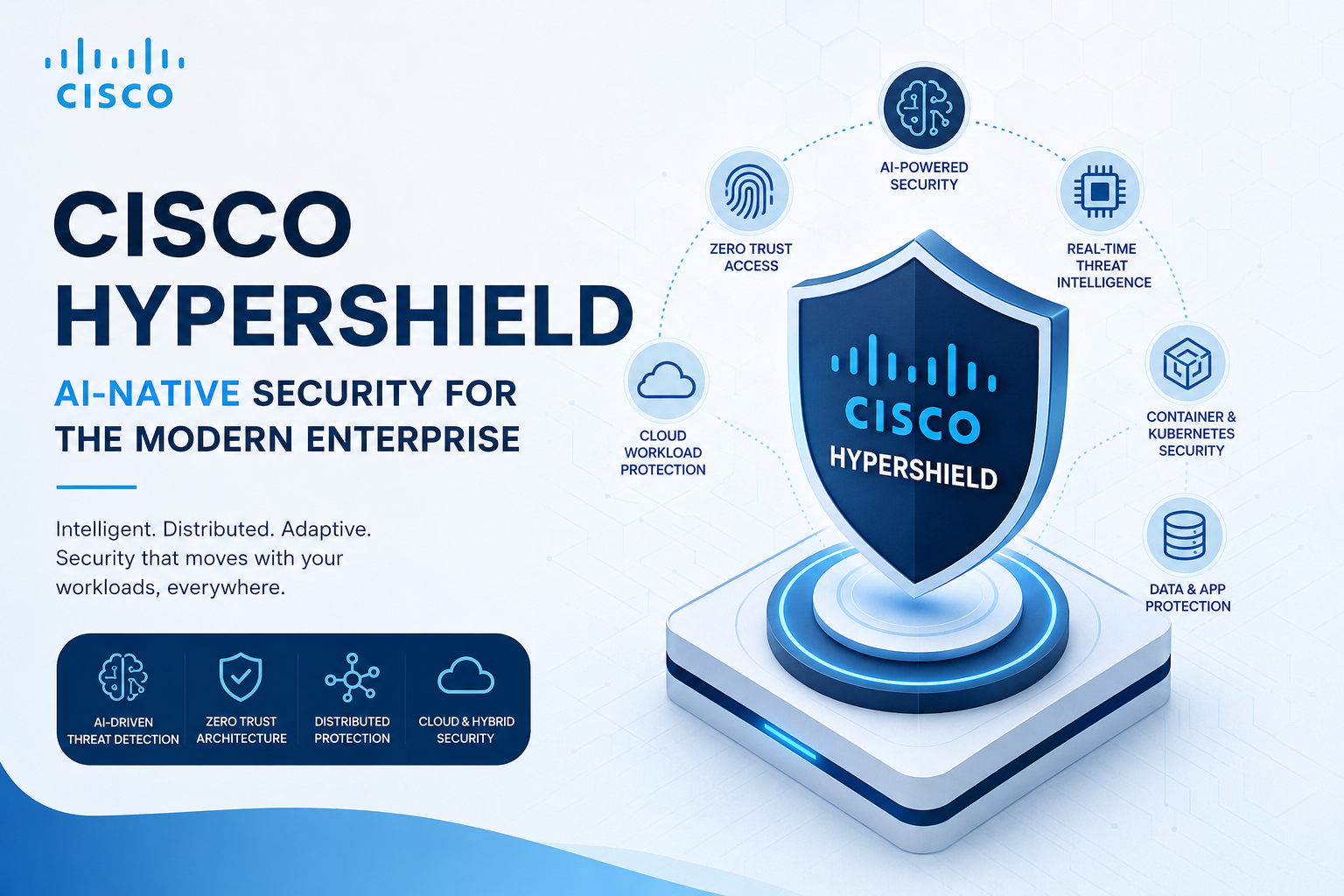
To address this challenge, Cisco introduced Cisco Hypershield, an AI-native security architecture designed to provide autonomous, distributed, and intelligent protection across enterprise environments. Rather than depending on perimeter security, Cisco Hypershield embeds protection directly into applications, workloads, operating systems, and network infrastructure, enabling security to move with the workload wherever it runs.
This article explores how Cisco Hypershield is transforming AI-native enterprise security, its core features, benefits, architecture, and why it represents the future of enterprise cybersecurity.
The Need for AI-Native Enterprise Security
The enterprise security landscape has dramatically changed over the last decade.
Businesses now operate across:
- Public clouds
- Private clouds
- Hybrid cloud environments
- Kubernetes clusters
- Virtual machines
- Containers
- Edge devices
- Remote workforce networks
- AI-powered applications
Every workload becomes a potential attack surface.
Traditional security solutions were designed around protecting a network perimeter. Today, there is no single perimeter.
Instead, organizations require security that follows workloads, automatically adapts to changing infrastructure, and continuously detects threats using artificial intelligence.
This is exactly where Cisco Hypershield excels.
What is Cisco Hypershield?
Cisco Hypershield is Cisco’s AI-native distributed security platform designed to secure applications, workloads, networks, virtual machines, and containers across hybrid and multi-cloud environments.
Unlike traditional firewalls that inspect traffic at centralized locations, Hypershield distributes security controls closer to applications and workloads.
The platform combines:
- AI-powered threat intelligence
- Zero Trust architecture
- Distributed enforcement
- Runtime workload protection
- Autonomous policy management
- Kernel-level security
- eBPF technology
- Cloud-native security controls
Together, these technologies create adaptive protection capable of responding to attacks in real time.
Why Cisco Built Hypershield
Enterprise environments have become increasingly dynamic.
Applications move between clouds.
Containers scale automatically.
Virtual machines appear and disappear within minutes.
AI workloads generate massive amounts of network traffic.
Traditional firewalls simply cannot adapt quickly enough.
Cisco designed Hypershield to solve problems such as:
- East-west traffic visibility
- AI workload protection
- Container security
- Kubernetes security
- API security
- Runtime application protection
- Cloud-native segmentation
- Distributed policy enforcement
Instead of protecting only network edges, Hypershield protects every workload individually.
Key Features of Cisco Hypershield
1. AI-Powered Threat Detection
Hypershield continuously analyzes billions of events using artificial intelligence.
Instead of relying solely on known malware signatures, AI identifies:
- Suspicious behavior
- Unusual network communication
- Privilege escalation
- Lateral movement
- Insider threats
- Zero-day attack indicators
This proactive approach significantly reduces the time needed to detect sophisticated cyberattacks.
2. Distributed Security Enforcement
Rather than routing all traffic through centralized firewalls, Cisco distributes security policies throughout the infrastructure.
Security enforcement occurs:
- Inside virtual machines
- On Kubernetes nodes
- Within containers
- Across cloud workloads
- On physical servers
This minimizes latency while improving scalability.
3. Zero Trust Architecture
Cisco Hypershield follows the principle:
Never Trust. Always Verify.
Every application, user, workload, and service must continuously authenticate before communication is allowed.
This significantly reduces unauthorized access and lateral movement.
4. Microsegmentation
Microsegmentation isolates workloads from one another.
Even if attackers compromise one workload, they cannot freely move across the enterprise network.
Benefits include:
- Reduced ransomware spread
- Better compliance
- Improved workload isolation
- Stronger internal security
5. Autonomous Patch Management
One of Hypershield’s most innovative capabilities is autonomous patching.
Instead of waiting for scheduled maintenance windows, Hypershield can apply virtual patches that block exploitation of known vulnerabilities until permanent fixes are deployed.
This dramatically reduces enterprise exposure.
6. Runtime Workload Protection
Applications constantly change during execution.
Hypershield monitors:
- Memory behavior
- Process execution
- API calls
- System calls
- File activity
- Network communication
If malicious activity occurs, enforcement happens immediately.
7. eBPF-Based Security
Cisco leverages eBPF (Extended Berkeley Packet Filter) to inspect workloads without deploying heavy software agents.
Benefits include:
- Lower CPU usage
- Better visibility
- Faster detection
- Minimal performance impact
8. AI-Driven Policy Automation
Security teams often struggle to manage thousands of firewall rules.
Hypershield uses AI to automatically:
- Generate policies
- Recommend segmentation
- Detect unnecessary permissions
- Optimize security rules
This reduces manual administration while improving security.

Cisco Hypershield Architecture
A typical deployment includes:
- AI analytics engine
- Distributed enforcement points
- Cloud workload protection
- Kubernetes security controls
- Identity verification
- Zero Trust policy engine
- Threat intelligence integration
- Automated response mechanisms
The architecture enables consistent security across on-premises infrastructure, public cloud platforms, and edge environments.
Benefits of Cisco Hypershield
Organizations adopting Cisco Hypershield gain several advantages:
Improved Threat Detection
AI continuously monitors workloads and identifies malicious behavior before significant damage occurs.
Faster Incident Response
Distributed enforcement enables security policies to stop attacks immediately at their source.
Better Cloud Security
Protection extends seamlessly across AWS, Azure, Google Cloud, and private cloud deployments.
Reduced Operational Complexity
AI automates policy creation, threat detection, and workload protection.
Lower Infrastructure Overhead
Agentless monitoring minimizes performance impact while maintaining deep visibility.
Stronger Compliance
Microsegmentation and Zero Trust controls help organizations meet regulatory requirements.
Cisco Hypershield vs Traditional Firewalls
| Feature | Traditional Firewall | Cisco Hypershield |
|---|---|---|
| AI Threat Detection | Limited | Advanced |
| Distributed Security | No | Yes |
| Zero Trust | Partial | Native |
| Container Security | Limited | Excellent |
| Kubernetes Support | Basic | Native |
| Runtime Protection | Limited | Yes |
| Autonomous Patching | No | Yes |
| Cloud Security | Moderate | Excellent |
| Microsegmentation | Limited | Advanced |
| AI Policy Automation | No | Yes |
Real-World Enterprise Use Cases
Cisco Hypershield is suitable for organizations that require strong, adaptive security across modern environments. Common use cases include:
- Protecting AI-powered business applications
- Securing Kubernetes clusters
- Hybrid cloud infrastructure protection
- Multi-cloud workload security
- Financial services
- Healthcare organizations
- Government infrastructure
- Manufacturing environments
- SaaS platforms
- Large enterprise data centers
Best Practices for Implementing Cisco Hypershield
To maximize its effectiveness:
- Adopt a Zero Trust mindset across users, devices, and workloads.
- Enable microsegmentation to isolate critical assets.
- Continuously review AI-generated security policies.
- Keep cloud and Kubernetes environments updated.
- Integrate Hypershield with your existing SIEM and threat intelligence tools.
- Regularly test incident response workflows.
- Train security teams on AI-assisted security operations.
Why AI-Native Security Matters
As enterprises increasingly rely on AI, cloud computing, and distributed applications, security must become more intelligent, autonomous, and adaptable.
AI-native security platforms like Cisco Hypershield shift from reactive defense to proactive protection by analyzing behavior, automating responses, and securing workloads wherever they operate. This approach helps organizations stay resilient against evolving cyber threats while supporting innovation.
Conclusion
Cisco Hypershield marks a significant evolution in enterprise cybersecurity. By combining AI-driven analytics, Zero Trust principles, distributed enforcement, microsegmentation, and runtime workload protection, it offers a modern approach to defending complex hybrid and multi-cloud environments.
As cyber threats become more sophisticated, organizations need security solutions that can adapt in real time without relying solely on traditional perimeter defenses. Cisco Hypershield provides a strong foundation for building resilient, AI-native enterprise security strategies that protect applications, workloads, and critical business assets.
Frequently Asked Questions (FAQs)
1. What is Cisco Hypershield?
Cisco Hypershield is an AI-native enterprise security platform that provides distributed protection for applications, workloads, containers, Kubernetes environments, and hybrid cloud infrastructure using Zero Trust principles and AI-driven threat detection.
2. How does Cisco Hypershield improve enterprise security?
It improves security by combining AI-powered threat detection, distributed policy enforcement, microsegmentation, runtime workload protection, and autonomous security automation to reduce attack surfaces and respond quickly to threats.
3. Is Cisco Hypershield suitable for cloud-native environments?
Yes. Cisco Hypershield is designed specifically for cloud-native deployments, including Kubernetes clusters, containers, virtual machines, hybrid clouds, and multi-cloud infrastructures.
4. What makes Cisco Hypershield different from traditional firewalls?
Unlike traditional firewalls that primarily protect the network perimeter, Cisco Hypershield embeds security closer to workloads, uses AI for intelligent threat detection, supports Zero Trust architecture, and provides distributed protection across modern enterprise environments.
5. Why is AI-native enterprise security important?
AI-native enterprise security helps organizations detect advanced threats faster, automate security operations, protect dynamic cloud workloads, reduce manual effort, and strengthen resilience against modern cyberattacks, making it essential for today’s digital enterprises.