

Table of Contents
Introduction
Modern web applications rely on HTTP/2 to provide faster, more efficient communication between browsers and servers. Compared to HTTP/1.1, HTTP/2 introduced advanced features such as multiplexing, header compression, stream prioritization, and binary framing. These improvements significantly reduced latency and improved website performance, making HTTP/2 the standard protocol used by most modern websites.
However, every technological advancement introduces new security challenges. Cybercriminals have discovered ways to abuse HTTP/2’s efficiency, leading to a class of attacks known as HTTP/2 Bomb Attacks. Unlike traditional Distributed Denial-of-Service (DDoS) attacks that require enormous bandwidth and thousands of compromised devices, HTTP/2 Bomb attacks exploit weaknesses in protocol implementation. With only a small amount of network traffic, an attacker can force a web server to consume excessive CPU, memory, and processing resources until it becomes slow or completely unavailable.
These attacks are particularly dangerous because they are difficult to detect using traditional network monitoring tools. Since the attacker sends legitimate-looking HTTP/2 traffic rather than massive volumes of malicious packets, many firewalls and intrusion detection systems initially consider the requests harmless. As organizations increasingly depend on cloud services, APIs, and online applications, understanding HTTP/2 Bomb attacks has become essential for cybersecurity professionals and system administrators.
Understanding HTTP/2
Before exploring the attack itself, it is important to understand how HTTP/2 operates.
HTTP/2 was introduced to solve several performance problems found in HTTP/1.1. Instead of opening multiple TCP connections, HTTP/2 allows multiple requests and responses to travel simultaneously over a single connection through a feature known as multiplexing.
Each request is divided into small binary frames. These frames belong to independent streams that the server processes concurrently. Because multiple streams can exist within a single TCP connection, websites load much faster and network resources are utilized more efficiently.
Another major enhancement is HPACK Header Compression, which reduces repetitive HTTP header information, decreasing bandwidth usage. HTTP/2 also supports stream prioritization and server push, enabling servers to send important resources before clients explicitly request them.
While these features greatly improve performance, they also increase protocol complexity. Attackers exploit this complexity by forcing servers to manage thousands of streams or repeatedly process protocol frames, consuming system resources without sending large amounts of traffic.
What Is an HTTP/2 Bomb Attack?
An HTTP/2 Bomb attack is a specialized Denial-of-Service (DoS) attack that abuses HTTP/2 protocol features to overwhelm a web server using very little bandwidth.
Instead of flooding the server with gigabytes of data, the attacker carefully crafts HTTP/2 frames that trigger expensive internal processing. Each small packet received by the server may cause the server to allocate memory, create streams, update connection states, decompress headers, schedule requests, or perform additional validation.
Because these operations require far more computational work than transmitting the original packet, the attacker achieves a highly amplified effect.
This imbalance between attacker effort and server workload is known as computational asymmetry. A few kilobytes of malicious HTTP/2 traffic can force a server to perform millions of internal operations, resulting in resource exhaustion.
How an HTTP/2 Bomb Attack Works
The attack begins when an attacker establishes one or several legitimate HTTP/2 connections with the target server. Since HTTP/2 is supported by most modern web servers, the connection appears completely normal.
The attacker then starts creating a very large number of HTTP/2 streams within the same connection. Because HTTP/2 allows many simultaneous streams, the server allocates memory and processing resources for each one.
Instead of completing those requests normally, the attacker sends specially crafted frame sequences that keep streams active for as long as possible. Some attacks repeatedly cancel and recreate streams, while others exploit frame prioritization or rapidly send reset frames that force the server to repeatedly update internal state information.
Every incoming frame causes the server to perform protocol validation, update stream tables, allocate buffers, and synchronize multiple worker threads.
Although the attacker transmits only a few packets, the server performs exponentially more work.
As the number of active streams continues growing, CPU utilization increases dramatically. Memory consumption rises as stream information accumulates. Eventually worker threads become exhausted, causing legitimate users to experience severe delays, connection timeouts, or complete service outages.
Why HTTP/2 Bomb Attacks Require Very Little Bandwidth
One of the most dangerous characteristics of this attack is its extremely low bandwidth requirement.
Traditional volumetric DDoS attacks rely on overwhelming network capacity with massive traffic volumes. Attackers often require botnets capable of generating hundreds of gigabits or even terabits per second.
HTTP/2 Bomb attacks operate differently.
Instead of exhausting network bandwidth, they exhaust server processing power.
A single HTTP/2 packet may trigger dozens or hundreds of internal operations. Every stream requires memory allocation, frame parsing, scheduling, synchronization, logging, and protocol management.
Consequently, a few megabytes of attacker traffic may consume gigabytes of server memory over time or keep CPUs operating at maximum utilization.
This amplification makes HTTP/2 Bomb attacks highly cost-effective for attackers while being extremely expensive for victims.
Common Techniques Used in HTTP/2 Bomb Attacks
Cybercriminals continuously develop new methods to exploit HTTP/2 implementations.
One common technique involves opening thousands of concurrent streams without completing them. The server maintains state information for every active stream until resources become exhausted.
Another technique abuses RST_STREAM frames by continuously creating and immediately canceling streams. Each cancellation forces the server to perform cleanup operations while simultaneously creating new stream structures.
Attackers may also exploit excessive HEADERS frames that require repeated HPACK decompression. Although compressed headers consume little bandwidth, decompression requires additional CPU cycles.
Some attacks manipulate stream priorities, causing the server scheduler to repeatedly reorganize stream processing queues. Others intentionally fragment HTTP/2 frames into numerous tiny pieces, increasing protocol parsing overhead.
Each method focuses on maximizing server computation while minimizing attacker bandwidth.
Real-World Impact
The impact of HTTP/2 Bomb attacks extends beyond temporary website outages.
Organizations may experience degraded application performance, API failures, interrupted customer transactions, increased cloud infrastructure costs, and damage to business reputation.
Cloud providers automatically scaling infrastructure during the attack may inadvertently increase operational expenses while failing to mitigate the underlying protocol abuse.
Online banking systems, healthcare applications, government portals, SaaS platforms, and e-commerce websites are particularly vulnerable because they depend heavily on uninterrupted web services.
In many cases, attackers combine HTTP/2 Bomb attacks with other techniques such as credential stuffing, ransomware deployment, or data theft, using the denial-of-service attack as a distraction for security teams.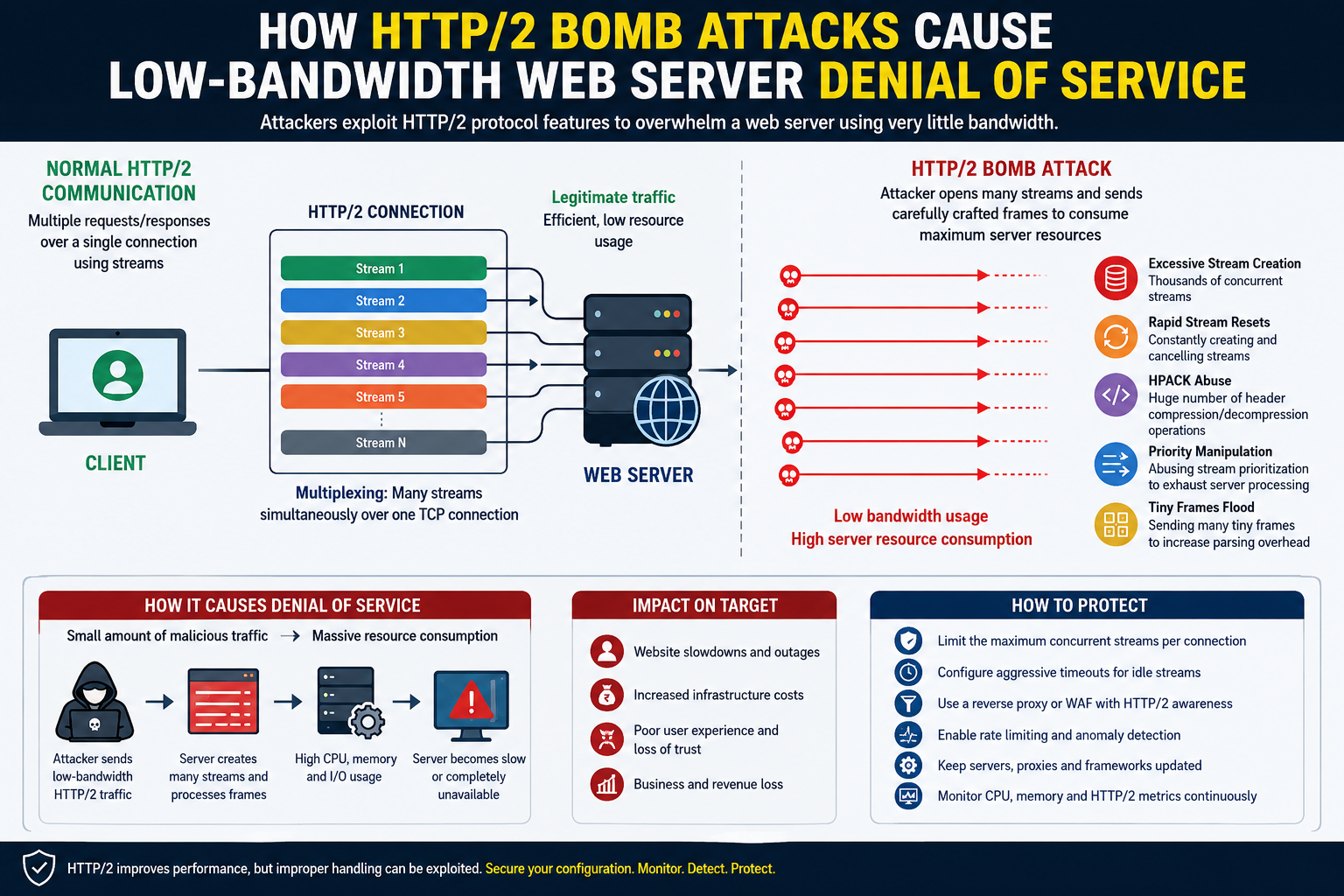
Detecting HTTP/2 Bomb Attacks
Detecting these attacks requires monitoring server behavior rather than simply measuring incoming bandwidth.
Security teams often notice unusually high CPU utilization despite low network traffic. Servers may report abnormally large numbers of active HTTP/2 streams originating from relatively few client connections.
Other warning signs include repeated stream resets, excessive HEADERS frames, large numbers of incomplete requests, and increased memory usage without corresponding increases in legitimate user activity.
Modern Web Application Firewalls (WAFs), HTTP/2-aware reverse proxies, and behavior-based intrusion detection systems can help identify these anomalies before they develop into full-scale denial-of-service incidents.
How to Protect Against HTTP/2 Bomb Attacks
Organizations should begin by ensuring that all web servers, reverse proxies, and load balancers are updated with the latest security patches. Many vendors have introduced improvements specifically designed to reduce HTTP/2 resource exhaustion attacks.
Administrators should configure reasonable limits on the maximum number of concurrent streams permitted for each connection. Restricting stream creation significantly reduces the attack surface.
Implementing aggressive connection timeouts helps remove idle or abusive connections before excessive resources are consumed. Rate limiting should also be applied to HTTP/2 frame processing rather than relying solely on bandwidth thresholds.
Reverse proxies such as Nginx, HAProxy, and Envoy can filter suspicious HTTP/2 behavior before requests reach backend servers. Deploying a Web Application Firewall capable of understanding HTTP/2 traffic provides another important defensive layer.
Continuous monitoring of CPU usage, memory allocation, HTTP/2 frame statistics, and abnormal stream behavior enables security teams to identify attacks early and respond before services become unavailable.
Organizations should also conduct regular stress testing and protocol-specific penetration testing to verify that infrastructure remains resilient against modern application-layer denial-of-service attacks.
Best Practices for Organizations
Protecting web infrastructure requires more than simply increasing bandwidth. Organizations should adopt a layered security strategy that includes secure HTTP/2 configurations, timely software updates, intelligent traffic analysis, and proactive monitoring.
Cloud-based DDoS protection services should be configured to inspect Layer 7 application traffic rather than focusing exclusively on network-layer floods. Security teams should regularly review HTTP/2 configuration settings and disable unnecessary protocol features if they are not required.
Employee training is equally important. System administrators should understand how HTTP/2 operates so they can recognize unusual behavior before it escalates into a serious outage.
Conclusion
HTTP/2 has transformed web communication by delivering faster, more efficient, and more responsive applications. However, the same advanced protocol features that improve performance can also be manipulated by attackers to create devastating denial-of-service conditions.
HTTP/2 Bomb attacks demonstrate that cybersecurity threats are no longer defined solely by bandwidth volume. Instead, attackers increasingly exploit protocol complexity to maximize computational workload while transmitting only minimal network traffic.
Organizations that rely on modern web services must strengthen HTTP/2 security through proper configuration, continuous monitoring, updated software, intelligent traffic analysis, and robust Web Application Firewalls. By understanding how these attacks function and implementing layered defensive measures, businesses can significantly reduce the risk of low-bandwidth application-layer denial-of-service attacks and maintain reliable online services even in the face of evolving cyber threats.
Frequently Asked Questions (FAQs)
1. What is an HTTP/2 Bomb attack?
An HTTP/2 Bomb attack is a type of application-layer Denial-of-Service (DoS) attack that exploits features of the HTTP/2 protocol to overwhelm a web server. Instead of sending large amounts of traffic, attackers use specially crafted HTTP/2 requests that force the server to consume excessive CPU, memory, and processing resources.
2. Why are HTTP/2 Bomb attacks considered low-bandwidth attacks?
Unlike traditional DDoS attacks that rely on massive traffic volumes, HTTP/2 Bomb attacks use only a small amount of data. They exploit protocol features such as multiplexing, stream creation, and header compression to make the server perform significantly more work than the attacker, leading to resource exhaustion.
3. Which systems are vulnerable to HTTP/2 Bomb attacks?
Any web server, reverse proxy, API gateway, or application that supports HTTP/2 can be vulnerable if it is not properly configured or updated. Servers running outdated versions of web software may be at greater risk.
4. How can organizations detect an HTTP/2 Bomb attack?
Common indicators include high CPU and memory usage despite low network traffic, an unusually high number of HTTP/2 streams, repeated stream resets, slow application performance, and unexpected service outages. Monitoring HTTP/2-specific metrics can help identify these attacks early.
5. How can HTTP/2 Bomb attacks be prevented?
Organizations can reduce the risk by keeping web servers updated, limiting the number of concurrent HTTP/2 streams, implementing rate limiting, using HTTP/2-aware Web Application Firewalls (WAFs) and reverse proxies, configuring connection timeouts, and continuously monitoring server resource usage for unusual activity.