Table of Contents
Introduction
Organizations worldwide are investing heavily in Zero Trust security architectures to protect sensitive data, applications, and digital infrastructure from increasingly sophisticated cyber threats. Zero Trust operates on a simple yet powerful principle: never trust, always verify. Every user, device, application, and network request must continuously prove its legitimacy before gaining access to organizational resources.
However, despite implementing identity verification, multi-factor authentication, endpoint protection, and network segmentation, many organizations unknowingly leave a dangerous security gap wide open. That gap comes in the form of Shadow APIs.
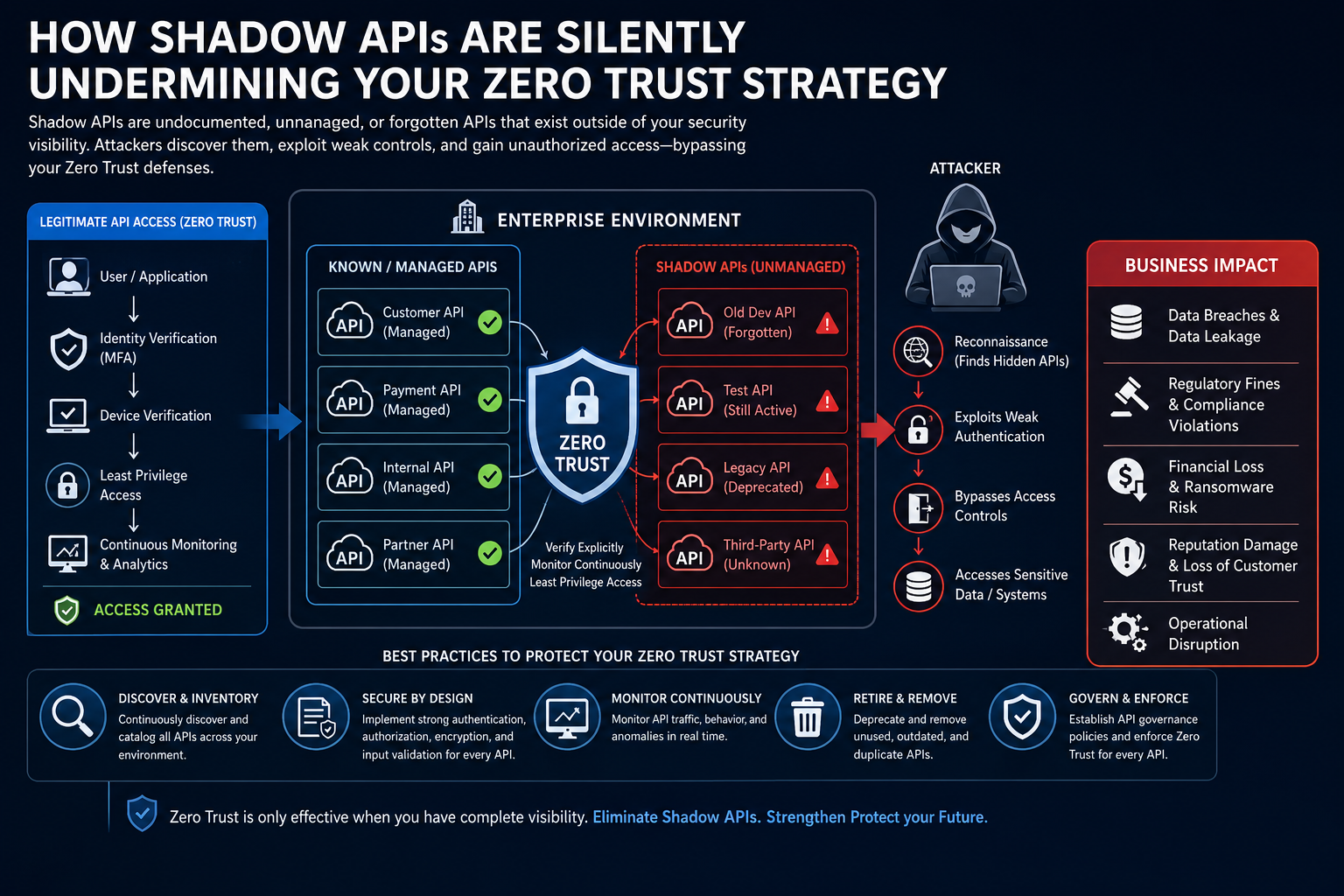
Shadow APIs are undocumented, forgotten, unmanaged, or unauthorized APIs that exist outside the visibility of an organization’s security team. These hidden interfaces often escape regular security assessments, vulnerability scanning, and monitoring, making them an attractive target for cybercriminals.
The irony is striking. An organization may spend millions building a Zero Trust environment while an old testing API, an undocumented mobile backend, or an abandoned partner integration quietly bypasses every security control.
Understanding Shadow APIs has become essential because APIs now power nearly every digital service—from cloud applications and mobile apps to banking platforms, healthcare systems, e-commerce websites, and enterprise software.
Understanding APIs and Their Role in Modern Organizations
An Application Programming Interface (API) allows different software applications to communicate with one another. APIs enable websites to fetch data, mobile apps to authenticate users, payment systems to process transactions, and cloud platforms to exchange information securely.
Modern organizations often manage hundreds or even thousands of APIs across multiple environments including:
- Customer-facing applications
- Internal enterprise systems
- Mobile applications
- Third-party integrations
- Cloud services
- DevOps pipelines
- Microservices architecture
As digital transformation accelerates, the number of APIs grows rapidly. Unfortunately, documentation and governance often fail to keep pace.
What Are Shadow APIs?
Shadow APIs are APIs that exist without proper visibility or management by an organization’s security or IT teams.
These APIs may have been created for testing, development, temporary projects, legacy systems, acquisitions, or third-party integrations. Although developers may no longer actively use them, they often remain publicly accessible and operational.
Common examples include:
- Forgotten development endpoints
- Old API versions still accepting requests
- Unused mobile application APIs
- Internal APIs accidentally exposed to the internet
- Deprecated services never decommissioned
- APIs created by outsourced development teams
- Cloud-hosted APIs left running after project completion
Because these APIs are rarely monitored, attackers frequently discover them before defenders do.
Why Shadow APIs Are Growing Rapidly
Several technological trends contribute to the rapid increase in Shadow APIs.
Organizations now deploy applications much faster than before using Agile development, DevOps automation, containers, Kubernetes, and cloud-native infrastructure. Developers regularly publish new APIs to support feature releases.
Many businesses also use multiple cloud providers, SaaS platforms, and third-party services. Each integration introduces additional APIs that may not be centrally documented.
Furthermore, mergers and acquisitions often combine infrastructures from different organizations, bringing hidden APIs into production without complete visibility.
As development speeds increase, security documentation often becomes an afterthought.
How Shadow APIs Break Zero Trust
Zero Trust assumes that every access point into an organization is known, authenticated, monitored, and continuously verified.
Shadow APIs violate these assumptions in several critical ways.
Invisible Attack Surface
Security teams cannot protect what they cannot see.
Unknown APIs fall outside vulnerability scanners, penetration tests, and monitoring systems. Attackers performing internet reconnaissance often identify these hidden endpoints before the organization discovers them.
The result is an expanding attack surface that exists entirely outside Zero Trust enforcement.
Weak Authentication
Many Shadow APIs were created before modern authentication standards became mandatory.
Some still rely on:
- Static API keys
- Hardcoded credentials
- Weak authentication tokens
- Basic authentication
- No authentication at all
An attacker discovering such an API may gain access without triggering standard Zero Trust verification processes.
Missing Authorization Controls
Even if authentication exists, authorization may be incomplete.
For example, an authenticated user might retrieve administrative information simply by modifying an API request because the endpoint never verifies user permissions correctly.
This enables attackers to perform privilege escalation while bypassing Zero Trust policies.
Lack of Continuous Monitoring
Zero Trust depends heavily on continuous monitoring and behavioral analytics.
Shadow APIs often generate no security logs, no alerts, and no anomaly detection.
Attackers can quietly:
- Enumerate data
- Download sensitive records
- Test credentials
- Probe infrastructure
for weeks or months without detection.
Exposure of Sensitive Data
Forgotten APIs frequently expose sensitive information such as:
- Customer records
- Financial information
- Authentication tokens
- Internal configuration files
- Source code references
- Employee information
- Cloud credentials
A single undocumented API can expose millions of records.
Real-World Attack Scenario
Imagine an organization implementing Zero Trust with modern identity management, endpoint verification, and strict network segmentation.
During development, engineers created an API endpoint:
/api/v1/testing/usersThe project launches successfully, but the testing endpoint is never removed.
Months later, attackers scan the organization’s domain and discover the forgotten endpoint.
The API still accepts old authentication tokens.
The attackers retrieve user information, identify administrator accounts, perform privilege escalation, and eventually gain access to internal systems.
The organization believes its Zero Trust implementation has failed.
In reality, the Zero Trust controls were simply never applied to the Shadow API because nobody knew it still existed.
Common Sources of Shadow APIs
Organizations often create Shadow APIs through normal business operations.
Some of the most common sources include:
Development teams creating temporary APIs for testing, legacy applications that remain online after migrations, abandoned mobile application backends, APIs introduced through third-party vendors, cloud services deployed outside central governance, forgotten proof-of-concept projects, and deprecated API versions left active for compatibility reasons.
Business Risks Associated with Shadow APIs
Shadow APIs create risks that extend beyond technical vulnerabilities.
Organizations may experience:
- Data breaches involving customer information
- Regulatory compliance violations
- Financial losses
- Ransomware attacks
- Intellectual property theft
- Brand reputation damage
- Operational disruptions
Industries subject to regulations such as GDPR, HIPAA, PCI DSS, and financial compliance standards face particularly severe consequences if undocumented APIs expose sensitive data.
How Organizations Can Detect Shadow APIs
Detection requires continuous visibility across the entire API ecosystem.
Security teams should maintain an accurate inventory of every API, continuously scan internet-facing assets for undocumented endpoints, analyze API traffic to identify unknown services, compare deployment records with production environments, and regularly review cloud infrastructure and legacy systems. Automated API discovery solutions can help uncover forgotten endpoints before attackers find them.
Best Practices for Protecting Zero Trust from Shadow APIs
Effective protection begins with visibility. Every API should be documented, inventoried, and assigned an owner responsible for its security throughout its lifecycle.
Organizations should adopt an API-first security strategy where authentication, authorization, encryption, logging, and continuous monitoring are built into every API from development through deployment. Deprecated APIs should be removed promptly rather than left operational.
Regular penetration testing, vulnerability assessments, and API security testing should specifically include undocumented and legacy endpoints. Security teams should also integrate API discovery into DevSecOps pipelines so that newly deployed APIs are automatically identified and evaluated before reaching production.
Finally, Zero Trust policies must extend beyond users and devices to include every API, service, workload, and machine identity. Continuous verification should apply equally to internal and external APIs, ensuring that hidden endpoints cannot bypass organizational security controls.
The Future of API Security
As organizations continue adopting cloud-native applications, artificial intelligence, microservices, and Internet of Things (IoT) technologies, the number of APIs will increase dramatically. Managing this growing ecosystem manually will become increasingly difficult.
Future security strategies will rely more heavily on automated API discovery, machine learning–based anomaly detection, runtime protection, and continuous API governance. Zero Trust architectures will increasingly incorporate API-specific security controls to ensure that every endpoint—known or newly created—is discovered, authenticated, authorized, and monitored from the moment it is deployed.
Organizations that treat APIs as first-class security assets rather than hidden technical components will be better positioned to defend against evolving cyber threats.
Conclusion
Zero Trust is only as strong as the visibility it provides. While organizations focus on securing users, devices, and networks, undocumented APIs can quietly create hidden pathways that undermine even the most advanced security architectures.
Shadow APIs represent one of the fastest-growing attack surfaces in modern enterprises. Because they often escape documentation, monitoring, and governance, they become ideal targets for attackers seeking unauthorized access to sensitive systems and data.
By implementing comprehensive API discovery, maintaining an accurate inventory, enforcing consistent authentication and authorization, continuously monitoring API activity, and integrating API security into the software development lifecycle, organizations can close these hidden gaps and strengthen their Zero Trust strategy. In today’s API-driven world, protecting every API is no longer optional—it is a fundamental requirement for maintaining a resilient cybersecurity posture.
FAQs
1. What are Shadow APIs?
Shadow APIs are undocumented, forgotten, or unauthorized APIs that operate outside an organization’s official API inventory. Because they are not properly monitored or secured, they create hidden entry points that attackers can exploit to access sensitive systems and data.
2. Why are Shadow APIs a threat to a Zero Trust security strategy?
Zero Trust relies on complete visibility and continuous verification of every user, device, and application. Shadow APIs undermine this model because they often bypass security policies, lack proper authentication, and remain outside security monitoring, creating blind spots that attackers can exploit.
3. How can organizations identify Shadow APIs?
Organizations can discover Shadow APIs by implementing automated API discovery tools, maintaining a centralized API inventory, performing regular security assessments, monitoring API traffic, and reviewing cloud environments and legacy applications for undocumented or forgotten endpoints.
4. What are the business risks of leaving Shadow APIs unsecured?
Unsecured Shadow APIs can lead to data breaches, unauthorized access, compliance violations, financial losses, ransomware attacks, operational disruptions, and significant reputational damage. Since these APIs are often overlooked, they provide cybercriminals with an easy path into enterprise environments.
5. How can organizations protect their Zero Trust architecture from Shadow APIs?
Organizations should continuously discover and inventory all APIs, enforce strong authentication and authorization, monitor API activity in real time, retire unused or outdated APIs, integrate API security into the DevSecOps lifecycle, and apply Zero Trust principles consistently across every API to eliminate hidden attack surfaces.