Table of Contents
Introduction
Modern web and mobile applications rely heavily on APIs to exchange data between users, servers, and third-party services. As businesses continue to adopt API-first architectures, GraphQL has rapidly become one of the most popular technologies for building flexible and efficient APIs. Companies such as Facebook (Meta), GitHub, Shopify, and many SaaS platforms use GraphQL because it allows developers to request only the data they need, reducing bandwidth usage and improving application performance.
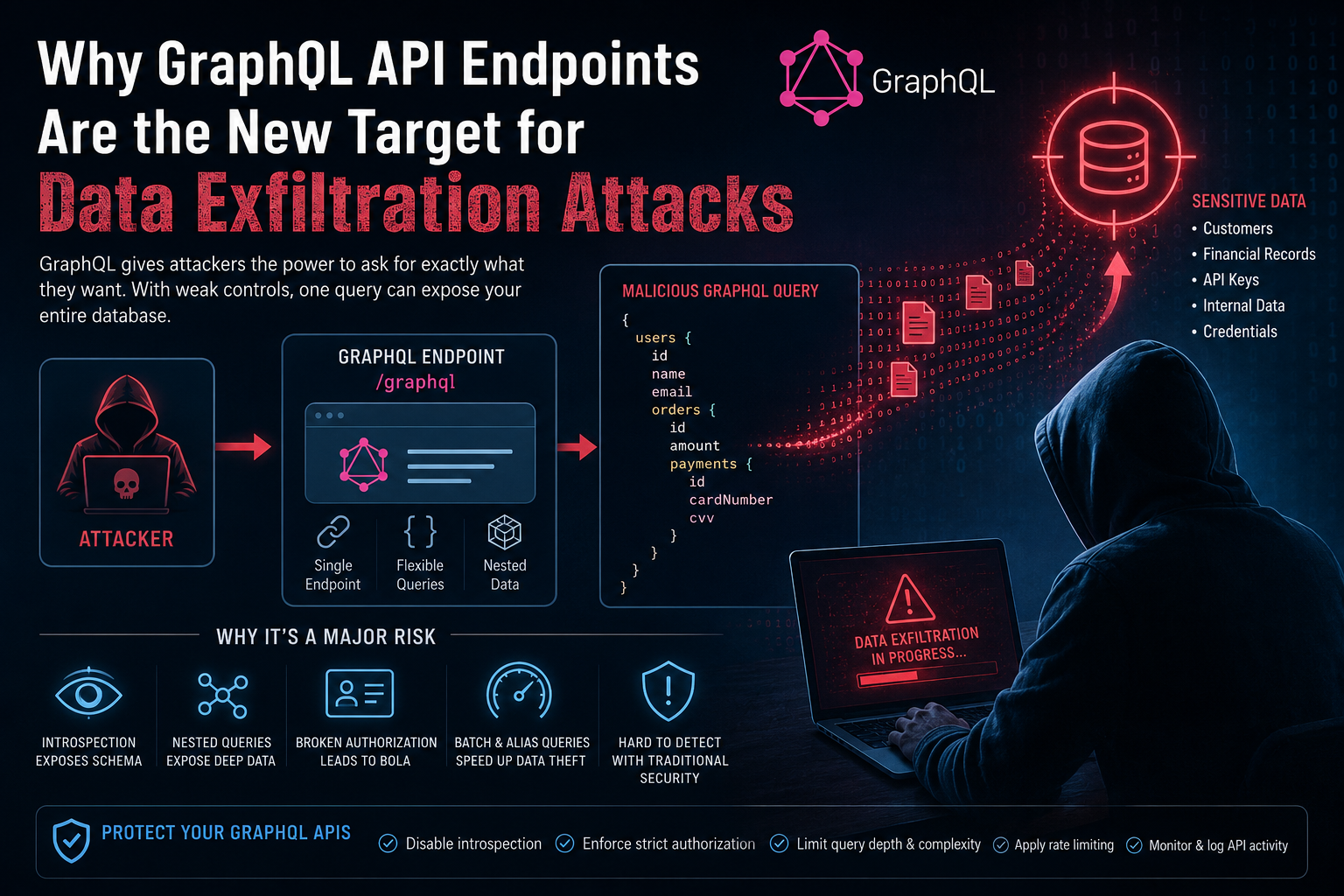
While GraphQL provides numerous advantages over traditional REST APIs, its flexibility has also introduced new security challenges. Cybercriminals have quickly recognized that GraphQL endpoints often expose far more information than developers intend. Poorly secured GraphQL implementations have become attractive targets for data exfiltration attacks, allowing attackers to retrieve sensitive business information, customer records, financial data, API secrets, and internal system details using legitimate API queries.
Unlike conventional attacks that depend on exploiting software vulnerabilities, GraphQL data exfiltration frequently occurs through perfectly valid requests that abuse the API’s powerful querying capabilities. This makes detection significantly more difficult because malicious traffic often resembles normal application usage.
In this article, we’ll explore why GraphQL endpoints are becoming prime targets for attackers, how these attacks work, the most common vulnerabilities, and the best security practices organizations should implement.
Understanding GraphQL
GraphQL is an open-source API query language developed by Meta that enables clients to request exactly the data they require. Unlike REST APIs, where each endpoint returns a predefined set of information, GraphQL exposes a single endpoint that can retrieve multiple related resources in one request.
For example, instead of making separate API calls for:
- User profile
- Orders
- Payment history
- Saved addresses
A GraphQL query can retrieve all of this information in one request.
This flexibility improves performance and simplifies development, but it also increases the risk of unauthorized data exposure if access controls are not implemented correctly.
What Is Data Exfiltration?
Data exfiltration refers to the unauthorized transfer or extraction of sensitive information from an organization’s systems. Attackers may steal:
- Customer databases
- Personal Identifiable Information (PII)
- Financial records
- Authentication tokens
- Internal documentation
- API keys
- Business intelligence
- Source code
Unlike ransomware, where attackers encrypt files, data exfiltration focuses on quietly stealing valuable information without triggering alarms.
Because GraphQL allows complex nested queries, attackers can often extract enormous amounts of information through relatively few requests.
Why GraphQL Endpoints Are Attractive to Attackers
GraphQL’s greatest strength—its flexibility—is also its biggest security challenge.
Traditional REST APIs expose many different endpoints with limited functionality. GraphQL exposes a single endpoint capable of accessing nearly every object within an application.
If authorization is weak, attackers can explore relationships between objects and retrieve data developers never intended to expose.
Attackers appreciate GraphQL because it provides:
- Rich schema information
- Predictable endpoint locations
- Flexible queries
- Deep object relationships
- Efficient bulk data retrieval
- Easy automation
A single compromised account can potentially expose thousands of records.
How Attackers Discover GraphQL Endpoints
Most GraphQL APIs are exposed through common URLs such as:
/graphql
/api/graphql
/graphql/v1
/query
Security researchers and attackers routinely scan websites for these endpoints.
Once discovered, attackers begin testing whether GraphQL introspection is enabled.
GraphQL Introspection: A Goldmine for Attackers
GraphQL includes an introspection feature that helps developers understand available queries, mutations, object types, and relationships.
While extremely useful during development, leaving introspection enabled in production environments provides attackers with a detailed blueprint of the API.
Instead of guessing available fields, they can simply ask the API to describe itself.
The attacker immediately learns:
- Database structure
- Object names
- Hidden fields
- Relationships
- Available operations
- Input parameters
This dramatically reduces reconnaissance time.
Nested Queries Increase Data Exposure
GraphQL supports nested queries that traverse multiple objects simultaneously.
For example, an attacker might retrieve:
Customer
↓
Orders
↓
Payments
↓
Shipping
↓
Invoices
↓
Support Tickets
↓
Employee Notes
If authorization is improperly enforced, one query may expose far more information than intended.
This “query chaining” significantly accelerates data theft.
Broken Authorization Is the Biggest Risk
One of the most common GraphQL security problems is Broken Object Level Authorization (BOLA).
Imagine a user requests:
user(id: 1001)If the API returns data for any user ID without verifying ownership, attackers can simply enumerate IDs:
1002
1003
1004
1005
Eventually retrieving thousands of customer records.
This vulnerability has appeared in numerous real-world APIs.
Excessive Data Exposure
Many GraphQL schemas include sensitive fields such as:
- Email addresses
- Phone numbers
- Password reset tokens
- Internal comments
- API credentials
- User roles
- Audit logs
Developers sometimes assume the frontend will never request these fields.
However, attackers can directly query them if authorization checks are absent.
Query Complexity Abuse
GraphQL permits deeply nested and recursive queries.
Attackers exploit this capability to request:
Users
 → Orders
   → Products
     → Reviews
       → Users
         → Orders
Such recursive requests consume excessive CPU and memory, potentially leading to denial-of-service conditions while also exposing large datasets.
Many APIs fail to enforce maximum query depth or complexity.
Batch Queries Accelerate Data Theft
GraphQL allows multiple operations in a single request.
Instead of sending hundreds of HTTP requests, attackers may retrieve hundreds of objects simultaneously.
This reduces:
- Logging noise
- Detection probability
- Network traffic
- Rate-limit effectiveness
As a result, organizations may not immediately recognize that sensitive information is being extracted.
Enumeration Through Predictable IDs
Many GraphQL APIs expose sequential object identifiers.
Attackers automate requests like:
customer(id:1)
customer(id:2)
customer(id:3)
...
Without proper authorization, massive customer databases can be harvested quickly.
GraphQL Aliases Enable Large-Scale Data Collection
GraphQL aliases allow multiple queries within a single request.
Example:
user1: user(id:1)
user2: user(id:2)
user3: user(id:3)
Hundreds of aliases can dramatically increase extraction speed while avoiding traditional rate-limiting mechanisms.
Why Detection Is Difficult
Unlike SQL injection or malware, GraphQL data theft often uses legitimate API requests.
From the server’s perspective:
- Valid authentication
- Valid endpoint
- Valid syntax
- Valid responses
Only the volume or pattern of requests may appear suspicious.
This makes behavioral monitoring essential.
Real-World GraphQL Security Challenges
Several organizations have experienced GraphQL-related security issues due to:
- Misconfigured authorization
- Public introspection
- Excessive permissions
- Information disclosure
- Sensitive field exposure
- Query abuse
As GraphQL adoption grows, security researchers continue discovering new implementation weaknesses.
Best Practices for Securing GraphQL APIs
Organizations should adopt a layered security strategy.
Disable Introspection in Production
Production APIs rarely require public schema discovery. Disabling introspection removes valuable reconnaissance information.
Enforce Object-Level Authorization
Every query should verify that users can access only the resources they own or are authorized to view.
Limit Query Depth and Complexity
Restrict deeply nested queries to prevent excessive resource consumption and data harvesting.
Apply Rate Limiting
Limit the number of requests each client can perform within a given period to slow automated attacks.
Validate Every Field
Sensitive fields should require explicit authorization, even if they are not displayed by the frontend application.
Monitor API Behavior
Analyze query frequency, object access patterns, response sizes, and unusual client behavior to identify potential exfiltration attempts.
Secure Authentication
Implement strong authentication using short-lived access tokens, secure session management, and multi-factor authentication where appropriate.
Maintain Detailed Audit Logs
Comprehensive logging helps security teams detect abnormal data access and investigate incidents effectively.
The Role of FireShark in GraphQL API Security
Organizations increasingly rely on specialized cybersecurity partners to secure modern API environments. FireShark Technologies helps businesses strengthen GraphQL and REST API security through services such as:
- API Security Assessments
- Web Application Penetration Testing (VAPT)
- Secure Configuration Reviews
- Cloud Security Assessments
- Continuous Security Monitoring
- Threat Detection and Incident Response
- Security Awareness and Best-Practice Guidance
By identifying misconfigurations, authorization flaws, and excessive data exposure before attackers do, proactive security assessments can significantly reduce the risk of data exfiltration.
Future of GraphQL Security
GraphQL adoption continues to grow across enterprise applications, cloud-native architectures, mobile platforms, and SaaS ecosystems. As organizations expose increasingly valuable business data through GraphQL APIs, attackers will continue developing more sophisticated methods for abusing these interfaces.
Future defenses will likely incorporate AI-driven anomaly detection, zero-trust authorization models, automated API security testing, and continuous schema validation to detect malicious behavior before sensitive information is lost.
Conclusion
GraphQL has transformed API development by offering flexibility, efficiency, and a better developer experience. However, the same capabilities that make GraphQL attractive to developers also make it highly appealing to cybercriminals. Features such as introspection, nested queries, aliases, and rich object relationships can become powerful tools for attackers when security controls are weak.
Protecting GraphQL APIs requires more than simply hiding endpoints. Organizations must enforce strict authorization, validate every field, limit query complexity, monitor API behavior, disable unnecessary features, and conduct regular security assessments. As API-driven applications continue to dominate modern software development, securing GraphQL endpoints is no longer optional—it is a critical component of protecting sensitive data and maintaining customer trust.
FAQs
1. Why are GraphQL APIs more vulnerable to data exfiltration than traditional REST APIs?
GraphQL’s flexible query capabilities, nested relationships, and single-endpoint architecture can expose large amounts of data if authorization and query limits are not properly implemented.
2. What is GraphQL introspection, and why should it be disabled in production?
Introspection lets clients discover the API schema. In production, it can provide attackers with a roadmap of available queries, mutations, and data structures, making reconnaissance much easier.
3. How can organizations prevent GraphQL data exfiltration attacks?
They should enforce object-level authorization, disable unnecessary introspection, limit query depth and complexity, implement rate limiting, monitor API usage, and perform regular security assessments.
4. Can GraphQL APIs be secured without losing their flexibility?
Yes. Proper authentication, fine-grained authorization, schema validation, query controls, and continuous monitoring allow organizations to maintain GraphQL’s benefits while minimizing security risks.
5. How can FireShark help secure GraphQL APIs?
FireShark Technologies provides services such as API security testing, VAPT, web application security assessments, cloud security reviews, threat monitoring, and incident response to identify and mitigate GraphQL vulnerabilities before they can be exploited.