Table of Contents
Introduction
Artificial Intelligence has rapidly evolved from being a productivity assistant to becoming an autonomous workforce capable of making decisions, executing workflows, interacting with enterprise applications, and handling sensitive business data. Modern AI agents can schedule meetings, process invoices, generate software code, analyze customer requests, investigate security incidents, and even perform financial operations with minimal human intervention.
While these capabilities significantly improve operational efficiency, they also introduce one of the most overlooked cybersecurity challenges: identity and access management (IAM) for AI agents.
Traditional security architectures were designed around human users, service accounts, and machine identities with predictable behavior. AI agents, however, function differently. They continuously interact with multiple APIs, cloud platforms, SaaExperts applications, databases, identity providers, and third-party services while making autonomous decisions based on real-time information.
If these agents receive excessive privileges, weak authentication mechanisms, or unmanaged credentials, they become attractive targets for cybercriminals. A compromised AI agent may possess more access than many employees, making identity-related attacks significantly more damaging.
As organizations increasingly deploy enterprise AI assistants, securing their identities becomes just as important as securing human employees.
Understanding Enterprise AI Agents
Unlike traditional chatbots that simply answer questions, AI agents can:
- Access enterprise databases
- Read and send emails
- Execute API requests
- Update CRM records
- Generate financial reports
- Analyze cybersecurity alerts
- Provision cloud resources
- Manage customer support tickets
- Automate HR workflows
- Interact with internal business applications
For example, an HR AI assistant might automatically retrieve employee records from an HR database, verify payroll information, update leave balances, generate contracts, and email employees—all without human intervention.
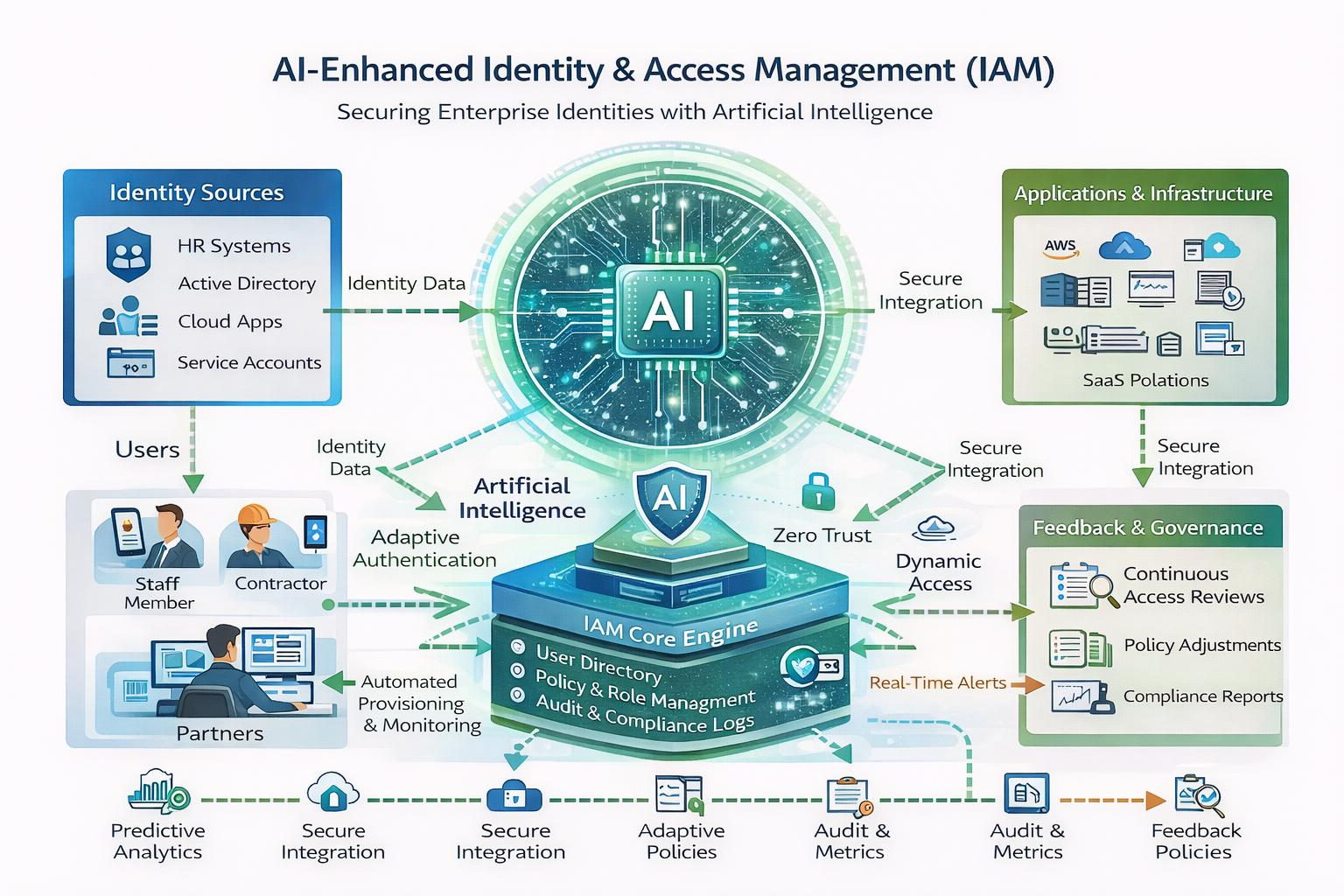
To accomplish these tasks, the AI requires access permissions across numerous enterprise systems. This creates an entirely new identity landscape that must be managed carefully.
Why Identity and Access Become Major Security Risks
Every AI agent essentially functions as a digital employee.
Like any employee, it needs:
- Authentication
- Authorization
- Identity verification
- Role-based permissions
- Activity monitoring
- Credential protection
The difference is that AI agents often work continuously, communicate with dozens of applications simultaneously, and process enormous amounts of sensitive data.
If an attacker compromises one AI agent, they may gain access to every connected business application.
This makes identity management one of the most critical security priorities in AI deployments.
The Growing Identity Explosion
Modern enterprises already manage thousands of identities.
These include:
- Human employees
- Contractors
- Vendors
- Service accounts
- APIs
- Cloud workloads
- Containers
- IoT devices
AI agents introduce another rapidly growing category known as non-human identities (NHIs).
A single enterprise may deploy:
- Customer support AI
- Security investigation AI
- Finance automation AI
- HR assistant
- Sales assistant
- Software development assistant
- Cloud operations assistant
- Data analytics assistant
Each agent requires its own identity, authentication method, API keys, OAuth tokens, cloud permissions, and application access.
Without centralized governance, organizations quickly lose visibility over who—or what—has access to critical systems.
Critical Identity and Access Gaps
Excessive Privileges
One of the most common security problems occurs when AI agents receive far more permissions than necessary.
Developers frequently assign administrator-level access simply to avoid permission errors during deployment.
Instead of granting limited access to customer records, an AI agent might receive full administrative privileges across the entire CRM.
If compromised, attackers immediately inherit these excessive permissions.
This directly violates the Principle of Least Privilege (PoLP), which states that every identity should receive only the minimum permissions required to perform its tasks.
Poor Credential Management
AI agents rely on numerous credentials.
These include:
- API keys
- OAuth tokens
- Access tokens
- Cloud credentials
- Database passwords
- Encryption keys
- Service account secrets
Unfortunately, many organizations still hardcode credentials directly into applications or configuration files.
If source code repositories become exposed or compromised, attackers can easily retrieve these secrets and gain unauthorized access.
Proper secret management platforms should always replace embedded credentials.
Weak Authentication
Many AI deployments still authenticate using static passwords or long-lived API keys.
These methods are vulnerable because stolen credentials remain valid until manually revoked.
Modern enterprise environments should adopt:
- Short-lived access tokens
- Multi-factor authentication where applicable
- Certificate-based authentication
- Hardware-backed credentials
- Identity federation
- Continuous authentication
These approaches significantly reduce credential theft risks.
Lack of Identity Visibility
Organizations often struggle to answer simple questions such as:
- Which AI agents currently exist?
- What systems can they access?
- Who created them?
- Which credentials do they use?
- When were permissions last reviewed?
Without centralized identity inventories, AI deployments become impossible to govern effectively.
Security teams need complete visibility into every AI identity across the enterprise.
Unmonitored Privileged Access
AI agents frequently require privileged permissions.
Examples include:
- Managing cloud infrastructure
- Accessing production databases
- Reading financial information
- Updating customer records
- Executing administrative scripts
Without continuous monitoring, abnormal behavior may go unnoticed.
Behavior analytics can detect unusual actions such as:
- Massive data downloads
- Unexpected API usage
- Unauthorized privilege escalation
- Access outside normal operating hours
API Security and AI Agents
Enterprise AI agents primarily communicate through APIs.
Every connected API becomes another attack surface.
Common API risks include:
- Broken authentication
- Excessive data exposure
- Weak authorization
- Insecure endpoints
- Token leakage
- Rate limit abuse
Securing AI agents therefore requires securing every API they interact with.
Modern API gateways should enforce authentication, authorization, encryption, logging, and anomaly detection.
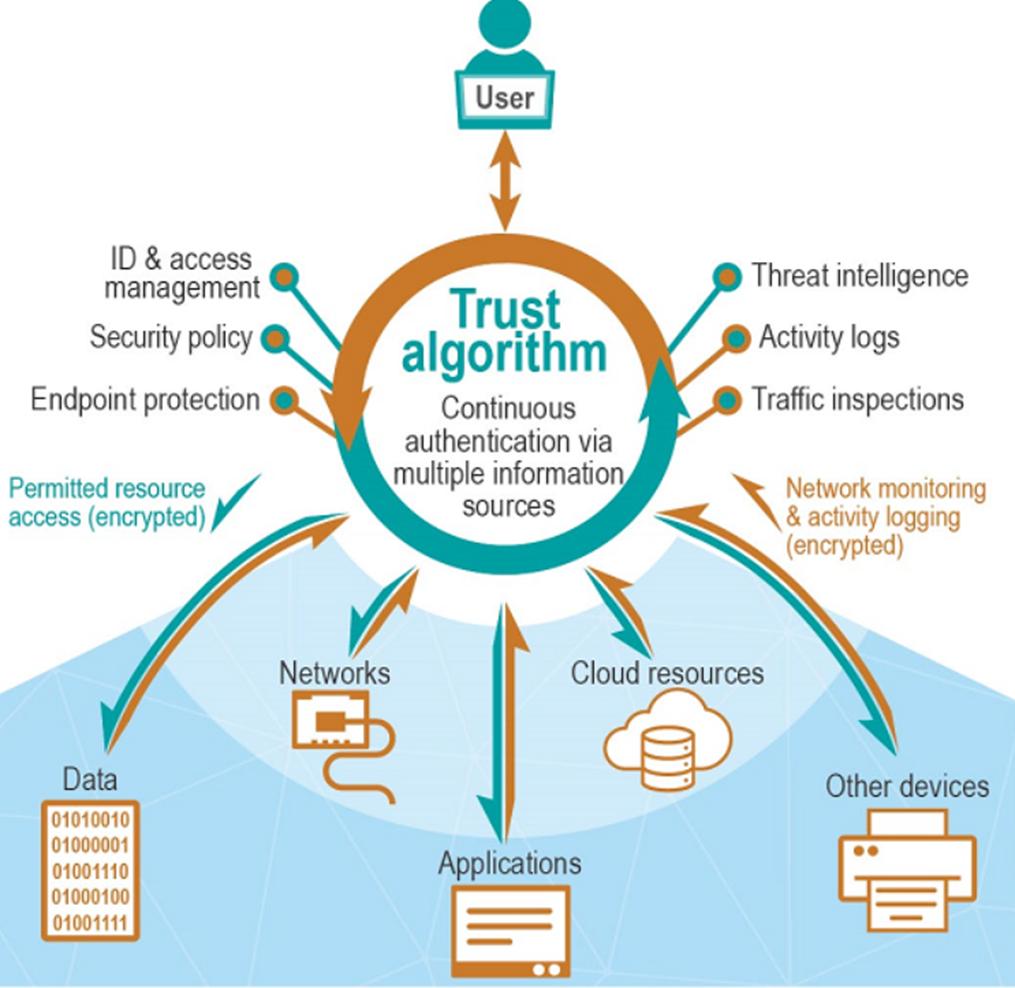
Implementing Zero Trust for AI Agents
Traditional enterprise security assumed that authenticated users inside the network could generally be trusted.
Zero Trust eliminates this assumption.
Every request made by an AI agent must be verified regardless of its location.
Zero Trust principles include:
- Verify every identity
- Authenticate every request
- Continuously evaluate risk
- Minimize permissions
- Monitor all activities
- Encrypt communications
- Assume breach
Even trusted AI agents should continuously prove their identity before accessing sensitive resources.
Role-Based and Attribute-Based Access Control
Modern enterprises should avoid assigning broad permissions directly to AI agents.
Instead, access should be governed through structured authorization models.
Role-Based Access Control (RBAC)
Permissions are assigned according to predefined roles.
Examples include:
- Finance AI
- HR AI
- Security AI
- Customer Support AI
Each role only accesses relevant business resources.
Attribute-Based Access Control (ABAC)
Access decisions consider additional attributes such as:
- Device health
- Location
- Time of day
- Data sensitivity
- User department
- Business risk level
ABAC provides greater flexibility for dynamic AI environments.
Securing Non-Human Identities
AI agents belong to the rapidly growing category of non-human identities.
Unlike human users, these identities never sleep, continuously execute workloads, and often possess high-value permissions.
Organizations should:
- Create unique identities for every AI agent
- Rotate credentials automatically
- Use certificate-based authentication
- Eliminate shared service accounts
- Apply least privilege
- Continuously monitor behavior
- Remove unused identities promptly
Lifecycle management is just as important for AI identities as it is for employee accounts.
Continuous Monitoring and Behavioral Analytics
Identity protection doesn’t end after authentication.
Organizations must continuously monitor AI behavior to detect anomalies.
Examples include:
- Sudden increases in API requests
- Accessing unfamiliar databases
- Downloading unusually large datasets
- Executing privileged commands unexpectedly
- Connecting from unauthorized locations
- Attempting lateral movement across systems
AI-powered User and Entity Behavior Analytics (UEBA) can identify these deviations early, allowing security teams to respond before significant damage occurs.
Governance, Compliance, and Audit Readiness
AI agents frequently process regulated information such as:
- Customer data
- Financial records
- Healthcare information
- Intellectual property
- Employee records
Organizations must maintain:
- Complete audit logs
- Identity lifecycle documentation
- Permission reviews
- Access certifications
- Compliance reporting
- Automated policy enforcement
Proper governance helps organizations meet regulatory requirements while reducing insider and external threats.
Best Practices for Closing Identity and Access Gaps
Organizations deploying enterprise AI should build security into every stage of the AI lifecycle. Every AI agent should have a unique identity, least-privilege permissions, securely managed secrets, and strong authentication mechanisms. Zero Trust principles should govern every interaction, with continuous verification replacing implicit trust. Centralized identity governance, privileged access management, behavioral analytics, regular access reviews, automated credential rotation, comprehensive logging, and continuous monitoring should all work together to reduce risk while maintaining operational efficiency.
Conclusion
Enterprise AI agents are transforming how businesses operate by automating complex workflows, improving productivity, and enabling faster decision-making. However, these benefits come with a significant responsibility: managing the identities and access privileges of autonomous systems. Treating AI agents as trusted digital employees without robust identity governance can expose organizations to credential theft, privilege escalation, data breaches, and regulatory violations.
By implementing Zero Trust security, least-privilege access, strong authentication, centralized identity governance, secure secrets management, and continuous monitoring, organizations can safely deploy AI agents while minimizing cybersecurity risks. As AI adoption continues to accelerate, securing both human and non-human identities will become a cornerstone of resilient enterprise security strategies, ensuring innovation and automation do not come at the expense of trust and protection.
Frequently Asked Questions (FAQs)
1. What are enterprise AI agents?
Enterprise AI agents are intelligent software systems that can perform tasks autonomously by interacting with business applications, databases, cloud services, and APIs. Unlike traditional chatbots, they can make decisions, automate workflows, and execute complex business processes with minimal human intervention.
2. Why is Identity and Access Management (IAM) important for AI agents?
Identity and Access Management (IAM) ensures that AI agents can only access the resources they are authorized to use. Proper IAM helps prevent unauthorized access, reduces the risk of data breaches, enforces the principle of least privilege, and improves compliance with security regulations.
3. What are the biggest identity and access risks in enterprise AI deployments?
Some of the most common risks include excessive permissions, weak authentication, unsecured API keys, poor credential management, lack of identity visibility, and inadequate monitoring of AI agent activities. These vulnerabilities can allow attackers to exploit AI agents and gain unauthorized access to critical systems.
4. How does Zero Trust improve AI agent security?
Zero Trust security requires every AI agent to continuously verify its identity before accessing enterprise resources. Instead of automatically trusting internal systems, Zero Trust enforces strong authentication, least-privilege access, continuous monitoring, and risk-based authorization, significantly reducing the likelihood of unauthorized access.
5. What are the best practices for securing enterprise AI agents?
Organizations should assign unique identities to every AI agent, implement least-privilege access, use strong authentication methods, secure API credentials with secret management solutions, continuously monitor agent behavior, regularly review permissions, and adopt a Zero Trust security model to protect enterprise AI deployments from evolving cyber threats.