Introduction
The generative AI landscape has shifted away from the initial phase of novelty. We are no longer amazed that a chatbot can mimic human conversation, generate a basic image, or draft an elementary email. Instead, today’s landscape demands rigorous logical reasoning, massive contextual memory, high-fidelity code generation, and flawless integration into specialized workflows.
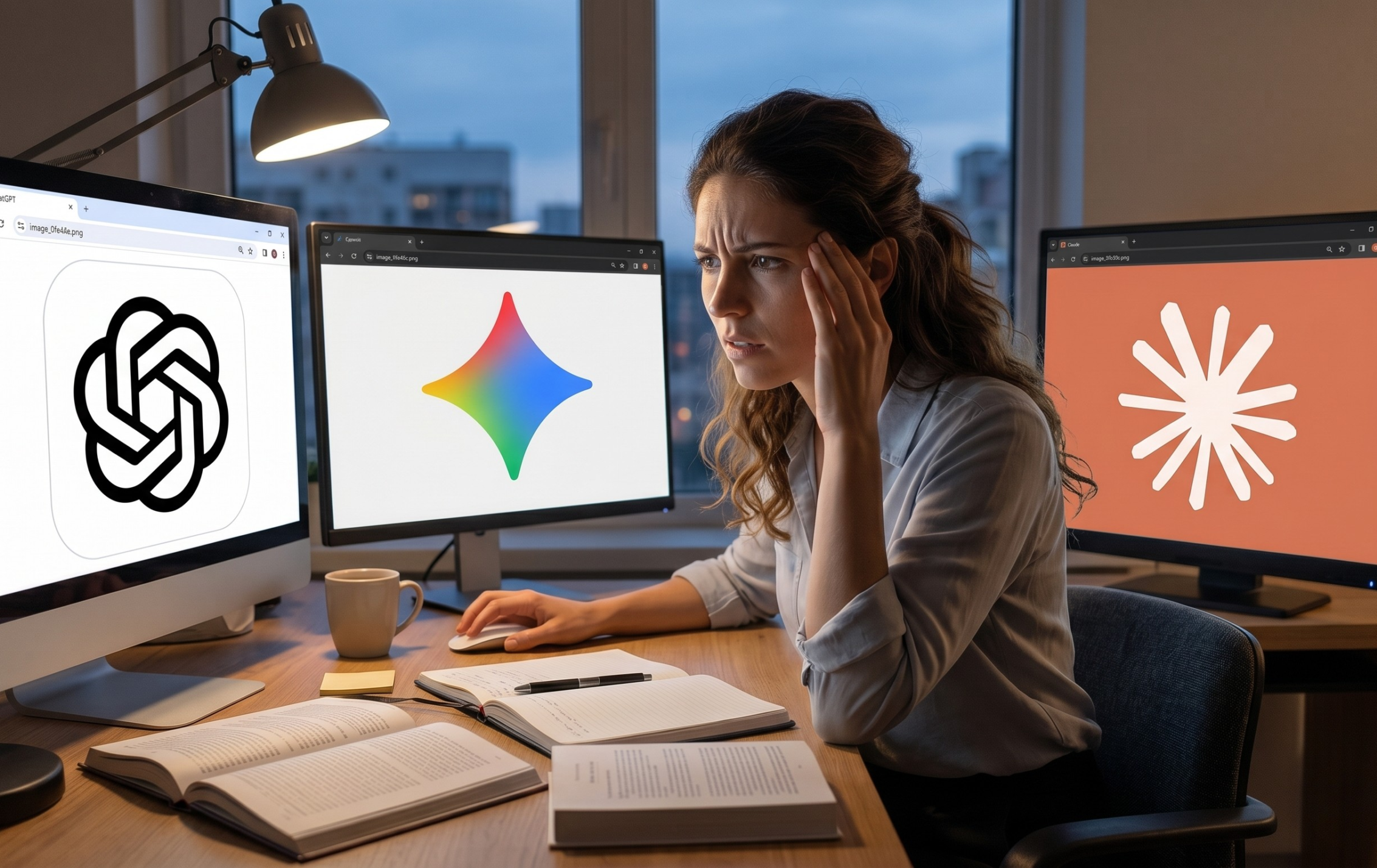
Three foundational powerhouses dominate this frontier: OpenAI’s ChatGPT, Google’s Gemini, and Anthropic’s Claude. While all three tools share the fundamental ability to process complex prompts and return sophisticated outputs, they are built on fundamentally different design philosophies, powered by contrasting architectural priorities, and optimized for distinct use cases.
Declaring one platform as the absolute “winner” over the others ignores the technical realities of large language models. The real objective is determining which model aligns with your specific cognitive style, data scale, and engineering requirements.
The Core Competencies: Three Unique Architectures
[ChatGPT] ──> Master of Conversational Fluidity & All-in-One Versatility
[Gemini]  ──> Multimodal Research Titan with Millions of Tokens in Memory
[Claude]  ──> Precision Engineering, Code Architecture & Nuanced Prose
1. ChatGPT: The Master of Versatility and Conversational Reasoning
OpenAI’s ChatGPT remains the benchmark for consumer accessibility and multi-functional versatility. At its core, ChatGPT functions like a highly dynamic, structurally adaptive digital workspace. Its primary strengths lie in complex logical tracking, conversational fluidity, and an expansive ecosystem of integrated features.
ChatGPT excels in environments where you need an all-in-one assistant. With its Advanced Voice Mode, it provides responsive verbal interaction, mimicking natural speech patterns, pacing, and emotional inflections. Furthermore, its integrated Advanced Data Analysis environment (Code Interpreter) allows it to execute real-time Python scripts, compile local data visualizations, and manipulate raw data sheets natively within the chat container.
While its output can occasionally lean into a distinctly recognizable, formulaic “AI voice,” its raw adaptability makes it an exceptional tool for rapid ideation, structural outlining, and interactive problem-solving.
2. Google Gemini: The Multimodal Research Engine with Massive Memory

Google engineered Gemini with a radically different structural priority: native multimodality coupled with an unprecedented contextual data capacity. Rather than training a text-based model and layering sensory elements on top, Gemini was built from the ground up to process text, audio, images, video, and codebase repositories simultaneously.
Gemini’s ultimate competitive advantage is its colossal context window, which expands from 1 million to over 2 million tokens in its premium iterations. While competitive models begin to experience context drift or forget foundational parameters after a few hundred pages of text, Gemini can ingest entire textbooks, multi-hour video files, or entire software repositories in a single prompt.
Because it hooks directly into Google’s real-world search index and live Workspace application layer (Gmail, Docs, Drive, YouTube), Gemini functions as a real-time research assistant. It excels at parsing sprawling data matrices, scanning live documentation, and synthesizing massive troves of mixed-media files at speeds that outpace its peers.
3. Anthropic Claude: The Champion of Literary Nuance and Complex Engineering

Anthropic’s Claude has earned an elite reputation among software engineers, technical editors, and researchers due to its strict safety framework (Constitutional AI), high-fidelity logical execution, and superior text composition. If ChatGPT is a versatile generalist and Gemini is an academic researcher, Claude operates like a meticulous systems engineer and literary editor.
Claude’s text outputs are universally recognized for their exceptional tone. It avoids the repetitive phrasing and predictable transitions common to generic AI models, delivering nuanced, contextually aware, and authentically human prose.
In technical domains, Claude systematically dominates major programming benchmarks (such as SWE-bench), proving uniquely capable of parsing intricate codebase dependencies, locating obscure structural bugs, and generating production-ready code. Features like Artifacts provide a dedicated side-by-side execution window where users can view, modify, and build live web applications, HTML designs, and vector graphics in real time, making it an incredible tool for interactive development.
Technical Capabilities Comparison Matrix
| Performance Parameter | OpenAI ChatGPT | Google Gemini | Anthropic Claude |
| Max Context Window | 128,000 Tokens | 1,000,000 – 2,000,000+ Tokens | 200,000 Tokens |
| Writing & Tone Quality | Structured, highly competent, occasionally formulaic. | Fast, expansive, can become verbose or generic. | Exceptionally nuanced, authentic, human-like cadence. |
| Coding & Debugging | Strong with Python execution via Code Interpreter. | Capable with major frameworks; can process large repos. | Industry-leading; writes clean, idiomatic, type-safe code. |
| Real-Time Data Indexing | Web-browsing enabled via Bing integration. | Native, real-time access to Google’s Search Engine. | Web-search enabled; relies heavily on strict prompt context. |
| Specialized Ecosystems | Custom GPTs, Advanced Voice Mode, DALL-E 3. | Google Workspace Extensions (Docs, Drive, Sheets). | Interactive Artifacts Window, Claude Code ecosystem. |
Evaluating the Use Cases: Which Fits Your Workflow?
Which AI Assistant Is Best for Students?
Students require clear conceptual explanations, research synthesis, and structured exam preparation.
ChatGPT functions as an excellent interactive tutor, capable of breaking down complex scientific or mathematical theories into tiered explanations based on the student’s current learning level.
Gemini provides immense value for students managing extensive reading loads. The ability to upload an entire semester’s textbook or a 500-page historical ledger and instantly locate cross-referenced arguments makes it an invaluable research engine.
Claude is the preferred option for graduate-level students drafting research papers, dissertations, or lab reports, as its superior comprehension of nuanced formatting ensures precise academic tone and structured argument flow.
Which AI Assistant Is Best for Content Creators?
Content creators need to brainstorm authentic ideas, map marketing funnels, script videos, and write copy that avoids sounding artificial.
Claude is the clear leader for high-quality, long-form content production. It writes with an organic flow, formats marketing copy to match strict brand guidelines without relying on cliché buzzwords, and generates compelling script structures.
ChatGPT remains highly effective for rapid content volume, enabling social media managers to brainstorm hundreds of content hooks, generate variation scripts, and create matching images through DALL-E 3 inside a unified interface.
Gemini shines when creators need to optimize content for current trends, utilizing live Google data to identify search traffic patterns and cross-referencing YouTube engagement matrices.
Which AI Assistant Is Best for Developers?
Software engineering demands strict logical cohesion, deep multi-file contextual understanding, and accurate code generation.
Claude stands as the primary choice for professional development. Its ability to maintain structural integrity across a 200,000-token codebase allows engineers to input entire application structures and ask Claude to debug subtle race conditions or refactor entire database architectures with minimal errors.
ChatGPT provides strong utility for standalone data science tasks, using its integrated sandbox to run Python code, clean messy datasets, and verify math outputs before outputting the results.
Gemini is best utilized when dealing with sheer codebase scale, allowing developers to dump massive, legacy repositories into the prompt container to map out general architecture pathways or translate codebases into new programming languages.
Which AI Assistant Is Best for Businesses?
Enterprise environments focus heavily on data protection, operational efficiency, and automation.
Gemini offers a massive operational advantage to organizations running on Google Workspace, allowing teams to seamlessly query internal Drive archives, summarize meeting records from Google Meet, and automate internal report updates.
ChatGPT provides broad utility for customer service pipelines, marketing departments, and general administrative task automation via custom enterprise workspaces and scalable API environments.
Claude appeals directly to compliance officers, legal teams, and security architectures. Its emphasis on safety frameworks, combined with its precise ability to evaluate complex documentation, makes it highly effective for enterprise-wide risk analysis.
The Cybersecurity Angle: Understanding Frontier Models
As organizations deploy these advanced AI systems across their data pipelines, security teams must understand the dual-use nature of these platforms. Malicious actors leverage the advanced coding capabilities of these models to automate the orchestration of phishing lures and refine automated exploit methodologies. Understanding how these structural systems operate is critical for modern defense teams.
Integrating advanced model routing into your corporate workflows requires an understanding of how automated tools handle data security. Security professionals utilize these models to accelerate threat hunting, parse firewall log files, and quickly review code for security flaws. To understand how automated systems fit into modern data defense matrices, explore our comprehensive guide on the Top AI Tools Every Cybersecurity Professional Should Know.
At the same time, because AI tools can be manipulated to generate malicious scripts or identify network weaknesses, defensive architectures must evolve to withstand automated attacks. For an analysis of how automated models are shifting the enterprise threat environment, review our overview on AI-Powered Cyber Attacks: How Hackers Are Using AI.
The Verdict: How to Choose Your Primary Tool
The Era of the Monolithic Assistant is Over: Maximizing your digital productivity requires selecting the model that aligns with your immediate objective. Relying exclusively on one platform means leaving substantial capabilities on the table.
Choose ChatGPT if you want the ultimate, highly collaborative generalist assistant. It remains the ideal tool for voice-driven conversations, multi-step data manipulation, and rapid, cross-disciplinary brainstorming sessions.
Choose Gemini if you are dealing with massive research constraints or large data volumes. It is the premier choice for parsing enormous document volumes, analyzing multi-hour video assets, and staying tightly aligned with the Google Workspace cloud environment.
Choose Claude if output quality, logical reasoning, and programming fidelity are your primary requirements. It is the gold standard for writing authentic, professional prose and engineering complex software solutions.
Frequently Asked Questions (FAQs)
1. Is Claude better than ChatGPT for programming tasks?
Yes, for complex multi-file software engineering and deep debugging, real-world benchmarks show that Claude provides superior, cleaner, and more type-safe code suggestions. However, ChatGPT remains highly competitive for data analytics and running standalone Python scripts because it executes code inside a live sandbox environment.
2. Why would someone choose Gemini if Claude has better writing quality?
Gemini’s primary advantage is its massive context memory window and native link to live Google information. If you need to summarize three hours of video footage, cross-reference an entire folder of company financial records, or search for real-time news index data, Gemini can process that information in a way that Claude’s 200,000-token capacity cannot match.
3. Do all three of these AI models protect my data privacy?
In their free consumer-facing tiers, these platforms generally reserve the right to utilize your prompt interactions to train future iterations of their models. To guarantee absolute data security, organizations should use the specialized Team or Enterprise subscription plans, or access the models via APIs, which legally prohibit data retention for model training purposes.
4. Can I use these AI platforms to analyze long video files or corporate meetings?
Google Gemini leads this specific category. You can upload extensive video files directly into the prompt container, and Gemini will parse both the visual frames and the audio tracking to provide precise timestamps, analytical summaries, and specific quotes.
5. Which AI platform is the most user-friendly for beginners?
ChatGPT is widely considered the most accessible entry point for beginners due to its intuitive user interface, versatile mobile application, and responsive conversational style. It naturally infers user intent even from poorly structured prompts, making it easy to navigate without advanced training.