Introduction
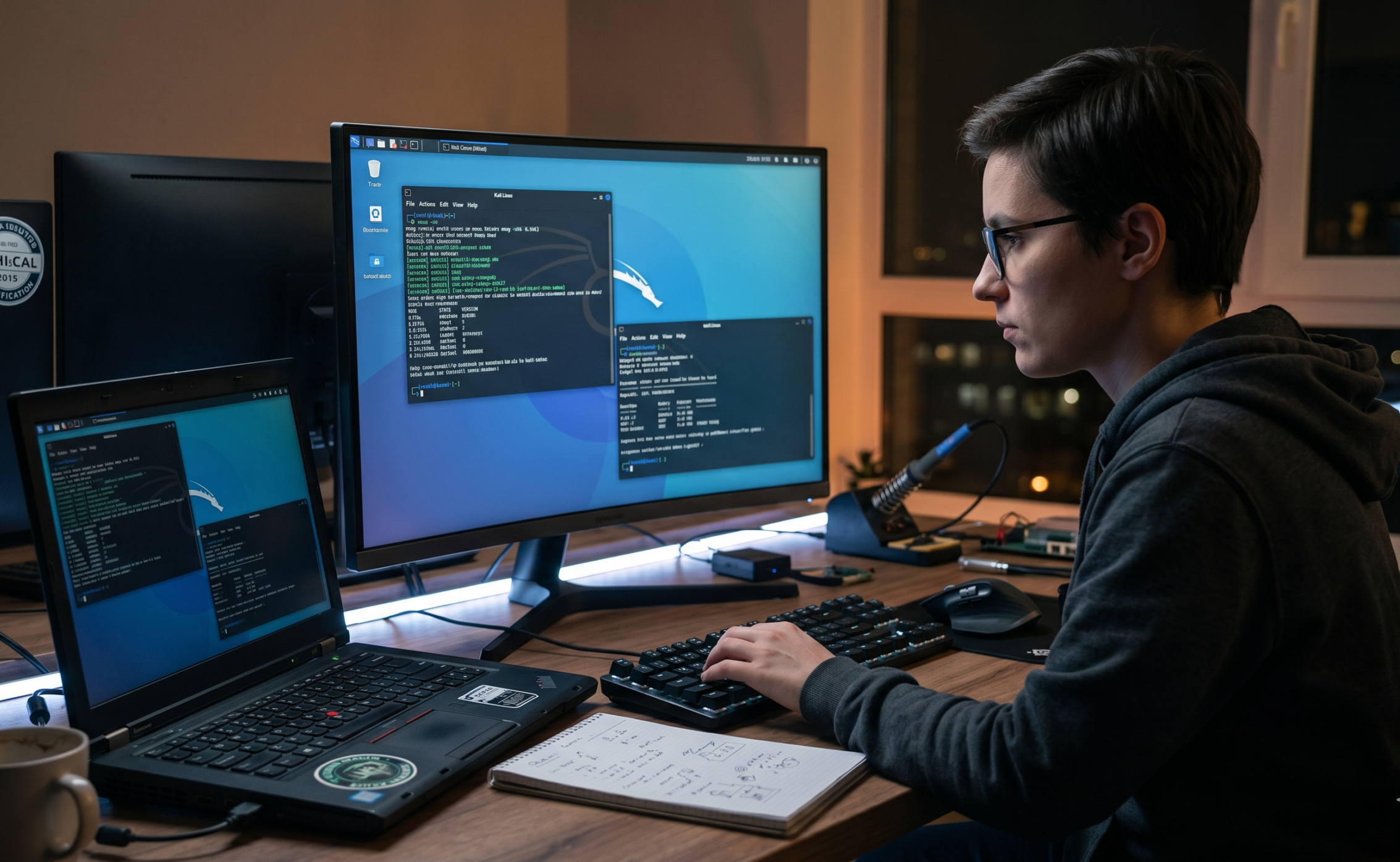
In the rapidly shifting architecture of cybersecurity, few platforms have commanded the enduring industry trust and structural dominance enjoyed by Kali Linux. Whether you are an entry-level student configuring your first isolated testing lab, an enterprise penetration tester conducting rigorous infrastructure assessments, or a red team operative simulating advanced adversarial tactics, Kali Linux is almost universally the default environment.
Over the years, it has transcended its status as a simple alternative operating system to become the standardized operational baseline for ethical hacking, vulnerability discovery, digital forensics, and proactive threat mitigation.
In 2026, against a backdrop of sophisticated, automated threat networks, the platform’s relevance is stronger than ever. Kali Linux succeeds not merely because it is a stable Linux distribution, but because it is engineered natively for the security practitioner. By bundling hundreds of specialized auditing utilities, supporting agile deployment architectures, and maintaining a massive, collaborative global ecosystem, Kali Linux offers an out-of-the-box infrastructure that saves security teams thousands of operational hours.
What Is Kali Linux?
Developed and continuously maintained by Offensive Security (OffSec), Kali Linux is an open-source, Debian-based Linux distribution designed from the ground up for advanced penetration testing, digital forensics, and security auditing.
[BackTrack Linux Heritage] ── Upgrade & Re-architecture ──> [Kali Linux Ecosystem]
Launched originally as the streamlined successor to the legendary BackTrack Linux project, Kali was rebuilt to maximize system stability, hardware compatibility, and modular execution. While consumer and commercial operating systems prioritize office productivity, media consumption, and restrictive user access controls, Kali Linux strips away these conventions. It provides a highly permissive, raw environment that treats the user as an absolute administrator, granting immediate, low-level control over network interfaces, kernel parameters, and hardware execution layers.
Using Kali responsibly requires a firm grasp of the underlying principles of defensive and offensive security paradigms. To understand how these assessments safeguard real-world organizations, explore our deep dive on Understanding Ethical Hacking: Types and Benefits.
A Massive, Pre-Configured Suite of Security Tools
The most immediate practical advantage of installing Kali Linux is its massive, meticulously curated library of pre-installed cybersecurity utilities. Rather than requiring engineers to manually download source code, resolve conflicting dependencies, and compile software for hundreds of distinct tools, a fresh Kali installation provides a weaponized security laboratory instantly.
These utilities are cataloged systematically across multiple disciplines, allowing practitioners to navigate smoothly through every phase of an engagement:
Information Gathering & Reconnaissance: Tools like Nmap and Maltego map attack surfaces, track open ports, and discover exposed network nodes.
Vulnerability Assessment: Platforms like Nikto scan configurations to identify unpatched flaws before malicious entities find them.
Web Application Auditing: Advanced proxy tools such as Burp Suite intercept, analyze, and manipulate HTTP/S traffic to identify systemic flaws like SQL injection or cross-site scripting.
Exploitation Frameworks: The Metasploit Framework enables testers to validate vulnerabilities safely by executing real-world exploit payloads in controlled environments.
Wireless Analysis: The Aircrack-ng suite provides robust packet capturing, injection, and cryptographic analysis tools for wireless networks.
Password Cracking & Cryptanalysis: Utilities like John the Ripper and Hashcat execute high-velocity dictionary and brute-force tests against compromised credential hashes.
Many of these identical frameworks serve as the foundation for professional validation standards globally. For a look at how these applications are implemented within industry assessments, see our guide on Certified Ethical Hacker Version 13 (CEHv13) Tools | CEH Practical.
Technical Flexibility: Multi-Platform Deployment Options
Modern security audits require practitioners to operate seamlessly across highly variable infrastructure environments. To meet this demand, Kali Linux features an incredibly flexible deployment architecture, allowing it to run across an array of hardware and virtual topologies.
| Deployment Target | Operational Use-Case | Practical Advantage |
| Bare-Metal Installation | Dedicated hardware laptops or security workstations. | Maximizes direct GPU power for password cracking; native wireless card injection. |
| Virtual Machines (VMs) | Isolated guest environments inside Windows or macOS hosts. | Snapshot capability allows immediate system rollbacks if an exploit causes system instability. |
| Cloud Environments (AWS/Azure) | Remote instances deployed in cloud infrastructure. | Allows testers to launch large-scale distributed scans and external phishing simulations. |
| Live USB Boot Drives | Portable, encrypted thumb drives with persistent storage. | Provides a fully functional forensic or testing environment on any host machine without touching the local hard drive. |
| ARM & Single-Board Computers | Deployment on Raspberry Pi or specialized mobile chipsets. | Ideal for physical red-team operations, allowing low-profile dropbox devices to be planted discreetly on local networks. |
An Exceptional Learning Environment for Aspiring Professionals
For individuals working to break into the cybersecurity space, Kali Linux serves as an invaluable, hands-on classroom. By working directly with the exact command-line utilities utilized daily by elite threat hunters and enterprise consultants, students bridge the gap between abstract computer science theory and practical execution.
[Theoretical Concept] ── Apply via Kali Terminal ──> [Hands-on Technical Competency]
Practicing with Kali in isolated, legal lab environments teaches students how data packets navigate networks, how operating system kernels manage memory privileges, and how configuration oversights leave businesses vulnerable. Because it is free and completely open-source, the barrier to entry is completely removed. Furthermore, mastering Kali Linux is a prerequisite for pursuing the industry’s most respected entry-level and intermediate credentials. To map out your educational path effectively, review our compilation of the Best Cybersecurity Certifications for Beginners.
Open-Source Transparency and Active Global Support
The open-source core of Kali Linux is vital to its status as a trusted security platform. Because security professionals must verify that their testing tools do not contain hidden malicious backdoors or unauthorized data-logging scripts, the complete transparency of Kali’s source code provides ironclad verification. Anyone can inspect, modify, and customize the operating system down to the kernel level.

Supporting this development is an active, global community of security enthusiasts and engineers. This collective knowledge ecosystem ensures that:
Zero-day patches and tool updates are delivered regularly via stable rolling-release models.
New tools are consistently reviewed, packaged, and integrated into official repositories.
Extensive public documentation, forums, and trouble-shooting guides exist to assist engineers in overcoming complex configuration hurdles.
Addressing the Misconception: Is Kali Linux Exclusively for Malicious Actors?
Because Kali Linux features a powerful collection of exploitation tools, popular media often associates it exclusively with underground cybercrime. This is a fundamental misunderstanding of the technology.
The Tool Ambiance: A lockpick can be used by a criminal to commit burglary, or by a licensed locksmith to secure a building or assist a locked-out homeowner. The technology itself is neutral; the legality and ethics are determined entirely by authorization.
Ethical hackers use Kali Linux under strict, legally binding contracts to uncover infrastructural weaknesses before malicious threat groups can capitalize on them. Organizations intentionally hire penetration testers to attack their perimeters, using the resulting reporting data to harden firewalls, patch software bugs, and train employees. When deployed with explicit authorization, Kali Linux is a powerful defensive asset that actively strengthens global digital perimeters.
Accelerating Security Competency with FireShark
Deploying Kali Linux and exploring its terminal interfaces is an exceptional technical step, but tool proficiency alone does not create an elite cybersecurity professional. True expertise requires understanding the underlying mechanics of network traffic, recognizing adversarial behavior patterns, and knowing how to implement protective controls across complex enterprise networks.
FireShark bridges the gap between basic utility mechanics and master-level security execution. Through comprehensive, hands-on instructional programs and real-world simulation scenarios, FireShark provides aspiring professionals and enterprise teams with the deep contextual training required to navigate advanced security landscapes.
By training students on proper auditing methodologies, legal compliance boundaries, and advanced risk remediation, FireShark transforms basic tool operators into highly capable security analysts and penetration testers. Equip yourself with the strategic instincts needed to defend critical networks by aligning your professional journey with FireShark’s specialized academies.
Conclusion
Kali Linux has earned its position as the premier operating system for the offensive and defensive security sectors by consistently delivering a flexible, dependable, and meticulously integrated ecosystem. Its massive repository of pre-packaged auditing applications, multi-platform deployment flexibility, and transparent open-source foundation make it an indispensable asset for security professionals worldwide. By utilizing Kali Linux to execute authorized, structured testing, security teams can proactively discover structural weaknesses, eliminate system exposures, and stay one step ahead of a complex, evolving threat landscape.
Frequently Asked Questions (FAQs)
1. Is it safe or recommended to use Kali Linux as a daily desktop operating system?
No. Kali Linux is explicitly engineered for penetration testing and security auditing, not general computing. It is configured to run with high root privileges by default and has various built-in security protections disabled or altered to allow for network packet manipulation and tools testing. For daily web browsing, gaming, or office work, standard distributions like Ubuntu, Fedora, or Windows are significantly safer choices.
2. Is using Kali Linux to scan a random website or network legal?
No. Running vulnerability scans, port maps, or exploitation scripts against any network, server, or device without the explicit, written authorization of the asset owner is illegal and can violate computer abuse laws. Ethical hacking must always be conducted within strict, pre-approved legal boundaries and isolated lab networks.
3. What is the minimum hardware required to run Kali Linux effectively?
Kali Linux is highly optimized and can run on modest hardware. At a baseline, a bare-metal installation requires a minimum of 2GB RAM (4GB+ recommended for graphical desktop environments), 20GB of disk storage space, and an Intel Core i3 or AMD equivalent processor. However, advanced tasks like high-speed password cracking require specialized dedicated graphics cards (GPUs).
4. What is the difference between a standard Linux distribution like Ubuntu and Kali Linux?
While both are Linux-based, Ubuntu is designed for general user productivity, stability, consumer hardware support, and ease of use. Kali Linux is stripped of general consumer bloatware and comes pre-packaged with hundreds of advanced network penetration and forensic utilities, configured natively to facilitate out-of-the-box security testing.
5. Do I need to be an expert programmer to start learning how to use Kali Linux?
No, you do not need to be an expert programmer to begin. However, having a foundational understanding of basic Linux command-line syntax, essential networking concepts (like TCP/IP, subnets, and ports), and basic scripting languages (like Bash or Python) will significantly accelerate your ability to use Kali’s toolset effectively.