Table of Contents
Introduction
Email remains the backbone of modern business communication, handling everything from customer interactions and financial transactions to password resets and internal collaboration. Because of its widespread use and inherent trust, email has become the most targeted attack vector for cybercriminals. While traditional phishing attacks have existed for decades, cybercrime has evolved into a highly organized industry. One of the most dangerous developments is Phishing-as-a-Service (PhaaS)—a business model where criminals sell ready-made phishing kits, hosting infrastructure, credential collection systems, and automation tools to anyone willing to pay.
Unlike earlier phishing campaigns that required technical expertise, PhaaS platforms have significantly lowered the barrier to entry. Today, attackers can subscribe to phishing services much like purchasing legitimate software subscriptions. These services provide customizable templates, automated deployment, credential dashboards, CAPTCHA bypass mechanisms, multi-factor authentication (MFA) interception, and analytics that measure campaign success. Even inexperienced attackers can launch sophisticated phishing campaigns targeting thousands of victims worldwide.
An often-overlooked weakness that enables these campaigns is the abuse of email relay infrastructure. Many organizations focus heavily on spam filters, antivirus software, and endpoint protection while overlooking vulnerabilities in mail relay configurations. Attackers exploit these blind spots to make malicious emails appear trustworthy, increasing delivery success and bypassing conventional email security controls.
This article explores how Phishing-as-a-Service bots exploit email relay blind spots, why these attacks are becoming increasingly successful, and what organizations can do to defend themselves.
Understanding Phishing-as-a-Service (PhaaS)
Phishing-as-a-Service operates similarly to legitimate Software-as-a-Service (SaaS) platforms. Instead of developing phishing websites, email templates, and infrastructure independently, criminals simply rent access to professionally maintained phishing platforms.
Subscribers typically receive access to phishing dashboards where they can generate fake Microsoft 365, Google Workspace, banking, cryptocurrency, or enterprise login pages. Many services include automated email delivery systems, stolen credential storage, visitor tracking, IP logging, geolocation filtering, and evasion techniques designed to avoid security detection.
Modern PhaaS kits continuously update themselves to mimic changing login portals, making fake websites nearly indistinguishable from legitimate ones. Some services even offer customer support through encrypted messaging platforms, demonstrating how organized cybercrime has become.
The result is a dramatic increase in phishing volume because technical expertise is no longer required.
What Is an Email Relay?
An email relay is an SMTP server responsible for forwarding emails between senders and recipients. Rather than delivering messages directly, mail servers often pass emails through multiple relay servers before reaching their final destination.
Email relays perform several essential functions:
- Routing emails across different mail servers
- Processing authentication
- Filtering spam
- Applying security policies
- Logging email activity
- Delivering outgoing messages
Properly configured email relays help maintain secure communication. However, poorly configured or inadequately monitored relay servers become valuable assets for attackers.
What Are Email Relay Blind Spots?
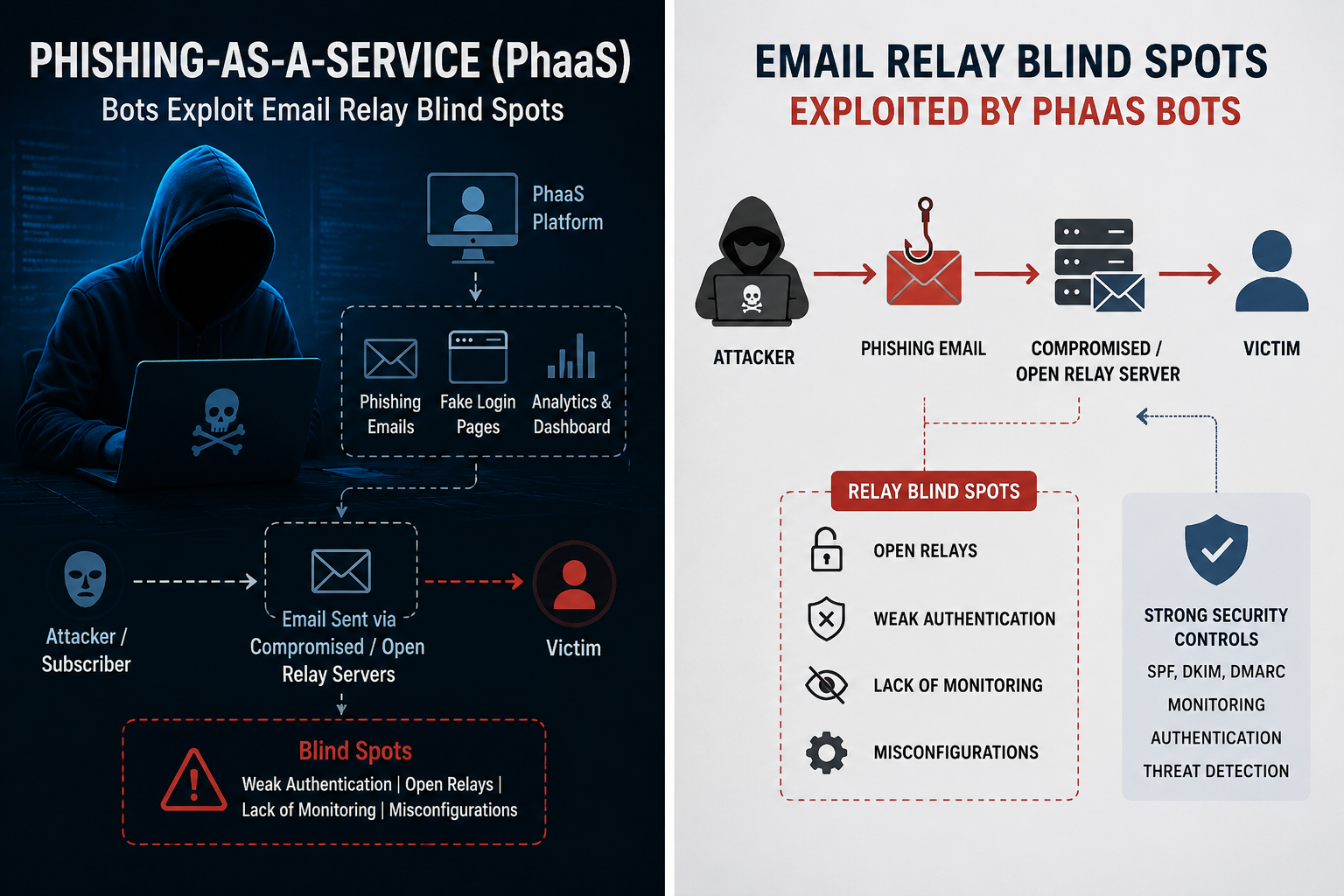
Email relay blind spots are security gaps where malicious email activity escapes visibility or security inspection.
These blind spots may arise due to:
- Misconfigured SMTP servers
- Open relay vulnerabilities
- Weak authentication policies
- Incomplete email logging
- Missing SPF, DKIM, or DMARC validation
- Third-party relay services with insufficient monitoring
- Internal mail forwarding systems
- Cloud-based email gateways lacking behavioral analysis
Because organizations often assume relay servers merely forward trusted traffic, security monitoring may be minimal. PhaaS operators exploit this assumption.
How PhaaS Bots Exploit Email Relay Blind Spots
Instead of sending phishing emails directly from malicious infrastructure, attackers increasingly abuse trusted relay services.
A typical attack begins when a PhaaS platform generates convincing phishing emails impersonating trusted brands such as Microsoft 365, Google, Adobe, Amazon, or banking institutions. Rather than sending these emails from suspicious domains, the platform routes them through compromised or poorly secured relay servers.
Since the relay server already has a positive reputation, many email filters assign the message a lower risk score.
Some attackers compromise legitimate business email accounts and use their outbound mail servers as relay points. Because recipients recognize the sender’s domain, they are far more likely to trust the email.
Others abuse cloud-based email platforms that allow authenticated SMTP relaying. After stealing valid credentials, attackers send phishing campaigns through legitimate cloud email infrastructure.
The email therefore appears authentic despite carrying malicious links or attachments.
How Relay Abuse Helps Bypass Security
Traditional email filtering heavily relies on domain reputation, sender authentication, IP reputation, and spam signatures.
Relay abuse weakens these protections because:
- Emails originate from trusted IP addresses.
- SPF validation often succeeds.
- DKIM signatures may remain valid.
- Domain reputation appears legitimate.
- SMTP connections originate from recognized infrastructure.
Many secure email gateways prioritize trust in authenticated relay servers, giving attackers a significant advantage.
Automation Makes PhaaS More Dangerous
Modern phishing bots continuously adapt during campaigns.
Automation enables them to:
- Rotate sender addresses
- Change phishing domains
- Randomize email subjects
- Generate unique URLs
- Personalize recipient names
- Schedule email delivery
- Detect spam filtering
- Retry failed deliveries
Some bots even monitor whether victims open emails or click links, automatically sending follow-up messages to increase success rates.
This level of automation makes large-scale phishing operations remarkably efficient.
Credential Theft Beyond Passwords
Today’s phishing campaigns rarely stop at stealing usernames and passwords.
Many PhaaS platforms now capture:
- Session cookies
- Authentication tokens
- Multi-factor authentication codes
- Browser fingerprints
- Device identifiers
- IP addresses
- Geographic information
Some advanced phishing kits intercept login sessions in real time using reverse proxy techniques, allowing attackers to bypass MFA without needing the victim’s password again.
Why Organizations Often Miss These Attacks
Many security teams concentrate on endpoint detection while assuming email gateways provide sufficient protection.
Unfortunately, relay abuse frequently avoids detection because:
- Outbound traffic appears legitimate.
- Internal relay servers receive limited monitoring.
- Security logs are incomplete.
- Authentication checks focus only on inbound email.
- Alert thresholds ignore low-volume campaigns.
- Cloud email platforms generate enormous log volumes that hide malicious activity.
Attackers intentionally spread phishing emails slowly to avoid triggering automated detection.
Real-World Techniques Used by PhaaS Operators
Current phishing campaigns commonly exploit:
- Microsoft 365 impersonation
- Google Workspace login pages
- Payroll portals
- Human Resources notifications
- Cloud storage sharing invitations
- Invoice payment requests
- DocuSign document approvals
- Password expiration alerts
- Security verification emails
Because these messages often originate from legitimate relay infrastructure, recipients rarely question their authenticity.
How Security Teams Can Reduce Email Relay Blind Spots
Organizations should treat email relays as critical security infrastructure rather than simple mail forwarding systems.
Key defensive measures include:
Implementing strict SMTP authentication ensures only authorized users can send mail through relay servers.
Deploying SPF, DKIM, and DMARC together significantly improves sender verification and reduces spoofing opportunities.
Continuous monitoring of relay logs helps detect unusual sending patterns, abnormal volumes, or geographic anomalies.
Behavior-based email security can identify suspicious activity even when messages originate from trusted infrastructure.
Limiting outbound relay permissions reduces opportunities for compromised accounts to distribute phishing emails.
Threat intelligence integration enables organizations to quickly identify malicious infrastructure associated with known PhaaS campaigns.
Multi-factor authentication for email administrators prevents attackers from hijacking relay configurations.
Regular security assessments should evaluate SMTP configurations, cloud email services, and third-party relay providers for hidden weaknesses.
The Role of Employee Awareness
Technology alone cannot eliminate phishing.
Employees should understand how modern phishing attacks differ from traditional spam. They must verify unexpected login requests, payment approvals, password reset emails, and document-sharing invitations before interacting with them.
Regular phishing simulations help employees recognize suspicious behavior while reinforcing secure reporting procedures.
An informed workforce significantly reduces the success rate of phishing campaigns.
How FireShark Helps Organizations Stay Protected
As phishing attacks continue to evolve, organizations require more than traditional spam filtering. FireShark assists businesses in strengthening their cybersecurity posture through advanced security assessments, email security evaluations, Vulnerability Assessment and Penetration Testing (VAPT), cloud security reviews, security awareness training, incident response, and proactive threat monitoring. By identifying email infrastructure weaknesses—including SMTP misconfigurations, authentication gaps, and relay vulnerabilities—FireShark helps organizations reduce the risk posed by modern Phishing-as-a-Service campaigns.
Conclusion
Phishing-as-a-Service has transformed phishing from isolated cyberattacks into a scalable criminal business model. By exploiting email relay blind spots, attackers can deliver highly convincing phishing messages through trusted infrastructure, bypassing many traditional security controls. As these attacks become more automated and sophisticated, organizations must move beyond basic spam filtering and adopt layered email security strategies that include strong authentication, continuous monitoring, behavioral analytics, and regular security assessments.
Protecting email infrastructure is no longer just an IT responsibility—it is a critical component of organizational cybersecurity. By addressing relay vulnerabilities and fostering user awareness, businesses can significantly reduce their exposure to one of today’s fastest-growing cyber threats.
Frequently Asked Questions (FAQs)
1. What is Phishing-as-a-Service (PhaaS)?
Phishing-as-a-Service (PhaaS) is a cybercrime business model where attackers provide ready-made phishing kits, fake login pages, email templates, and hosting services to subscribers, allowing even non-technical criminals to launch phishing attacks.
2. What are email relay blind spots?
Email relay blind spots are security gaps in email relay infrastructure caused by misconfigurations, weak authentication, insufficient monitoring, or improper email security policies. Attackers exploit these weaknesses to deliver phishing emails that appear legitimate.
3. How do PhaaS bots use email relays in phishing attacks?
PhaaS bots often route phishing emails through compromised or poorly secured email relay servers. This helps malicious emails bypass spam filters and security checks because they appear to come from trusted sources.
4. How can organizations protect themselves from relay-based phishing attacks?
Organizations should implement SPF, DKIM, and DMARC, secure SMTP relay configurations, enable multi-factor authentication (MFA), continuously monitor email traffic, and conduct regular security assessments to identify and fix relay vulnerabilities.
5. Why is employee awareness important in preventing phishing attacks?
Even with advanced email security, human error remains a major risk. Regular cybersecurity awareness training helps employees recognize suspicious emails, verify unexpected requests, and report phishing attempts before they cause damage.