
Table of Contents
Introduction
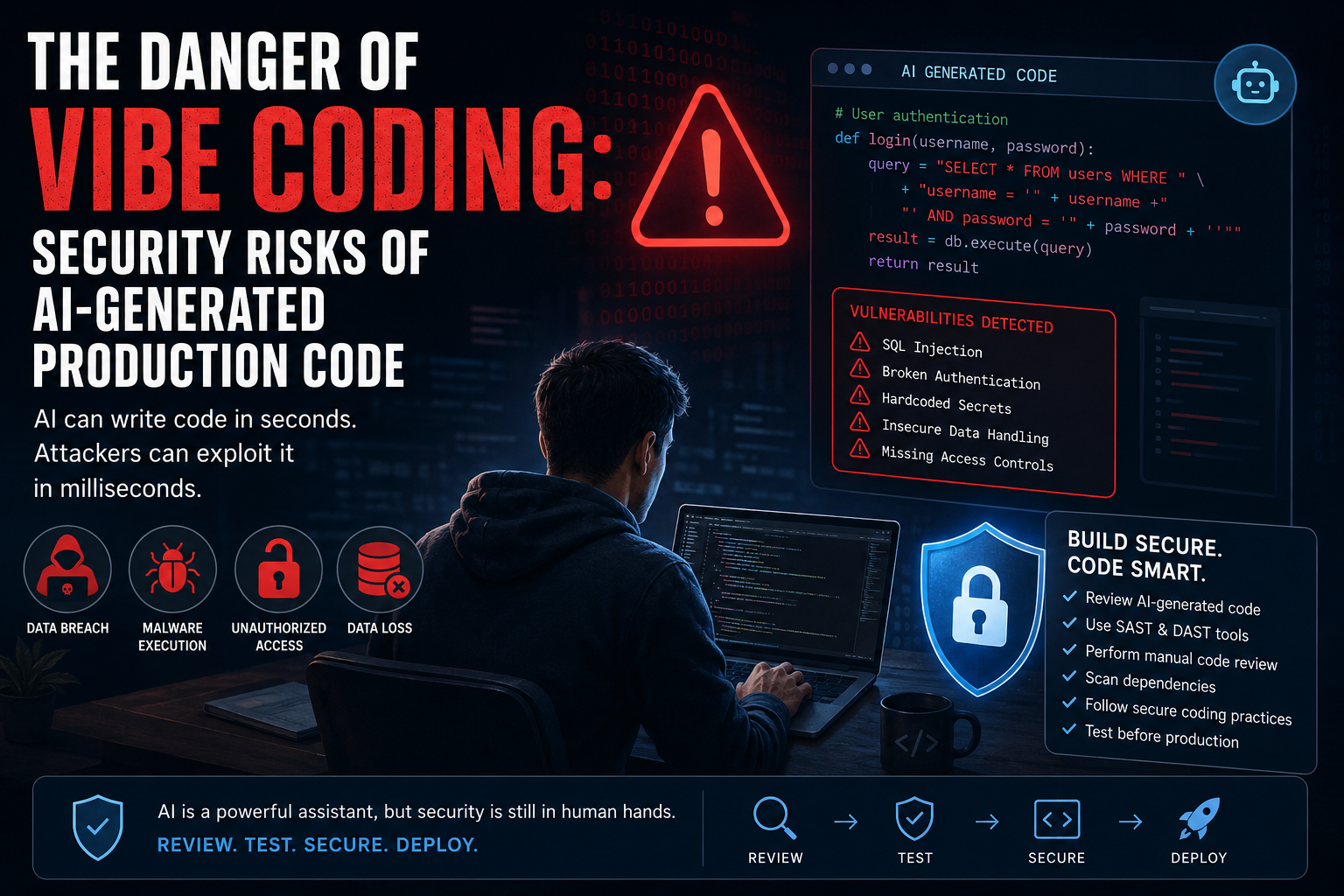
Artificial Intelligence has transformed software development. Modern coding assistants can generate entire functions, APIs, database queries, and even complete applications within seconds. Developers are increasingly relying on tools like GitHub Copilot, ChatGPT, Claude, and Gemini to accelerate development, reduce repetitive work, and solve programming challenges. This trend has given rise to a new phenomenon known as “Vibe Coding.”
Vibe coding describes the practice of building software by continuously accepting AI-generated code based on prompts and intuition rather than deeply understanding every line of code being written. Developers simply describe what they want, the AI generates it, and they move on to the next feature.
While this dramatically improves productivity, it also introduces one of the biggest emerging cybersecurity challenges in modern software development. When developers deploy AI-generated code into production without proper validation, they may unknowingly introduce vulnerabilities that attackers can exploit.
As organizations race to integrate AI into their development workflows, understanding the security implications of AI-generated production code has become more important than ever.
What Is Vibe Coding?
Vibe coding is an informal term used within the developer community to describe writing software by collaborating with AI rather than manually implementing every component.
Instead of carefully designing architecture, reviewing documentation, and understanding every algorithm, developers rely heavily on AI suggestions and rapidly assemble applications.
The workflow often looks like this:
- Ask AI to generate authentication logic.
- Accept the generated code.
- Ask AI to create APIs.
- Accept database models.
- Generate frontend components.
- Deploy.
The application appears functional, but much of the underlying logic hasn’t been thoroughly reviewed by a human expert.
This “trust-first” approach is where security risks begin.
Why AI-Generated Code Can Become Dangerous
Large Language Models generate code based on patterns learned from millions of public repositories, tutorials, blogs, and documentation.
The AI does not understand secure software design in the same way an experienced security engineer does. It predicts the most likely code that satisfies a prompt.
If insecure coding examples were common in training data, the AI may reproduce similar patterns.
Even when the generated code works perfectly, it may still contain:
- Weak authentication
- Missing authorization
- Poor input validation
- Unsafe database queries
- Hardcoded secrets
- Insecure cryptography
- Outdated libraries
- Race conditions
- Logic flaws
These vulnerabilities may remain hidden until attackers discover them.
Security Risk Vulnerable Authentication Logic
Authentication is one of the most security-critical parts of any application.
AI often generates simple login systems that appear functional but miss important security controls.
Common problems include:
- Weak password hashing
- Missing rate limiting
- No account lockout
- Poor session management
- Insecure JWT implementation
- Missing MFA support
An application may successfully authenticate users while still allowing credential stuffing or session hijacking attacks.
Security Risk SQL Injection
AI-generated database queries may directly concatenate user input into SQL statements.
For example, instead of using parameterized queries, generated code may build queries using string interpolation.
This opens the door to SQL Injection attacks where attackers manipulate database commands to:
- Read confidential data
- Modify records
- Delete databases
- Escalate privileges
Even experienced developers can overlook these issues when they trust AI-generated code without careful review.
Security Risk Cross-Site Scripting (XSS)
Many AI-generated web applications display user-generated content without proper output encoding.
If user input is inserted directly into HTML pages, attackers can inject malicious JavaScript.
Successful XSS attacks may allow attackers to:
- Steal cookies
- Hijack sessions
- Redirect users
- Perform actions on behalf of victims
These vulnerabilities remain among the most common web application security issues.
Security Risk Hardcoded Secrets
AI frequently includes example API keys, passwords, or secret tokens inside source code.
Developers sometimes forget to replace these examples before deployment.
Hardcoded credentials can expose:
- Cloud accounts
- Payment gateways
- Email servers
- Internal APIs
- Databases
Attackers actively scan public repositories looking for leaked credentials.
Security Risk Insecure Dependency Selection
AI-generated projects often recommend third-party libraries.
However, AI may choose:
- Outdated packages
- Vulnerable versions
- Abandoned projects
- Poorly maintained dependencies
Software supply chain attacks have become increasingly common because organizations inherit vulnerabilities through external packages.
Keeping dependencies updated and regularly scanning them is essential.
Security Risk Authorization Mistakes
Authentication verifies who a user is.
Authorization determines what they are allowed to do.
AI frequently generates endpoints that authenticate users correctly but forget to verify permissions.
For example:
- Normal users accessing administrator functions
- Customers viewing other customers’ data
- Employees modifying restricted records
Broken Access Control has consistently ranked among the most critical web security risks.
Security Risk Poor Error Handling
AI-generated applications often return detailed error messages intended for debugging.
These messages may reveal:
- Database schemas
- Internal file paths
- Stack traces
- Server technologies
- Framework versions
Attackers use this information to identify weaknesses and plan targeted attacks.
Production systems should provide generic error messages while logging technical details securely.
Security Risk Insecure Cryptography
Cryptography is difficult even for experienced developers.
AI sometimes recommends:
- Weak hashing algorithms
- Deprecated encryption methods
- Incorrect random number generation
- Poor key management
Using outdated cryptographic practices can compromise sensitive customer information even when the application appears secure.
Security Risk Business Logic Vulnerabilities
AI is excellent at generating syntax.
It is less effective at understanding business rules.
Examples include:
- Unlimited coupon redemption
- Negative payment values
- Double spending
- Inventory manipulation
- Price tampering
These vulnerabilities cannot always be detected by automated scanners because they involve application logic rather than coding mistakes.
Security Risk Overconfidence in AI
Perhaps the greatest danger is psychological rather than technical.
Developers naturally trust code that compiles and passes basic testing.
Because AI generates code quickly and confidently, people may assume it is correct.
This creates a false sense of security where important reviews are skipped.
Secure software development requires skepticism, regardless of whether code is written by humans or AI.
Real-World Impact
Organizations worldwide are rapidly integrating AI coding assistants into daily development.
While these tools significantly improve productivity, security researchers have repeatedly demonstrated that AI-generated code can contain exploitable vulnerabilities if used without review.
A single insecure authentication function or poorly validated API endpoint can expose:
- Customer information
- Financial records
- Healthcare data
- Intellectual property
- Internal infrastructure
The financial and reputational costs of a breach often far outweigh the time saved by accepting AI-generated code without verification.
Best Practices for Secure AI-Assisted Development
AI should be viewed as a productivity assistant rather than a replacement for secure software engineering.
A secure development workflow should include:
Human Code Review
Every AI-generated code snippet should be reviewed by an experienced developer before deployment.
Static Application Security Testing (SAST)
Use automated scanners to detect vulnerabilities during development.
Dynamic Application Security Testing (DAST)
Test running applications for real-world attack scenarios.
Dependency Scanning
Continuously monitor third-party libraries for known vulnerabilities.
Secure Coding Standards
Follow established practices such as input validation, output encoding, least privilege, and secure authentication.
Penetration Testing
Regular security assessments help identify weaknesses that automated tools may miss.
Developer Security Training
Teams should understand common vulnerabilities rather than relying entirely on AI-generated implementations.
AI Is a Powerful Assistant—Not a Security Expert
Artificial intelligence is revolutionizing software development by enabling faster prototyping, reducing repetitive coding tasks, and helping developers solve complex problems more efficiently. However, speed should never come at the expense of security.
AI generates code based on probability, not intent or security awareness. It cannot fully understand an organization’s business logic, compliance requirements, or threat landscape. Treating AI-generated code as production-ready without verification creates unnecessary risk.
Organizations that combine AI-assisted development with strong DevSecOps practices, automated security testing, manual code reviews, and regular penetration testing can benefit from AI’s productivity while maintaining a secure software supply chain.
The future of software development is undoubtedly AI-assisted—but secure software will always require informed human judgment.
Conclusion
Artificial Intelligence is transforming software development by enabling developers to build applications faster than ever before. AI coding assistants can significantly improve productivity, reduce repetitive work, and help teams deliver projects more efficiently. However, the growing trend of vibe coding—accepting AI-generated code without fully understanding or reviewing it—introduces serious security risks that organizations cannot afford to ignore.
While AI-generated code may appear functional and error-free, it can still contain hidden vulnerabilities such as SQL injection, broken authentication, insecure cryptography, hardcoded credentials, and authorization flaws. These weaknesses can expose sensitive data, compromise systems, and lead to costly cyberattacks if they reach production environments. Since AI generates code based on learned patterns rather than security awareness, it should never replace secure coding practices or professional security expertise.
To safely embrace AI-assisted development, organizations must combine the speed of artificial intelligence with robust DevSecOps practices, including manual code reviews, automated security testing, dependency scanning, penetration testing, and continuous developer security training. AI should be viewed as a powerful development assistant—not an autonomous security expert. By maintaining a strong security-first mindset, businesses can enjoy the productivity benefits of AI while protecting their applications, users, and data from evolving cyber threats.
Frequently Asked Questions (FAQs)
1. What is vibe coding?
Vibe coding is the practice of relying heavily on AI coding assistants to generate software without fully understanding, reviewing, or validating the generated code before deploying it. While it speeds up development, it can also introduce hidden security vulnerabilities if proper code reviews and security testing are skipped.
2. Is AI-generated code secure enough for production?
Not always. Although AI-generated code can be functional and well-structured, it may still contain security flaws such as SQL injection, Cross-Site Scripting (XSS), broken authentication, insecure cryptography, or hardcoded credentials. Every AI-generated code snippet should be reviewed, tested, and validated before being used in production.
3. What are the biggest security risks of AI-generated code?
Some of the most common risks include SQL Injection, Cross-Site Scripting (XSS), Broken Access Control, insecure authentication, exposed API keys, outdated third-party libraries, weak encryption, and business logic vulnerabilities. These issues can lead to data breaches, unauthorized access, and system compromise if left unaddressed.
4. How can developers securely use AI coding assistants?
Developers should treat AI as a productivity tool rather than a replacement for secure software engineering. Following secure coding standards, performing manual code reviews, using Static Application Security Testing (SAST), Dynamic Application Security Testing (DAST), dependency scanning, and regular penetration testing are essential for reducing security risks associated with AI-generated code.
5. Why is human code review still important in AI-assisted development?
Human code review is essential because AI does not truly understand business logic, security requirements, or organizational policies. Experienced developers and security professionals can identify vulnerabilities, logic errors, compliance issues, and security weaknesses that AI may overlook, ensuring the final application is both functional and secure.