

Introduction
Artificial intelligence has rapidly transformed enterprise operations. From AI-powered chatbots and customer support systems to intelligent data analytics and autonomous workflows, organizations increasingly rely on AI gateways to connect users, applications, and large language models (LLMs). These AI gateways act as centralized access points that authenticate requests, enforce policies, monitor usage, and route traffic between enterprise applications and AI services.
However, as AI adoption accelerates, cybercriminals are shifting their focus toward these critical gateways. One of the emerging threats is automated cryptomining malware, malicious software designed to secretly hijack enterprise computing resources for cryptocurrency mining. Unlike ransomware, which demands immediate payment, cryptomining malware often remains hidden for months, silently consuming CPU, GPU, memory, and cloud resources while significantly increasing operational costs.
Modern attackers are even combining artificial intelligence with automation to create malware capable of identifying vulnerable AI gateways, exploiting security weaknesses, and deploying mining payloads with little or no human intervention. Understanding this evolving threat landscape is essential for organizations that rely on AI-powered infrastructure.
Enterprise AI Gateways: The New Security Frontier
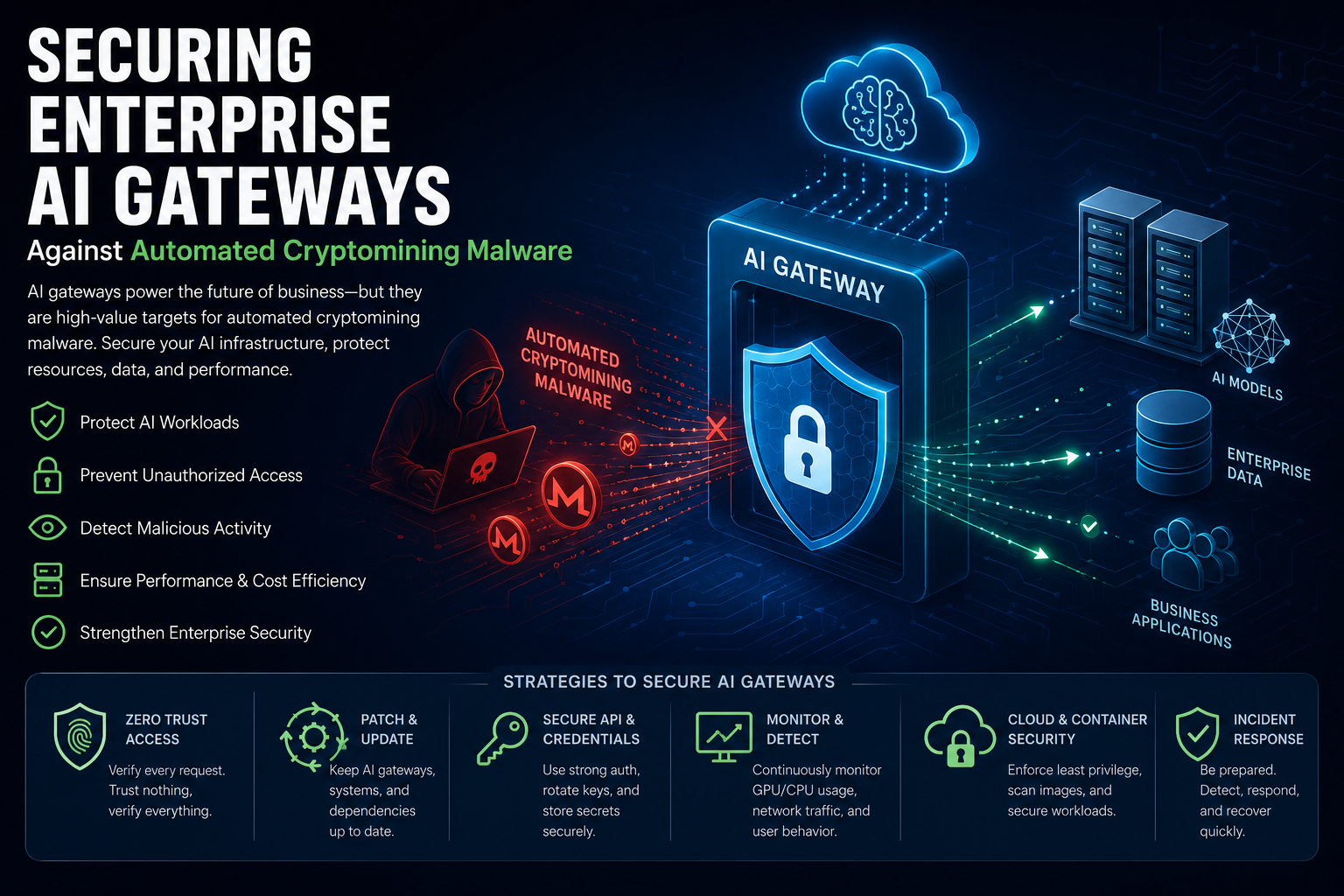
An enterprise AI gateway functions as the secure bridge between employees, business applications, and AI models. It manages authentication, request filtering, rate limiting, logging, compliance, and communication with AI providers or internally hosted models.
Because AI gateways process sensitive information and often possess elevated privileges across enterprise environments, they represent attractive targets for attackers. A compromised gateway may provide access to cloud infrastructure, AI workloads, APIs, databases, and GPU clusters.
As organizations deploy increasingly powerful AI systems, attackers recognize that these environments contain abundant computational resources—exactly what cryptomining malware requires.
Understanding Automated Cryptomining Malware
Cryptomining malware is designed to install itself on servers, workstations, containers, cloud instances, or Kubernetes clusters and use available hardware to mine cryptocurrencies such as Monero, which is particularly popular among attackers due to its privacy-focused architecture.
Traditional cryptomining malware often required manual deployment by attackers. Modern variants, however, operate with extensive automation. They continuously scan the internet for exposed services, vulnerable AI gateways, misconfigured cloud APIs, unsecured Docker containers, or outdated software. Once a weakness is identified, the malware automatically exploits it, installs itself, disables security controls, and begins mining cryptocurrency without the victim’s knowledge.
Some advanced malware families can even propagate laterally across enterprise networks, infecting additional systems and maximizing mining capacity.
Why AI Gateways Are Attractive Targets
Enterprise AI environments typically provide exactly the resources cryptominers seek.
Organizations invest heavily in GPU clusters capable of accelerating AI inference and machine learning workloads. These GPUs are exceptionally valuable for cryptocurrency mining because they deliver massive computational power.
AI gateways also maintain continuous communication with cloud platforms, internal APIs, storage services, and AI models. If compromised, attackers gain a strategic foothold that allows them to access multiple enterprise systems simultaneously.
Furthermore, many AI deployments operate continuously, meaning infected systems can mine cryptocurrency around the clock while blending into normal AI processing activities.
How Automated Cryptomining Attacks Work
An automated cryptomining attack generally begins with internet-wide reconnaissance. Attackers use automated bots to search for exposed AI gateways, open management interfaces, weak API authentication, or publicly accessible cloud services.
After identifying a vulnerable target, the malware exploits known software vulnerabilities, stolen credentials, exposed API keys, insecure containers, or default administrative accounts.
Once access is established, the malware installs persistence mechanisms that allow it to survive system reboots and software updates. It often disables antivirus software, modifies firewall rules, and attempts to evade detection by limiting CPU utilization during business hours.
The malware then downloads mining software, connects to remote mining pools, and begins generating cryptocurrency for the attacker.
Some sophisticated variants periodically update themselves, rotate mining pools, and download additional malware components, making detection increasingly difficult.
Security Risks Beyond Resource Theft
Many organizations mistakenly view cryptomining malware as merely an IT performance issue. In reality, the consequences can be far more severe.
An infected AI gateway may expose confidential enterprise data processed through AI applications. Sensitive prompts, customer information, financial documents, source code, and proprietary business intelligence may become accessible to attackers.
The malware may also serve as a backdoor for additional attacks, including ransomware deployment, credential theft, espionage, and lateral movement throughout the organization.
Continuous mining places sustained stress on CPUs and GPUs, accelerating hardware degradation while increasing electricity consumption and cloud infrastructure costs.
Performance degradation can also reduce AI response quality, slow customer-facing applications, and interrupt mission-critical business operations.
Common Entry Points for Cryptomining Malware
Several weaknesses frequently contribute to successful attacks against enterprise AI gateways.
Outdated AI gateway software containing unpatched vulnerabilities remains a primary target. Weak authentication mechanisms, exposed administrative dashboards, insecure APIs, and improperly configured cloud storage significantly increase organizational risk.
Attackers also exploit leaked API keys stored in public code repositories, stolen cloud credentials obtained through phishing campaigns, insecure Kubernetes deployments, vulnerable Docker containers, and overly permissive Identity and Access Management (IAM) policies.
Misconfigured GPU servers exposed directly to the internet further simplify malware deployment.
Warning Signs of a Cryptomining Infection
Organizations should monitor for several indicators that may suggest cryptomining malware activity.
Unexpected spikes in CPU or GPU utilization often occur even when AI workloads remain relatively stable. Cloud infrastructure costs may increase without corresponding business growth.
Servers may experience unusual overheating, increased fan speeds, slower AI inference, degraded application performance, or unexplained system instability.
Network monitoring tools may detect persistent outbound connections to unfamiliar mining pools or command-and-control servers.
Security logs may also reveal unauthorized scheduled tasks, modified startup services, suspicious container deployments, or unusual privileged account activity.
Best Practices for Securing Enterprise AI Gateways
Protecting enterprise AI gateways requires a layered security strategy that combines preventive, detective, and responsive controls.
Organizations should begin by implementing Zero Trust principles, ensuring every request is authenticated, authorized, and continuously verified regardless of its origin.
Strong multi-factor authentication should protect all administrative interfaces. Role-based access control should limit user privileges according to operational requirements.
AI gateway software, operating systems, container images, and AI frameworks should receive timely security updates to eliminate known vulnerabilities before attackers exploit them.
API keys and cloud credentials should never be hardcoded into applications or stored within source code repositories. Instead, organizations should use dedicated secrets management solutions.
Continuous monitoring of GPU utilization, cloud resource consumption, and network behavior enables early detection of unauthorized mining activity.
Endpoint Detection and Response (EDR), Extended Detection and Response (XDR), runtime container protection, and cloud workload protection platforms provide additional visibility into suspicious processes.
Organizations should also segment AI infrastructure from other business systems to reduce the impact of lateral movement.
The Role of AI in Defending Against AI-Powered Threats
Ironically, artificial intelligence itself has become one of the strongest defenses against automated attacks.
Modern AI-driven security platforms analyze billions of events in real time, identifying subtle behavioral anomalies that traditional signature-based antivirus solutions often miss.
Machine learning models can detect abnormal GPU utilization, unusual API request patterns, unauthorized container creation, unexpected privilege escalation, and suspicious outbound communication.
Behavior-based detection significantly improves an organization’s ability to identify cryptomining malware before major damage occurs.
Cloud Security Considerations
Many enterprise AI workloads operate in hybrid or public cloud environments, making cloud security especially important.
Organizations should continuously audit cloud permissions, monitor identity access, enforce least-privilege policies, encrypt data at rest and in transit, and enable comprehensive cloud logging.
Automated compliance monitoring helps identify insecure configurations before attackers exploit them.
Cloud-native security services combined with Security Information and Event Management (SIEM) platforms provide centralized visibility across AI infrastructure.
Incident Response for Cryptomining Attacks
When cryptomining malware is detected, organizations should immediately isolate affected systems from the network to prevent further spread.
Security teams should terminate malicious processes, collect forensic evidence, analyze attacker activity, remove persistence mechanisms, rotate compromised credentials, patch exploited vulnerabilities, and validate system integrity before returning affected systems to production.
Post-incident analysis is equally important because understanding how attackers gained access helps strengthen future defenses.
Future Outlook
As enterprise AI adoption continues to expand, attackers will increasingly automate cryptomining operations using artificial intelligence, autonomous scanning, and adaptive malware.
Future malware may intelligently evade detection, dynamically switch mining strategies, exploit AI-specific vulnerabilities, and use compromised AI gateways as launch points for broader cyberattacks.
Organizations that invest today in secure AI architecture, continuous monitoring, behavioral analytics, Zero Trust security, and proactive threat hunting will be significantly better prepared to defend against these evolving threats.
Conclusion
Enterprise AI gateways have become critical components of modern digital infrastructure, enabling organizations to harness the power of artificial intelligence securely and efficiently. Unfortunately, their valuable computational resources and privileged network access also make them attractive targets for automated cryptomining malware.
Protecting these gateways requires more than traditional antivirus software. Enterprises must adopt a comprehensive security strategy that includes strong identity management, secure API design, continuous monitoring, cloud security best practices, behavioral threat detection, and rapid incident response. By implementing layered defenses and remaining vigilant against evolving threats, organizations can safeguard their AI investments while ensuring their infrastructure remains resilient against increasingly sophisticated cryptomining attacks.
FAQs
1. What is automated cryptomining malware?
It is malicious software that automatically infects systems and secretly uses their computing resources to mine cryptocurrency without the owner’s knowledge.
2. Why are enterprise AI gateways targeted?
AI gateways often have access to powerful GPUs, cloud infrastructure, sensitive enterprise data, and privileged APIs, making them valuable targets for attackers.
3. How can organizations detect cryptomining malware?
Monitoring abnormal CPU/GPU usage, unusual cloud costs, suspicious outbound network traffic, unauthorized processes, and behavioral anomalies can help detect infections early.
4. Can AI-powered security tools stop cryptomining attacks?
Yes. AI-driven security solutions can analyze behavior, detect unusual resource consumption, identify anomalies, and respond to threats faster than traditional signature-based tools.
5. How can businesses strengthen AI gateway security?
By implementing Zero Trust architecture, MFA, regular patching, secure API management, secrets management, continuous monitoring, EDR/XDR solutions, network segmentation, and cloud security best practices.