Introduction
Cybersecurity threats continue to evolve alongside operating systems and defensive technologies. For years, Endpoint Detection and Response (EDR) solutions have successfully identified malware by monitoring suspicious processes, file modifications, registry changes, memory injections, and abnormal system calls. However, attackers are now exploiting technologies originally designed to improve system performance rather than compromise security.
One of the most concerning developments in modern Linux security is the emergence of eBPF-based malware. By abusing Extended Berkeley Packet Filter (eBPF), attackers can operate deep inside the Linux kernel while remaining extremely difficult to detect using conventional endpoint security tools.
Unlike traditional malware that runs as a visible user-space process, eBPF malware executes inside the kernel itself, allowing it to intercept network traffic, monitor processes, hide malicious activities, and manipulate system behavior with minimal traces. This shift represents a major challenge for organizations relying solely on conventional EDR solutions.
Understanding how eBPF works—and how attackers misuse it—is becoming essential for every cybersecurity professional.
What is eBPF?
Extended Berkeley Packet Filter (eBPF) is a Linux kernel technology that enables developers to safely execute custom programs inside the operating system kernel without modifying kernel source code.
Originally introduced for efficient packet filtering, eBPF has evolved into a powerful framework capable of monitoring almost every aspect of the operating system.
Today, organizations use eBPF for:
- Network monitoring
- Performance optimization
- Application observability
- Kubernetes networking
- Runtime security
- Cloud-native monitoring
- System tracing
- Container security
Because eBPF programs execute within the kernel, they can observe system activity with extremely low overhead compared to traditional monitoring tools.
This same capability unfortunately provides attackers with powerful opportunities.
Understanding eBPF Architecture
An eBPF program follows a structured workflow:
- A user-space application loads an eBPF program.
- The Linux verifier checks whether the code is safe.
- If approved, the program is attached to kernel hooks.
- The kernel executes the program whenever the specified event occurs.
- Results are stored in eBPF maps or returned to user space.
Because these programs execute directly inside the kernel, they gain visibility that traditional applications cannot achieve.
Why Attackers Love eBPF
Modern malware developers are constantly searching for stealthier execution methods.
Traditional malware often leaves traces such as:
- Running processes
- Scheduled tasks
- Files on disk
- DLL injections
- Suspicious services
- Registry persistence
eBPF malware avoids many of these indicators.
Instead of operating entirely in user space, malicious code executes inside the Linux kernel itself.
This significantly reduces the attacker’s visibility to conventional monitoring tools.
How Traditional EDR Solutions Work
Most Endpoint Detection and Response platforms rely on monitoring user-space activity.
Common detection methods include:
- Process creation
- File activity
- Memory injections
- Network connections
- PowerShell execution
- Command-line behavior
- Registry modifications
- DLL loading
- Parent-child process relationships
These methods are highly effective against conventional malware.
However, eBPF changes the visibility model entirely.
Instead of creating suspicious user-space activity, malicious behavior occurs within the kernel.
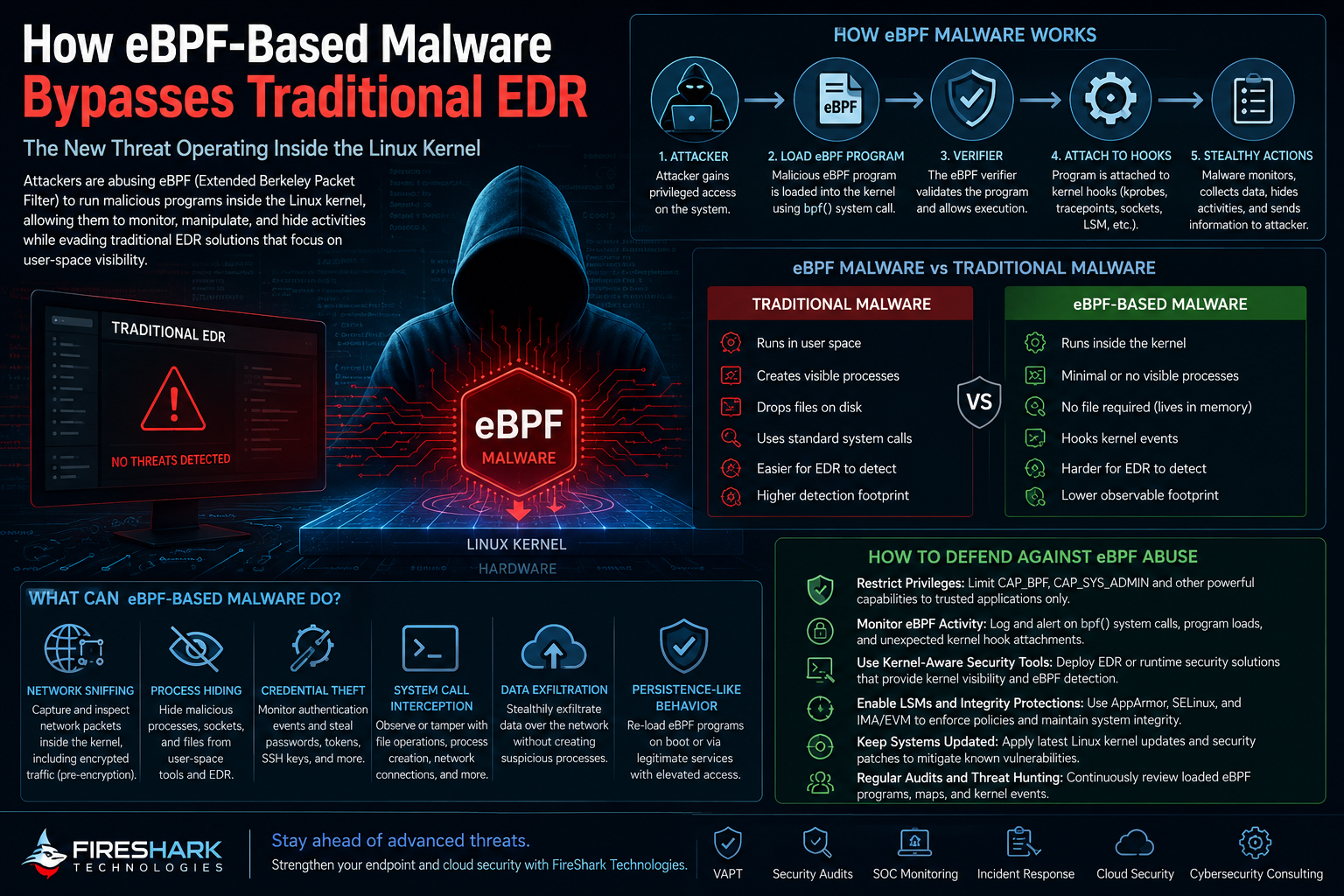
How eBPF Malware Bypasses Traditional EDR
1. Kernel-Level Execution
The biggest advantage of eBPF malware is its execution environment.
Instead of running as a standard executable, the malicious logic becomes part of the kernel’s event-processing pipeline.
Many EDR solutions primarily monitor user-space applications, meaning kernel-resident eBPF programs may not generate the expected telemetry.
Attackers can therefore observe or manipulate events without triggering many traditional behavioral detections.
2. Invisible Network Monitoring
One of eBPF’s strongest legitimate capabilities is packet inspection.
The same feature can be weaponized.
Malicious eBPF programs can:
- Capture network packets
- Inspect encrypted connections before encryption
- Monitor credentials
- Intercept API requests
- Track internal communications
Because packet processing occurs within the kernel networking stack, standard endpoint agents may have limited visibility into the collection process.
3. Process Hiding
Attackers can use eBPF hooks to interfere with how process information is exposed.
This can make malicious activities harder to notice during routine monitoring.
Some advanced malware attempts to:
- Hide specific processes
- Conceal network sockets
- Mask command execution
- Manipulate process information returned to monitoring tools
While this requires sophisticated techniques, it demonstrates how kernel-level control can undermine visibility.
4. System Call Interception
Every Linux application communicates with the kernel using system calls.
eBPF programs can attach to many kernel events related to these calls.
An attacker may observe or influence operations such as:
- File access
- Process creation
- Network activity
- User authentication
- Privilege changes
Rather than modifying applications directly, the malware operates where the operating system itself handles these requests.
5. Credential Collection
eBPF programs can monitor authentication-related kernel events.
Attackers may attempt to collect:
- Login attempts
- SSH sessions
- Authentication tokens
- User credentials
- Network authentication data
Because the monitoring occurs within kernel execution paths, it may evade tools focused only on user-space processes.
6. Rootkit-Like Capabilities
Although eBPF is not a rootkit by design, attackers can use it to achieve behavior reminiscent of rootkits, such as selectively hiding activity or observing sensitive events without modifying the kernel binary itself.
This makes forensic analysis more difficult.
eBPF Malware vs Traditional Malware
| Traditional Malware | eBPF Malware |
|---|---|
| Runs in user space | Runs within kernel context |
| Easier to detect | More difficult to observe |
| Visible processes | Minimal visible processes |
| Uses executable files | Uses eBPF programs |
| Easier behavioral detection | Lower observable footprint |
| Limited kernel visibility | Deep kernel access (within eBPF’s capabilities) |
Real-World Security Concerns
Researchers have demonstrated proof-of-concept malware that abuses eBPF for stealth, credential theft, packet interception, and persistence-like behavior. Security vendors and the Linux community have increasingly highlighted the need to monitor eBPF usage because it can be misused if attackers obtain sufficient privileges.
As eBPF adoption grows in cloud-native environments, Kubernetes clusters, and enterprise Linux systems, defenders must treat unauthorized eBPF program loading as a significant security event.
Why Cloud Environments Are at Greater Risk
Cloud infrastructure heavily depends on Linux.
Modern platforms increasingly use eBPF for:
- Kubernetes networking
- Container security
- Service meshes
- Runtime monitoring
- Observability platforms
If attackers compromise privileged workloads or hosts, abusing eBPF can allow them to blend in with legitimate kernel instrumentation.
Organizations should therefore maintain strict control over who can load eBPF programs.
Detecting eBPF-Based Malware
Traditional antivirus software alone is often insufficient for detecting malicious eBPF activity.
Effective detection strategies include:
- Monitoring for unexpected eBPF program loads.
- Auditing privileged operations such as the
bpf()system call. - Restricting kernel capabilities like
CAP_BPFandCAP_SYS_ADMINto trusted applications. - Enabling Linux Security Modules (LSMs) and integrity protections.
- Using runtime security tools that understand eBPF activity.
- Correlating endpoint telemetry with network and cloud logs.
- Keeping Linux kernels and security tooling up to date.
Best Practices to Prevent eBPF Abuse
Organizations can significantly reduce risk through layered defenses.
Keep Linux systems updated to receive the latest kernel security improvements. Apply the principle of least privilege so only trusted administrators or services can load eBPF programs. Harden container environments by avoiding unnecessary privileged containers and limiting host access. Continuously audit kernel events, enable secure boot where appropriate, and regularly review loaded eBPF programs and maps.
Security teams should also conduct periodic threat hunting focused on kernel activity rather than relying solely on user-space indicators.
The Future of Endpoint Security
As attackers continue moving toward kernel-level techniques, endpoint protection must evolve beyond traditional process monitoring.
Future EDR platforms are increasingly integrating:
- Kernel telemetry
- Runtime integrity validation
- eBPF-aware monitoring
- AI-assisted anomaly detection
- Behavioral analytics
- Cloud workload protection
- Container runtime security
Organizations that modernize their security architecture will be better positioned to detect sophisticated threats that operate beneath conventional visibility layers.
Conclusion
eBPF is one of the most innovative technologies introduced into the Linux kernel, powering observability, networking, and performance at scale. Yet its powerful capabilities also create opportunities for attackers who gain sufficient privileges to abuse it.
Because eBPF programs execute close to the operating system itself, malware leveraging this technology can reduce its observable footprint and challenge traditional EDR approaches that focus primarily on user-space activity. Defending against these threats requires kernel-aware monitoring, strong privilege management, continuous auditing, and a layered security strategy.
As Linux continues to dominate cloud infrastructure, containers, and enterprise servers, understanding both the benefits and risks of eBPF will be essential for security professionals. Organizations that proactively monitor and govern eBPF usage will be better equipped to detect advanced threats while still benefiting from the technology’s legitimate performance and observability advantages.
Frequently Asked Questions (FAQs)
1. What is eBPF in Linux?
eBPF (Extended Berkeley Packet Filter) is a Linux kernel technology that allows verified programs to run safely in kernel space for tasks such as networking, tracing, performance monitoring, and security.
2. Why can eBPF malware be difficult for traditional EDR tools to detect?
Because malicious logic may execute within kernel event hooks rather than as obvious user-space processes, reducing the visibility available to EDR tools that primarily monitor user-space behavior.
3. Does eBPF itself make Linux insecure?
No. eBPF is a legitimate and valuable feature. The risk arises when attackers with sufficient privileges abuse it for malicious purposes.
4. How can organizations defend against malicious eBPF usage?
Restrict privileges for loading eBPF programs, monitor bpf() activity, audit kernel events, use kernel-aware runtime security tools, and keep Linux systems updated.
5. Can eBPF be used for cybersecurity defense?
Yes. Many modern security platforms use eBPF for threat detection, runtime monitoring, network visibility, and cloud-native workload protection because it provides efficient, low-overhead access to kernel events.