Introduction
The modern digital workplace has changed dramatically over the last few years. Employees work remotely, cloud applications have become business-critical, IoT devices continue to grow, and cybercriminals are using increasingly sophisticated attack techniques. Traditional security models that rely on protecting only the network perimeter are no longer sufficient to defend modern organizations.
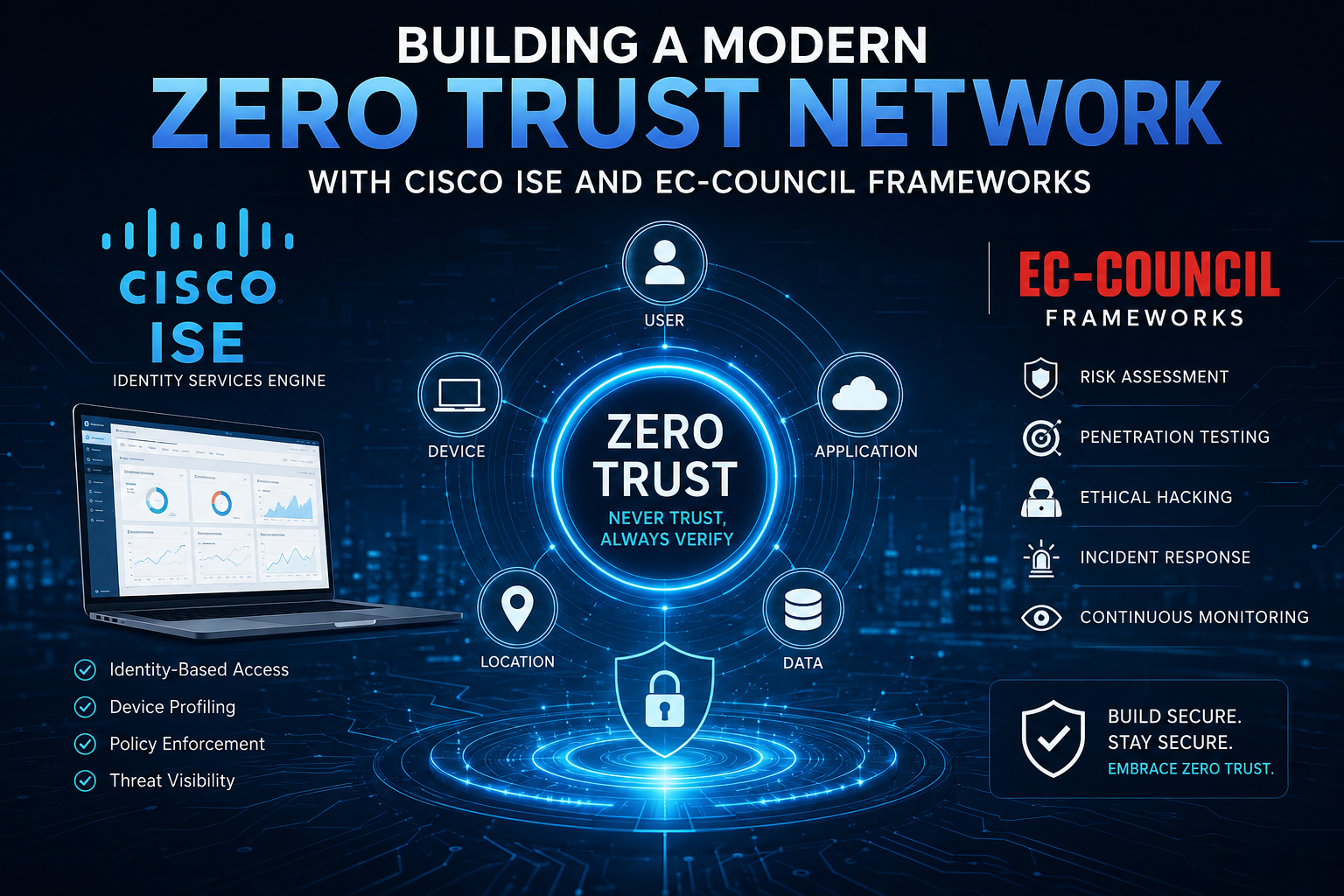
This is where Building a Modern Zero Trust Network becomes essential. Instead of automatically trusting users or devices once they are inside the corporate network, Zero Trust follows a simple but powerful principle:
Never Trust. Always Verify.
Every user, endpoint, application, and network request must be continuously authenticated, authorized, and monitored before access is granted.
Among the leading technologies enabling this approach is Cisco Identity Services Engine (Cisco ISE), which provides centralized identity management, policy enforcement, device profiling, and secure network access. When combined with the practical cybersecurity methodologies promoted through EC-Council frameworks, organizations can create a resilient, identity-driven security architecture capable of defending against today’s evolving cyber threats.
In this guide, we will explore how Cisco ISE and EC-Council frameworks work together to build a secure, scalable, and future-ready Zero Trust network.
Understanding Zero Trust Security
Traditional network security assumes that users inside the organization are trustworthy. Unfortunately, this assumption creates opportunities for attackers who gain access through stolen credentials, compromised devices, insider threats, or phishing attacks.
Zero Trust completely changes this mindset.
Instead of granting broad access after login, every request is evaluated based on multiple security factors, including:
- User identity
- Device health
- Location
- Time of access
- Risk score
- Security posture
- Network behavior
Even after access is granted, users continue to be monitored throughout their session.
This significantly reduces the attack surface and limits the damage caused by compromised accounts.
EC-Council Official Website for CEH v13 : https://www.eccouncil.org/train-certify/certified-ethical-hacker-ceh/
What is Cisco ISE?
Cisco Identity Services Engine (Cisco ISE) is Cisco’s flagship Network Access Control (NAC) platform that enables organizations to control who and what connects to their network.
Cisco ISE acts as the central policy engine for authentication, authorization, and accounting (AAA).
Its primary capabilities include:
- Identity-based access control
- Device profiling
- Guest access management
- BYOD onboarding
- Security group tagging
- Network segmentation
- Endpoint posture assessment
- Integration with Active Directory
- Multi-Factor Authentication support
- Threat response automation
Cisco ISE allows organizations to create highly granular security policies based on user roles instead of simply relying on IP addresses.
Why Zero Trust Requires Cisco ISE
One of the biggest challenges in cybersecurity is knowing exactly who is connecting to your network.
Cisco ISE solves this by verifying:
- User identity
- Device ownership
- Operating system
- Security compliance
- Antivirus status
- Endpoint encryption
- Patch level
- Device certificates
If a device fails security checks, Cisco ISE can automatically quarantine it or restrict access until compliance requirements are met.
This dynamic policy enforcement is one of the foundations of a successful Zero Trust implementation.
The Role of EC-Council Frameworks in Zero Trust
EC-Council has developed globally recognized cybersecurity training methodologies that help professionals understand both offensive and defensive security.
Rather than focusing solely on tools, EC-Council frameworks emphasize:
- Risk assessment
- Threat modeling
- Ethical hacking
- Incident response
- Security operations
- Penetration testing
- Vulnerability assessment
- Network defense
- Identity management
- Security governance
Professionals trained through programs such as CEH v13 AI, CPENT, CSA, and other EC-Council certifications gain practical skills needed to implement and maintain Zero Trust environments effectively.
These frameworks encourage continuous verification, layered security, and proactive threat detection—principles that align closely with Zero Trust.
Core Components of a Modern Zero Trust Network
A successful Zero Trust architecture includes several interconnected security layers.
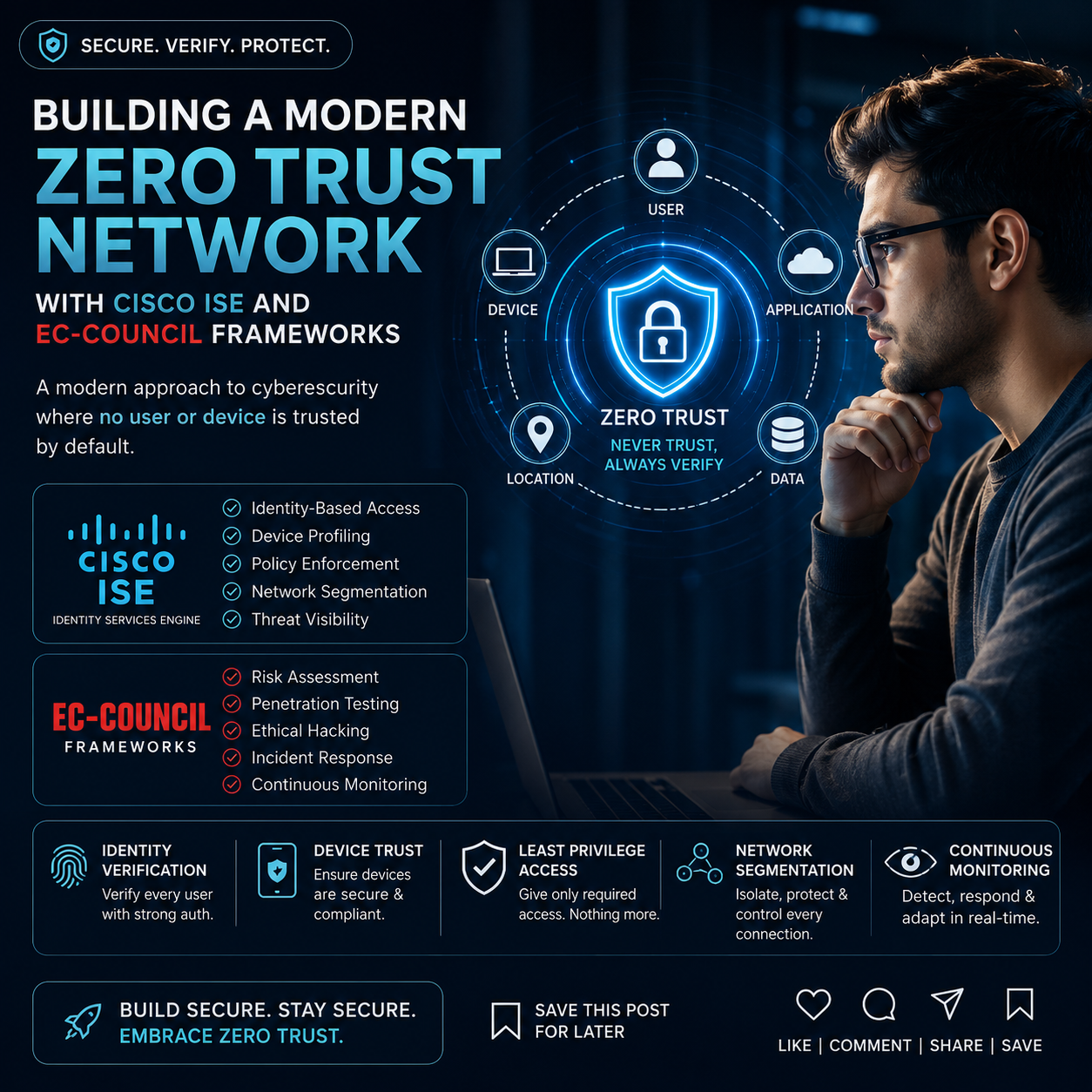
Identity Verification
Every user must be authenticated before gaining access.
Authentication methods include:
- Passwords
- MFA
- Biometrics
- Smart cards
- Digital certificates
Identity becomes the new security perimeter.
Device Trust
Not every authenticated user should receive access.
Cisco ISE evaluates whether devices meet organizational security standards before allowing connectivity.
Examples include:
- Antivirus installed
- Disk encryption enabled
- Latest patches applied
- Firewall active
- Operating system supported
Least Privilege Access
Users receive only the permissions necessary for their specific job responsibilities.
For example:
- HR staff access HR systems only.
- Developers access development servers only.
- Finance employees access financial databases only.
This minimizes lateral movement during attacks.
Network Segmentation
Instead of one large trusted network, Zero Trust divides infrastructure into multiple secure zones.
Cisco ISE enables dynamic segmentation using Security Group Tags (SGTs), allowing policies to follow users and devices regardless of physical location.
Benefits include:
- Reduced ransomware spread
- Better compliance
- Improved visibility
- Simplified policy management
Continuous Monitoring
Security does not stop after login.
Every activity is continuously monitored for:
- Suspicious logins
- Privilege escalation
- Malware behavior
- Abnormal traffic
- Insider threats
If risk increases, Cisco ISE can automatically revoke or restrict access.
How Cisco ISE and EC-Council Frameworks Work Together
Building a Modern Zero Trust Network becomes much more effective when technology and cybersecurity methodology complement each other.
Cisco ISE provides the technical enforcement layer, while EC-Council frameworks help security teams design, validate, and improve security strategies through practical knowledge and best practices.
For example, ethical hackers trained using EC-Council methodologies can simulate real-world attacks against an organization’s infrastructure. The results help security administrators refine Cisco ISE policies, strengthen authentication controls, improve network segmentation, and eliminate unnecessary permissions.
This continuous cycle of testing, monitoring, and improvement creates a mature Zero Trust security posture.
Best Practices for Implementing a Zero Trust Network
Organizations should begin by identifying critical assets and classifying users based on their roles. Every endpoint connecting to the network should undergo posture assessment before receiving access. Multi-Factor Authentication should be mandatory for privileged users, while least privilege principles should be applied consistently across all systems.
Network segmentation should isolate sensitive resources, and continuous monitoring should detect unusual activity in real time. Regular penetration testing and security awareness training further strengthen the environment by validating controls and reducing human risk.
Common Challenges
Implementing Zero Trust is not without obstacles. Many organizations operate legacy systems that lack modern authentication capabilities. Complex infrastructures with remote workers, cloud services, and IoT devices require careful planning and policy design.
Balancing strong security with a seamless user experience can also be difficult. However, with phased deployment, regular policy reviews, and ongoing staff training, these challenges can be effectively managed.
Why Cybersecurity Professionals Should Learn Cisco ISE and EC-Council Frameworks
As organizations increasingly adopt Zero Trust strategies, professionals with expertise in Cisco ISE, identity management, network access control, and EC-Council security methodologies are in high demand.
Skills in these areas enable professionals to design secure enterprise architectures, respond to modern cyber threats, and support compliance initiatives. Practical training and hands-on labs further prepare individuals to manage real-world security environments.
Conclusion
Building a Modern Zero Trust Network is no longer optional for organizations facing sophisticated cyber threats. By combining Cisco ISE’s identity-driven network access control with the practical methodologies offered through EC-Council frameworks, businesses can create a security architecture that continuously verifies users, protects critical resources, and minimizes the impact of attacks.
As enterprises continue adopting cloud services, remote work, and connected devices, Zero Trust will remain one of the most effective strategies for securing modern digital environments. Investing in the right technologies, skilled professionals, and ongoing cybersecurity education is key to maintaining a resilient and future-ready enterprise.
Frequently Asked Questions (FAQs)
1. What is a Zero Trust Network?
A Zero Trust Network is a cybersecurity model that assumes no user or device should be trusted by default. Every access request is continuously verified based on identity, device security, and contextual factors before permission is granted.
2. What is Cisco ISE used for?
Cisco Identity Services Engine (Cisco ISE) is a Network Access Control (NAC) solution that manages authentication, authorization, device profiling, posture assessment, and policy enforcement across enterprise networks.
3. How does Cisco ISE support Zero Trust?
Cisco ISE enforces identity-based access, verifies device compliance, enables dynamic network segmentation, integrates with authentication services, and continuously applies security policies to ensure only trusted users and devices access network resources.
4. How do EC-Council frameworks complement Zero Trust?
EC-Council frameworks provide practical methodologies for ethical hacking, penetration testing, risk assessment, incident response, and security operations. These practices help organizations validate and strengthen Zero Trust implementations.
5. Which cybersecurity skills are important for implementing Zero Trust?
Professionals should develop expertise in identity and access management (IAM), Cisco ISE, Network Access Control (NAC), Zero Trust Architecture, network segmentation, Multi-Factor Authentication (MFA), endpoint security, penetration testing, vulnerability assessment, SIEM, and security monitoring.