
Introduction
Artificial Intelligence (AI) has transformed the way businesses operate. From intelligent chatbots and virtual assistants to fraud detection systems and automated decision-making platforms, AI is now integrated into almost every industry. While these technologies improve productivity and innovation, they also introduce a new generation of cybersecurity threats that traditional security practices are not fully equipped to handle.
Attackers are increasingly targeting AI models through prompt injection, model poisoning, adversarial attacks, insecure plugins, data leakage, and unauthorized model manipulation. As organizations rapidly adopt Generative AI and Large Language Models (LLMs), the demand for professionals who understand both cybersecurity and AI application security has grown significantly.
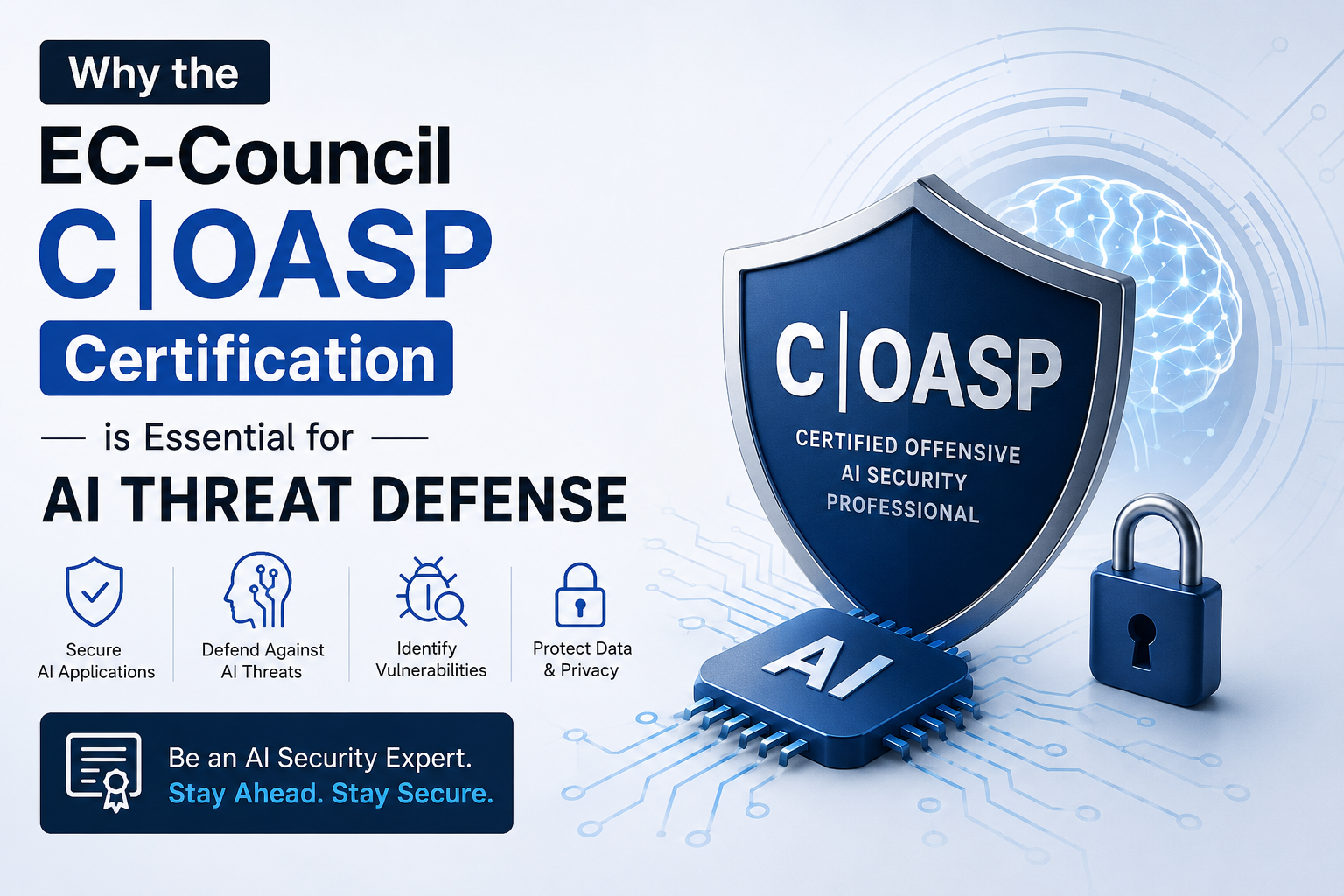
This is where the EC-Council C|OASP (Certified Offensive AI Security Professional) certification becomes invaluable. Designed specifically for securing AI-powered applications, C|OASP equips cybersecurity professionals with practical knowledge to identify, exploit, and defend against modern AI vulnerabilities.
Whether you’re an ethical hacker, penetration tester, SOC analyst, security engineer, or AI developer, this certification prepares you for one of the fastest-growing areas in cybersecurity.
The Rise of AI-Powered Cyber Threats
Artificial intelligence is changing cybersecurity on both sides of the battlefield.
Organizations use AI to automate threat detection and incident response, while cybercriminals leverage AI to create sophisticated phishing campaigns, malware variants, deepfake attacks, credential theft techniques, and automated vulnerability discovery.
Modern AI threats include:
- Prompt Injection
- Jailbreaking AI models
- Model Poisoning
- Data Leakage
- Training Data Manipulation
- AI Supply Chain Attacks
- Adversarial Machine Learning
- Plugin Exploitation
- Sensitive Information Disclosure
- Insecure AI APIs
Traditional penetration testing often overlooks these AI-specific attack vectors. Security professionals therefore require specialized knowledge focused on AI systems.
What is the EC-Council C|OASP Certification?
The Certified Offensive AI Security Professional (C|OASP) is an advanced cybersecurity certification developed to help professionals understand how AI systems can be attacked—and more importantly—how they can be secured.
Unlike traditional cybersecurity certifications, C|OASP focuses entirely on offensive AI security by teaching real-world attack techniques and defensive strategies for AI-powered applications.
The certification emphasizes hands-on learning, allowing professionals to understand vulnerabilities before attackers exploit them.
Why AI Security Skills Are No Longer Optional
Many companies are integrating ChatGPT-like assistants, AI copilots, recommendation systems, autonomous agents, and internal LLMs into their business operations.
Unfortunately, many of these applications are deployed without comprehensive security assessments.
As AI adoption increases, organizations require professionals capable of securing:
- Enterprise AI platforms
- LLM-powered applications
- AI APIs
- AI Agents
- AI-integrated SaaS products
- Machine Learning pipelines
- Generative AI applications
Professionals with AI security expertise are becoming some of the most sought-after cybersecurity specialists worldwide.
Key AI Threats Covered in C|OASP
The certification focuses on practical attack techniques commonly used against AI applications.
These include:
Prompt Injection
Attackers manipulate AI prompts to bypass safety restrictions or retrieve confidential information.
Prompt Leakage
Sensitive prompts containing internal business logic or confidential instructions may unintentionally become exposed.
Jailbreaking AI Models
Attackers exploit weaknesses in AI safety controls to force models into generating restricted or harmful outputs.
Model Poisoning
Malicious data inserted during training changes how AI systems behave.
Retrieval-Augmented Generation (RAG) Exploitation
Improperly secured knowledge bases may expose confidential organizational information.
AI Supply Chain Risks
Compromised third-party AI models, datasets, or plugins introduce security vulnerabilities.
Adversarial Inputs
Specially crafted inputs manipulate AI predictions while appearing normal to human users.
Hands-On Learning Makes the Difference
One of the strongest aspects of the EC-Council C|OASP certification is its practical approach.
Instead of learning theory alone, candidates work in hands-on labs where they identify vulnerabilities, exploit AI applications safely, and implement effective defenses.
Practical skills include:
- AI penetration testing
- Prompt injection testing
- AI API security assessment
- LLM security validation
- Secure prompt engineering
- AI threat modeling
- AI vulnerability assessment
- Secure deployment practices
Employers increasingly value professionals who can demonstrate practical AI security experience.
Alignment with OWASP AI Security Standards
Modern AI security requires adherence to industry-recognized frameworks.
The certification introduces professionals to security concepts inspired by the OWASP Top 10 for LLM Applications, helping them understand common risks associated with Generative AI systems.
Learning these standards enables professionals to perform more effective AI security assessments and recommend stronger defensive controls.
Career Benefits of Earning the C|OASP Certification
As organizations adopt AI at scale, AI security expertise is becoming a specialized career path.
Professionals holding the C|OASP certification may pursue roles such as:
- AI Security Engineer
- Offensive AI Security Specialist
- AI Penetration Tester
- AI Security Consultant
- Application Security Engineer
- Cloud Security Engineer
- AI Threat Analyst
- Red Team Operator
- AI Risk Assessor
- Cybersecurity Consultant
The certification also strengthens existing careers in ethical hacking, penetration testing, DevSecOps, and application security.
Why Organizations Value C|OASP Professionals
Organizations implementing AI face increasing regulatory and security challenges.
Hiring professionals with offensive AI security expertise helps organizations:
- Secure AI applications before deployment
- Prevent data leakage
- Reduce AI-related business risks
- Protect customer information
- Improve regulatory compliance
- Strengthen AI governance
- Detect vulnerabilities early in development
- Enhance secure software development practices
These capabilities directly reduce the likelihood of costly security incidents.
Best Practices for AI Threat Defense
Organizations should combine technical controls with trained professionals to secure AI systems effectively.
Recommended practices include:
- Validate all AI inputs.
- Restrict access using strong authentication.
- Monitor AI-generated outputs continuously.
- Perform regular AI penetration testing.
- Secure APIs and plugins.
- Encrypt sensitive AI data.
- Review third-party AI integrations carefully.
- Apply least-privilege access controls.
- Conduct periodic AI security audits.
- Keep AI models updated and monitored.
Professionals trained through the C|OASP certification understand how to implement these practices in real-world environments.
Why Choose FireShark for C|OASP Training?
For professionals looking to build practical AI security expertise, FireShark provides industry-focused cybersecurity training designed around hands-on learning.
Students gain exposure to real-world AI attack simulations, offensive security techniques, expert mentorship, practical labs, and certification guidance that help bridge the gap between theoretical knowledge and practical AI threat defense.
Whether you’re beginning your AI security journey or expanding existing cybersecurity skills, structured training can significantly improve your readiness for modern AI security challenges.
Conclusion
Artificial intelligence is transforming industries at an unprecedented pace, but it also introduces entirely new categories of cyber threats. Traditional cybersecurity skills alone are no longer sufficient to protect AI-powered applications.
The EC-Council C|OASP Certification prepares cybersecurity professionals to understand, identify, and defend against these emerging AI-specific risks through practical offensive security techniques and real-world labs.
As businesses continue integrating Generative AI into critical operations, professionals with AI security expertise will remain in high demand. Investing in specialized AI security training today is one of the smartest steps toward building a future-ready cybersecurity career.
Frequently Asked Questions (FAQs)
1. What is the EC-Council C|OASP Certification?
The EC-Council C|OASP (Certified Offensive AI Security Professional) certification focuses on identifying, exploiting, and defending against security vulnerabilities in AI-powered applications, including Large Language Models (LLMs), AI APIs, and Generative AI systems.
2. Who should pursue the C|OASP certification?
It is ideal for ethical hackers, penetration testers, SOC analysts, application security engineers, DevSecOps professionals, cloud security engineers, AI developers, and cybersecurity consultants who want to specialize in AI security.
3. What AI threats are covered in the C|OASP course?
The certification covers prompt injection, prompt leakage, AI jailbreaking, adversarial attacks, model poisoning, AI supply chain attacks, insecure AI APIs, Retrieval-Augmented Generation (RAG) vulnerabilities, and AI threat modeling.
4. Is C|OASP suitable for beginners?
While basic cybersecurity knowledge is beneficial, the certification is best suited for professionals with foundational experience in networking, cybersecurity, ethical hacking, or application security who want to expand into AI security.
5. How does C|OASP improve career opportunities?
As organizations increasingly adopt AI technologies, professionals with expertise in AI application security are in high demand. The certification helps qualify candidates for roles such as AI Security Engineer, Offensive AI Security Specialist, AI Penetration Tester, Application Security Engineer, and AI Security Consultant.