

Introduction
Digital marketing has evolved dramatically over the past decade, but no innovation has reshaped the industry as rapidly as Artificial Intelligence (AI). What once required hours of manual work, detailed market research, and massive teams can now be accomplished within minutes using AI-powered environments. From creating personalized customer journeys to automating repetitive operations and predicting precise consumer behavior, AI has become an absolute game-changer for businesses of all sizes.
Today, forward-thinking companies are no longer relying solely on traditional marketing channels. Instead, they are deeply integrating machine learning and predictive workflows into their campaigns to maximize operational efficiency, expand consumer engagement, and generate significantly higher returns on investment (ROI). Whether it is hyper-targeted content creation, programmatic email marketing, real-time social media management, or conversational customer support, AI is thoroughly rewriting the playbook for modern digital marketing.
The Evolution of Digital Marketing with AI
Traditional digital marketing depended heavily on human intuition and static historical data. Marketers had to spend days manually analyzing customer metrics, identifying demographic trends, drafting copy variations, and continuously A/B testing live campaigns. While these legacy methods laid the foundation for modern web metrics, they were fundamentally time-consuming and limited by how fast human teams could parse large datasets.
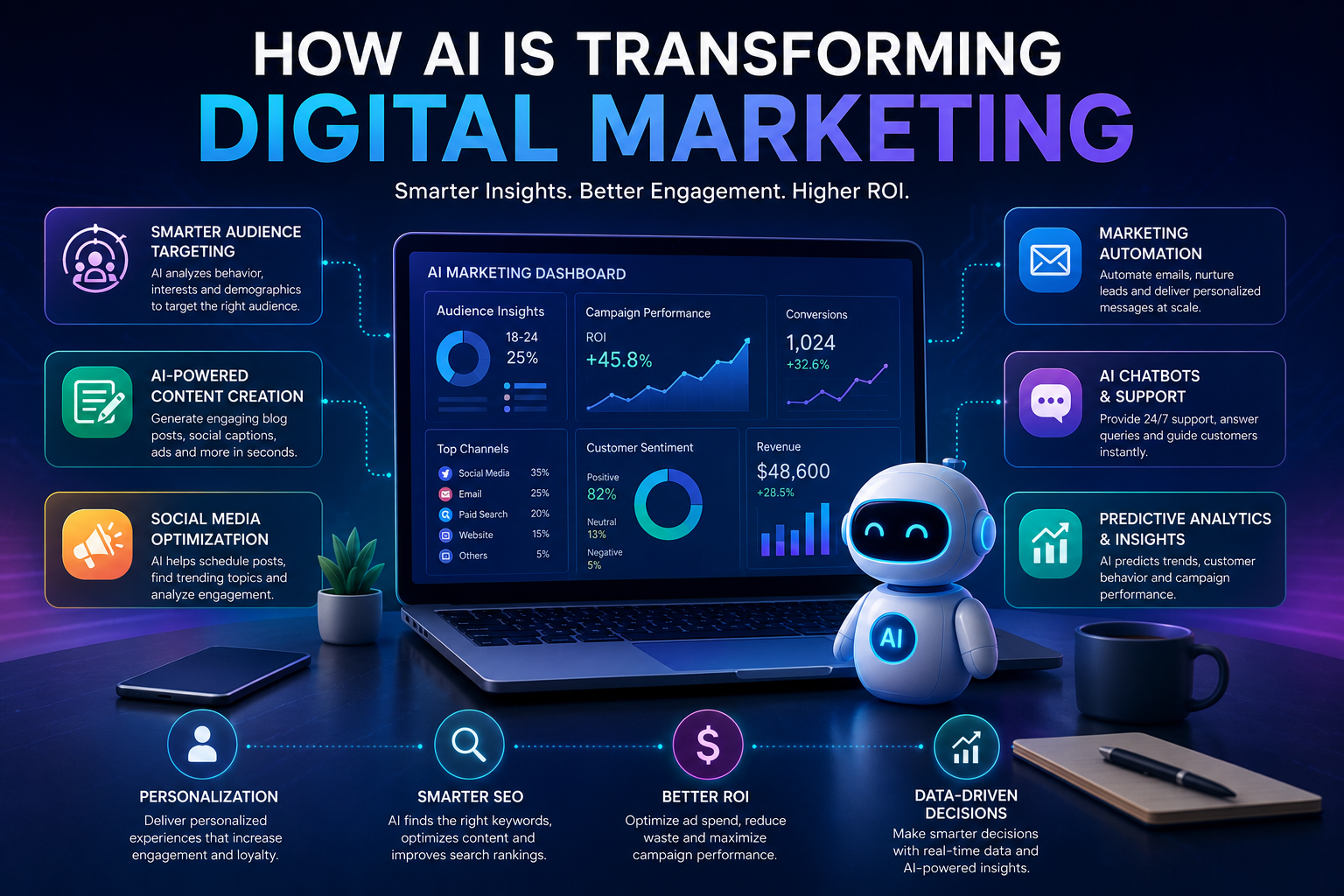
Artificial Intelligence has fundamentally upended this landscape by processing millions of data points in real time. Modern AI architectures analyze immediate behavioral signals, forecast shifting consumer trends, and dynamically recommend campaign pivots. Instead of guessing what a target demographic might want next, brands can now make hyper-informed, data-driven decisions. This strategic shift has effectively transformed digital marketing from a reactive operational model into a proactive, predictive engine.
Personalized Customer Experiences
One of AI’s greatest strengths is its ability to deliver personalized experiences at an unprecedented scale. Modern consumers expect brands to seamlessly understand their active preferences and deliver highly contextual product recommendations without friction. AI systems accomplish this by continuously monitoring user touchpoints, including:
Real-time browsing history and click patterns
Historical purchase behavior and basket configurations
Granular demographic parameters
Social media sentiment and multi-channel interactions
When a customer visits an e-commerce storefront, AI instantly analyzes their digital trajectory to surface products they are statistically most likely to purchase. Streamlining this data pipeline allows businesses to move away from rigid, uniform messaging and toward unique, individualized customer experiences.
However, as personalization scales up, consumers are becoming increasingly conscious of the data trails they leave across the web. Understanding how these tracking algorithms map online behaviors makes it critical for both businesses and consumers to understand What Is a Digital Footprint and Why It Matters Online. Balancing smart personalization with transparency is essential for maintaining consumer trust.
AI-Powered Content Creation: Text and Imagery
Content remains the central pillar of digital engagement, and AI has completely revolutionized how that content is conceptualized, created, and scaled. Advanced generative tools can instantly draft long-form blog concepts, write engaging ad copy, generate optimized meta tags, and even script social media video sequences with minimal human oversight.
When choosing the right engine to scale your copy and marketing assets, evaluating the underlying models is essential; find a detailed breakdown in our evaluation of ChatGPT vs Claude vs Gemini: Which AI Assistant Is Better?.
[Strategic Brief] ──> [Generative Text Engine] ──> [SEO-Optimized Multi-Platform Copy]
       │
       └────────────> [Generative Image Models] ──> [Hyper-Targeted Creative Assets]
Furthermore, generative AI isn’t confined to text alone. Visual marketing asset production has shifted into high gear with text-to-image architectures, allowing marketing design teams to rapidly generate custom illustrations, unique ad variations, and stylized brand art. For example, brands can unlock highly creative visual aesthetics by exploring workflows like Creating Ghibli-Style AI Images Using Grok 3 and ChatGPT.
The Hybrid Model: AI tools are most effective when positioned as a collaborative assistant. While algorithms provide unprecedented speed and structural optimizations, human creators provide the strategic storytelling, brand identity, and authentic empathy that truly connect with audiences.
Marketing Operations Transformation Matrix
To fully understand the shift taking place across enterprise marketing divisions, it helps to look at how traditional day-to-day operations compare directly to modern, AI-integrated workflows:
| Marketing Function | Legacy Approach | Modern AI-Driven Workflow |
| Search Engine Optimization | Manual keyword volume tracking and static, retroactive on-page structural audits. | Predictive search intent parsing, automated internal linking, and real-time content gap analysis. |
| Paid Ad Optimization | Periodic manual budget bidding adjustments and delayed split-testing review cycles. | Automated programmatic bidding, real-time creative asset testing, and predictive audience targeting. |
| Social Media Management | Fixed scheduling grids based on historical averages and broad demographic estimations. | Algorithmic timing adjustments based on live network activity and automated sentiment tracking. |
| Audience Segmentation | Broad, group-based indexing using rigid demographic buckets (e.g., age, geographic location). | Hyper-granular micro-segmentation updated dynamically based on real-time behavioral intent signals. |
Agentic AI Chatbots and Modern Customer Support
Customer service has transformed from a costly operational bottleneck into a proactive revenue driver through the introduction of advanced Agentic AI. Unlike the rigid, script-based legacy chatbots of the past, modern conversational AI agents understand complex context, remember previous multi-channel interactions, and deliver natural, conversational responses.
These intelligent agents operate 24/7/365, managing thousands of incoming queries simultaneously. They can resolve standard complaints, walk customers through purchasing funnels, and handle order adjustments autonomously. By taking over routine customer inquiries, AI allows human support personnel to focus their energy entirely on high-value, emotionally complex customer situations.
Predictive Analytics and Data-Driven Advertising
Digital advertising platforms rely heavily on AI to maximize the impact of every single ad dollar spent. By processing user demographics, precise micro-interests, and cross-platform browsing habits, predictive analytics ensures advertisements reach the absolute ideal viewer at the optimal time.
Instead of waiting for a multi-week ad campaign to conclude to review the performance reports, marketers can use predictive engines to assess campaign trajectories in real time. These tools can automatically reallocate budgets away from underperforming ad variations and toward winning campaigns. This constant, micro-level optimization helps organizations minimize wasted ad spend and dramatically improve their overall return on ad spend (ROAS).
Challenges and Security Risks of AI Adoption
Despite the massive competitive advantages, integrating AI into digital marketing requires navigating complex operational hurdles. Over-reliance on automated systems can occasionally result in generic, uninspired content that lacks true emotional depth. Furthermore, brands must carefully navigate data privacy regulations, ethical machine-learning standards, and absolute transparency regarding how user data is gathered and utilized.
Additionally, scaling up automated marketing ecosystems expands an enterprise’s data surface area, introducing significant corporate security vulnerabilities. Because automated platforms manage extensive pipelines of sensitive customer metrics, safeguarding this data from exploitation is paramount. To properly protect your corporate infrastructure and tech stack, it is vital to keep track of the Top Cybersecurity Threats Businesses Should Prepare for in 2026.
Conclusion
Artificial Intelligence is no longer a futuristic luxury in digital marketing—it is the core engine driving modern growth, personalization, and efficiency. From intelligent content creation frameworks and predictive SEO to automated optimization algorithms and autonomous conversational agents, AI enables brands to truly understand their target audience and deliver precise, real-world value.
The future of digital marketing belongs to a hybrid operational model: one where human creative direction, emotional intelligence, and strategic vision work hand-in-hand with the computational speed and analytics power of AI. Organizations that successfully balance these two forces will be exceptionally well-positioned to lead the market.
Frequently Asked Questions (FAQs)
1. What exactly is AI in digital marketing? AI in digital marketing refers to the integration of machine learning algorithms, natural language processing, predictive analytics, and automated workflows into standard marketing strategies. It is used to analyze real-time consumer data, personalize user content, optimize ad campaigns, and drive business growth.
2. Will AI completely replace human digital marketers? No. While AI can automate highly repetitive tasks and process complex data at incredible speeds, it cannot replace core human capabilities like creative storytelling, strategic brand building, emotional intelligence, and nuanced moral judgment. The most successful modern strategies position AI as an assistant to human talent.
3. How does AI help improve a website’s SEO? AI tools significantly improve SEO by instantly tracking shifting search engine algorithms, discovering high-value long-tail search terms, analyzing competitor layouts, identifying content coverage gaps, and automatically suggesting structural updates to improve overall readability.
4. What are the primary benefits of marketing automation? Marketing automation saves massive amounts of time, reduces internal operational overhead, prevents human entry errors, and ensures that customers receive timely, context-rich communication (such as personalized shopping cart abandonment reminders) completely automatically.
5. What are the biggest data privacy concerns tied to AI marketing? Because AI systems require extensive user metrics to fuel hyper-personalized experiences, businesses must strictly follow compliance frameworks like GDPR and CCPA. Organizations must ensure user data is safely gathered, transparently processed, and securely stored to avoid damaging leaks or regulatory penalties.