Introduction
In today’s digital era, encryption serves as the foundational bedrock of online security. Every time we send an email, process an online payment, authenticate onto social media platforms, or access critical cloud storage networks, encryption actively shields our sensitive records from unauthorized interception. The macro-security frameworks of modern banking infrastructures, confidential government communications, healthcare ecosystems, and even decentralized cryptocurrencies rely entirely on modern cryptographic algorithms.
Current encryption methods are built upon advanced mathematical problems that are practically impossible for classical computers to solve within a reasonable timeframe. For example, asymmetric algorithms like RSA depend on the extreme computational difficulty of factoring massive integers into prime factors, while Elliptic Curve Cryptography (ECC) relies on the discrete logarithm problem over elliptic curves—equations that would take traditional supercomputers hundreds of thousands of years to crack.
The primary assumption sustaining global data security is straightforward: while a mathematical solution exists, computing it requires an impractical amount of time and hardware resources. To better understand these baseline concepts before they are disrupted by next-generation hardware, explore our guide on Understanding the Difference Between Encryption and Decryption.
Understanding Quantum Computing
Unlike classical supercomputers that process information sequentially using bits represented strictly as either a binary $0$ or $1$, quantum computers leverage the bizarre laws of quantum mechanics. They utilize quantum bits, or qubits, which can exist in multiple fractional states simultaneously through a structural property known as superposition.
Furthermore, qubits can link together via a phenomenon called quantum entanglement. When qubits become entangled, the state of one qubit instantaneously influences the state of another, allowing the system to process complex mathematical calculations at speeds that classical transistors can never replicate.
This architectural shift allows an advanced quantum system to evaluate millions of potential solutions at the exact same time instead of checking them one by one. Rather than replacing classical computers entirely for everyday tasks, quantum computers will specialize as highly advanced processors meant to solve specific computational roadblocks that are currently deemed completely impossible.
Why Current Encryption Is Vulnerable
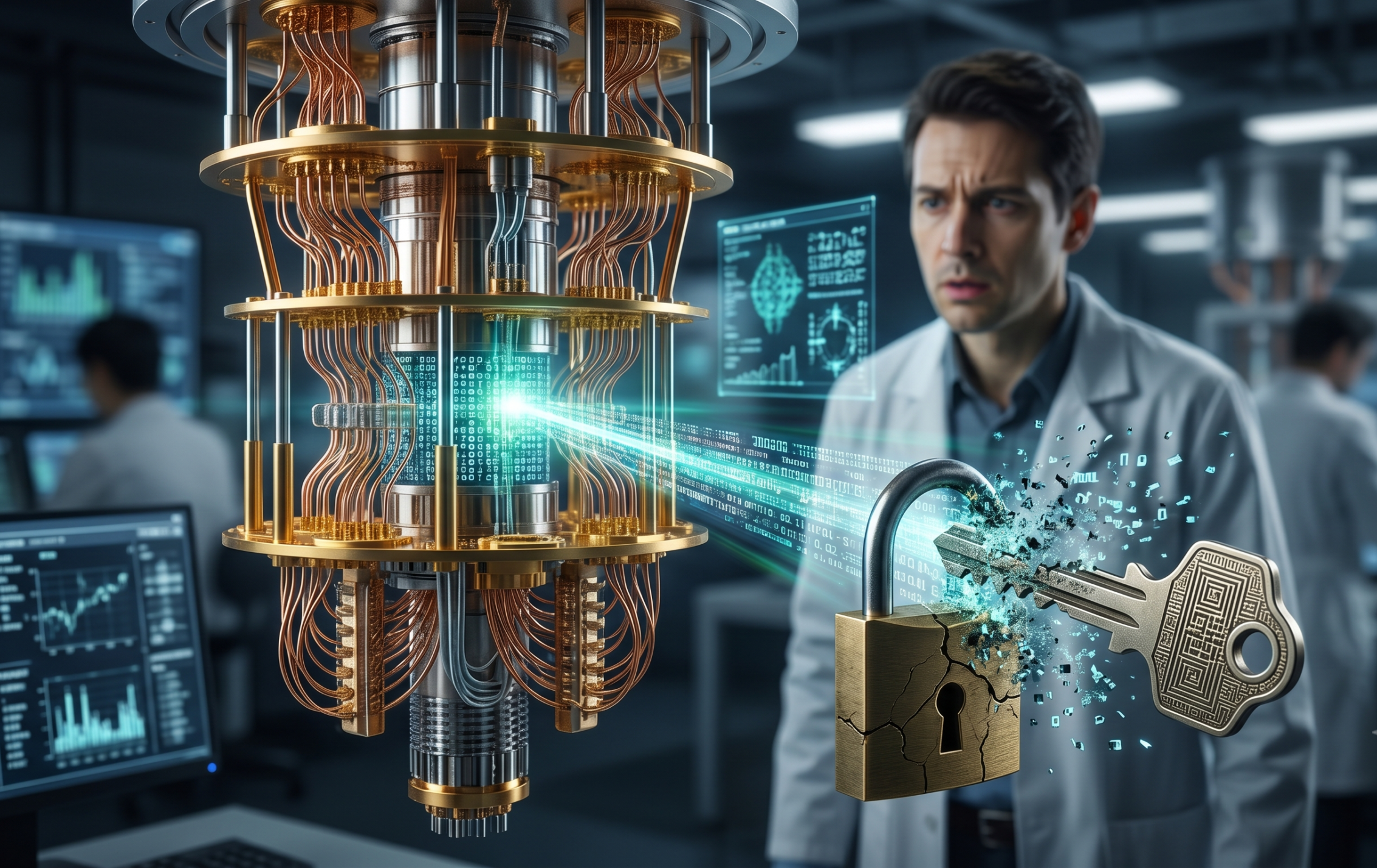
The existential crisis facing modern cybersecurity stems directly from a legendary mathematical breakthrough known as Shor’s Algorithm. Developed by mathematician Peter Shor, this quantum algorithm proves that a sufficiently scaled, fault-tolerant quantum computer could effortlessly factor large integers and solve discrete logarithms in a fraction of the time.
By running Shor’s Algorithm, a powerful quantum computer could fundamentally dismantle the underlying mathematical equations protecting RSA, Diffie-Hellman, and ECC frameworks. What would normally require millions of years of brute-force calculation for a classical machine could potentially be processed by an advanced quantum computer in minutes or hours.
[Classical Brute Force] ──> Requires Millions of Years (Secure Baseline)
[Quantum Shor's Algo]   ──> Solves Equations in Minutes (Complete Compromise)
As a result, critical secure protocols across multiple verticals could face total compromise:
Online banking frameworks and point-of-sale verification pipelines
Classified government communications and encrypted diplomatic cables
Military tactical command networks and satellite communication links
Proprietary corporate secrets, trade patterns, and industrial designs
Digital security certificates and Public Key Infrastructures (PKI)
Virtual Private Networks (VPNs)—even those utilized to secure enterprise channels or help consumers Experience Blazing Fast Internet with ZoogVPN
Blockchain verification layers, smart contracts, and cryptocurrency wallets
The “Harvest Now, Decrypt Later” Threat
Many organizations mistakenly assume that because functional, large-scale quantum computers do not yet exist, quantum threats pose no immediate danger. However, cybercriminals and nation-state threat actors are actively deploying an aggressive espionage strategy known as Harvest Now, Decrypt Later (HNDL).
In an HNDL operational scenario, adversaries intercept and siphon off vast quantities of highly encrypted corporate, state, and personal data today. They cannot read the stolen information right now, so they store it in massive, secure data repositories. Their long-term strategy is simple: hold onto the encrypted files until quantum computing architecture matures to a sufficient scale, then execute algorithms retroactively to unlock the compromised data.
This introduces severe, immediate risks for high-value data categories that require long-term confidentiality over several decades:
High-Value HNDL Targets:
Comprehensive medical histories and genomic data maps
Proprietary intellectual property, software codebases, and chemical patents
Classified government intelligence archives and operative identities
National defense plans, defense blueprints, and military configurations
Protected legal records, corporate mergers, and non-disclosure assets
Long-term corporate financial logs and institutional banking records
Cryptographic Vulnerability Matrix
Not all encryption methodologies face the same level of risk in a quantum-enabled threat landscape. The impact of quantum acceleration depends heavily on whether an algorithm relies on public-key infrastructure or symmetric keys:
| Cryptographic Algorithm | Primary Use Case | Quantum Risk Level | Primary Threat Vector / Mitigation |
| RSA | Public-key encryption, digital signing | Critical Risk | High vulnerability to Shor’s Algorithm; requires complete replacement. |
| ECC (Elliptic Curve) | Mobile security, key exchanges, blockchain | Critical Risk | Easily broken by Shor’s Algorithm due to lower key size thresholds. |
| Diffie-Hellman | Secure cryptographic key establishment | Critical Risk | Vulnerable to mathematical factorization via quantum acceleration. |
| AES-128 | Symmetric data-at-rest encryption | Moderate Risk | Vulnerable to Grover’s Algorithm, which halves effective symmetric security bits. |
| AES-256 | Enterprise-grade symmetric data encryption | Highly Resistant | Grover’s Algorithm reduces its strength to 128 bits, which remains completely uncrackable. |
The Rise of Post-Quantum Cryptography (PQC)
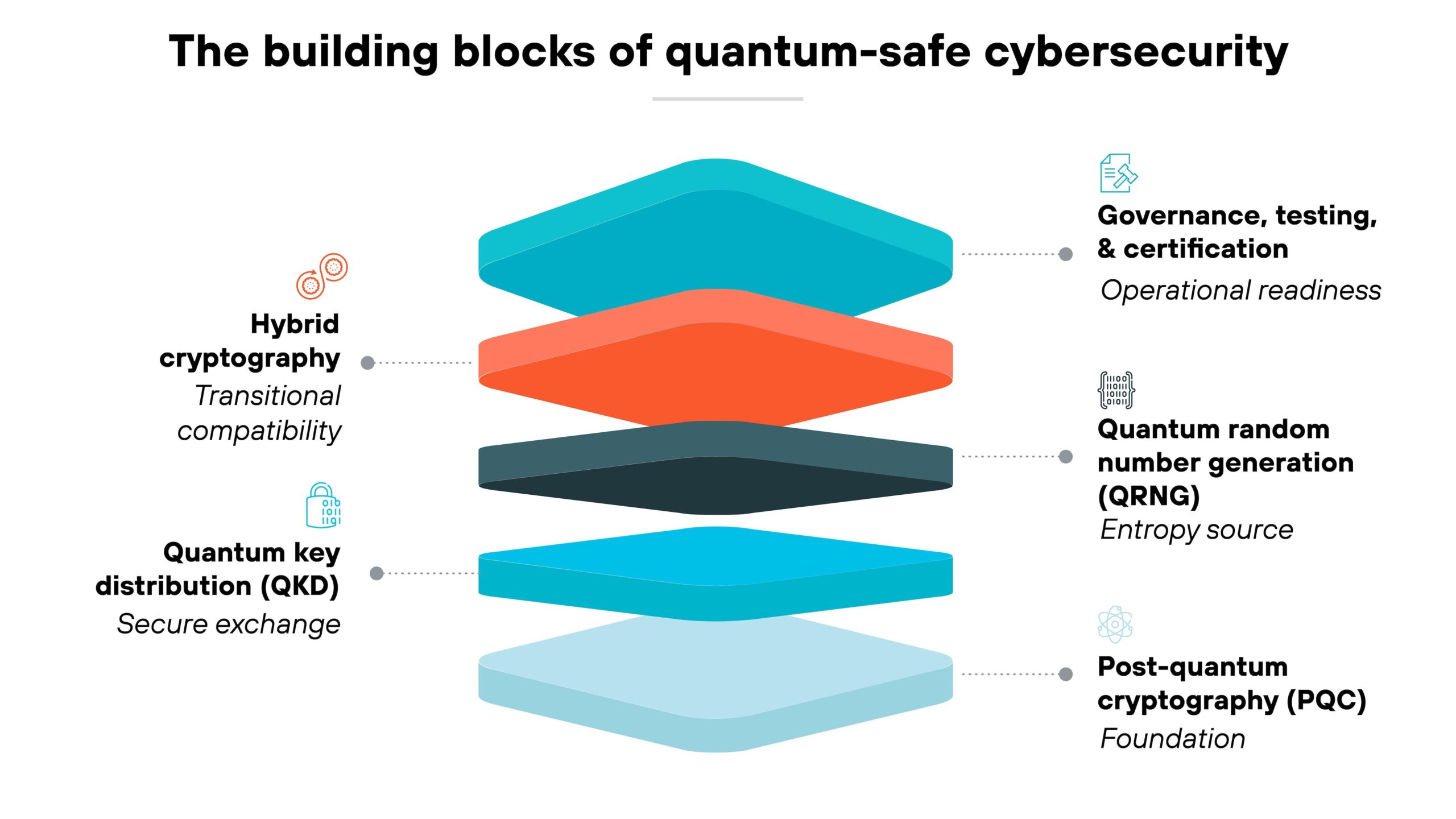
To counter this looming technological disruption, security researchers, mathematical institutes, and international standards bodies are aggressively developing Post-Quantum Cryptography (PQC). These represent next-generation mathematical frameworks engineered to remain secure against attacks from both classical supercomputers and advanced quantum systems.
Unlike current asymmetric architectures, PQC algorithms do not rely on integer factorization or discrete logarithms. Instead, they utilize incredibly complex mathematical structures—such as lattice-based cryptography, multivariate equations, and code-based frameworks—that have no known efficient shortcuts, even when processed by parallel qubit systems.
Transitioning the global internet infrastructure to these new standards is a massive puzzle that requires years of deliberate planning, software refactoring, and hardware updates before the old systems can be safely deprecated.
Impact on Businesses and Governments
Upgrading global cryptographic standards across billions of interconnected servers, enterprise applications, legacy databases, and consumer devices is a monumental task. This infrastructural migration must be treated as an urgent priority rather than a distant concern.
To safely survive this architectural shift, enterprise businesses and technology operators must take immediate, proactive steps:
Audit Cryptographic Assets: Inventory exactly where public-key encryption is currently deployed within your internal networks, APIs, and vendor configurations.
Evaluate Data Lifespans: Classify data assets based on long-term confidentiality needs to prioritize which pipelines require immediate PQC hardening against HNDL attacks.
Formulate Migration Roadmaps: Build structured implementation strategies to seamlessly transition out-of-date algorithms over to quantum-resistant alternatives.
Decouple Legacy Code: Update localized software platforms and underlying network hardware to support cryptographic agility.
Upskill Security Staff: Train internal cybersecurity personnel on emerging PQC engineering frameworks and deployment rules.
This transition must be managed alongside other pressing corporate operational risks. Organizations must evaluate how quantum preparation integrates into the broader context of the Top Cybersecurity Threats Businesses Should Prepare for in 2026. Furthermore, as traditional network perimeters become untrustworthy, many advanced firms are adopting a strict architecture based on What Is Zero Trust Security and Why Modern Companies Need It to protect internal communication pathways from structural compromise.
Conclusion
Quantum computing represents one of the most astonishing technological leaps of the modern era, but it simultaneously introduces an existential risk to the cryptographic systems that secure our digital world. Because the mathematical models protecting our most sensitive assets will eventually fall to quantum processing, the global security community has chosen to act long before the first decrypting qubits go live.
While fault-tolerant, large-scale quantum attacks are not an immediate threat today, the timeline required to migrate global infrastructure demands early action. Organizations that audit their systems, prioritize data agility, and adopt post-quantum solutions early will be best positioned to protect their data and maintain trust in a quantum-powered world.
Frequently Asked Questions (FAQs)
1. What exactly is quantum computing?
Quantum computing is a next-generation computing paradigm that utilizes the principles of quantum mechanics—specifically superposition and entanglement—to process specific, highly complex mathematical problems exponentially faster than traditional silicon-based classical supercomputers.
2. Why does quantum computing pose a threat to our current encryption?
Advanced quantum computers can run specialized processes like Shor’s Algorithm. This mathematical framework allows quantum systems to quickly solve the complex integer factorization and discrete logarithm problems that form the security foundations for widely used public-key systems like RSA and ECC.
3. Will a quantum computer break every single type of encryption?
No. Public-key infrastructure (asymmetric encryption) is highly vulnerable and will need to be completely replaced. However, symmetric encryption algorithms like AES-256 are naturally resilient against quantum acceleration; while quantum algorithms can speed up attacks against them, using large 256-bit keys provides plenty of security to keep data safe.
4. What is Post-Quantum Cryptography (PQC)?
Post-Quantum Cryptography refers to new, advanced cryptographic systems designed to secure data against attacks from both classical computers and future quantum systems. These algorithms are built on intricate mathematical structures like lattice cryptography that have no known shortcuts.
5. Why should businesses prepare for quantum threats right now if the hardware isn’t ready?
Organizations must prepare immediately due to the “Harvest Now, Decrypt Later” strategy, where threat actors steal encrypted data today to decrypt it once quantum computers mature. Because re-engineering global infrastructure takes years, delaying preparation leaves long-term data highly vulnerable to future exposure.