
Introduction
Ransomware stands out as one of the most destructive cyber threats confronting modern businesses, government entities, healthcare institutions, and educational organizations. Today, cybercriminal groups operate like highly organized, well-funded enterprises. They systematically plan their intrusions to inflict maximum operational disruption and financial leverage. Security leaders routinely classify these extortion campaigns among the top cybersecurity threats businesses should prepare for in 2026.
Threat actors generally secure their initial foothold through predictable entry points: deceptive phishing campaigns, stolen identity credentials, unpatched remote access gateways, or software vulnerabilities. However, the initial compromise of a single laptop or user account is rarely the true catastrophe. The real crisis begins with ransomware sprawl—the rapid, uncontrolled lateral movement of malware across internal networks. Within hours, a localized breach can expand to paralyze an entire global operation.
Network segmentation serves as a fundamental architectural defense against this exact threat. By dividing a massive network into distinct, isolated compartments, organizations can restrict communication, trap malware at its entry point, and prevent a single compromised device from triggering a catastrophic enterprise-wide shutdown.
Understanding Network Segmentation
Network segmentation is the operational practice of partitioning a large, unified computer network into multiple smaller, independent sub-networks or zones. Devices, data repositories, applications, and users within a specific segment can only communicate with resources in another segment via tightly regulated, strictly monitored data pathways.
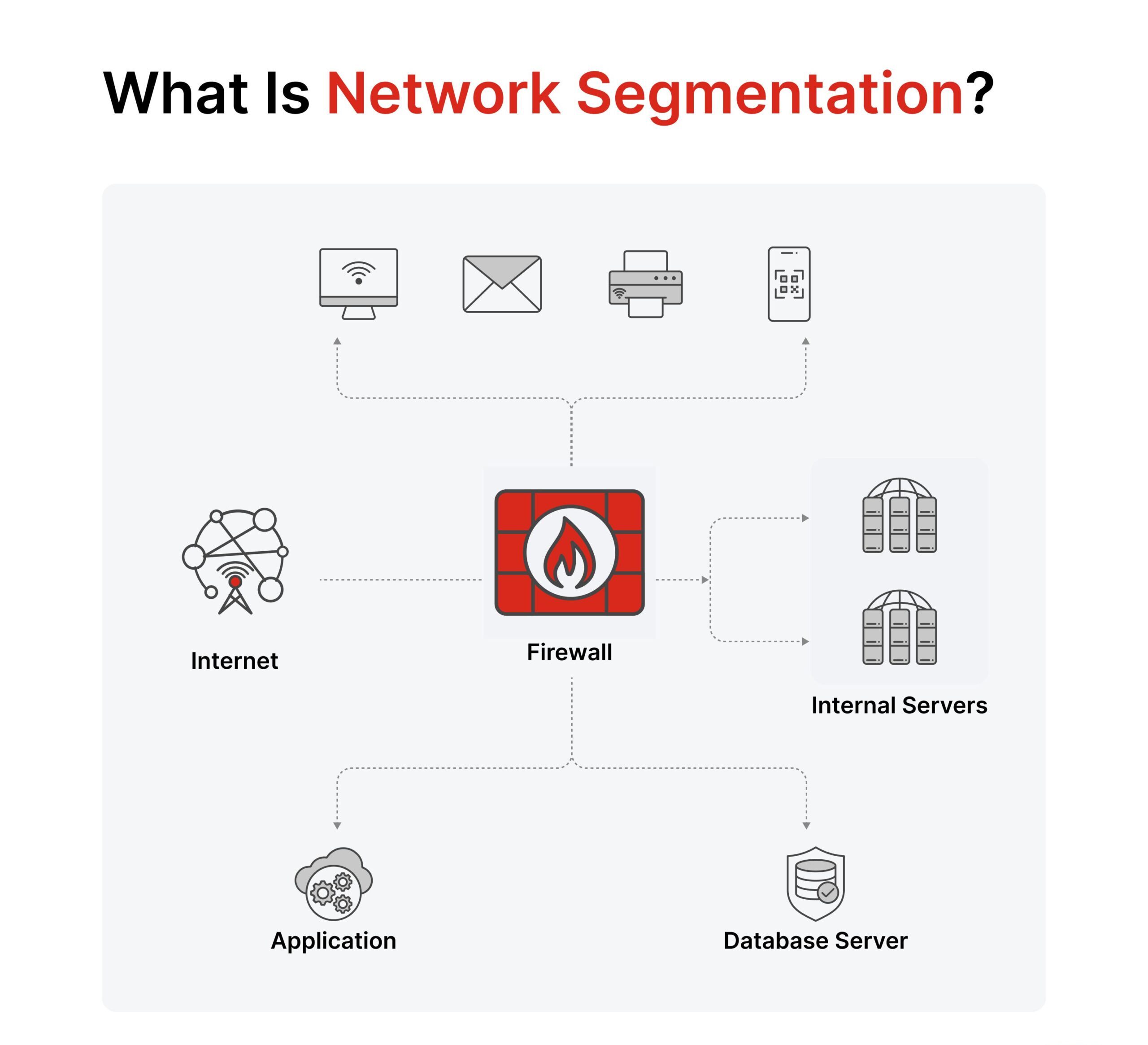
Rather than allowing unrestricted, direct communication between every workstation, server, and endpoint, segmentation establishes granular rules that govern internal traffic. These security boundaries are structurally enforced utilizing a mix of architectural tools:
Virtual Local Area Networks (VLANs) and access control lists (ACLs).
Software-defined networking (SDN) and micro-segmentation policies.
Internal enforcement points, such as deploying a next-generation firewall to inspect internal traffic.
To conceptualize this, consider the architectural design of a modern corporate office building:
The Fire Compartment Analogy:
If an office building consisted of one massive, open room with no interior walls, a fire starting in a single corner would rapidly consume the entire structure. However, by building fire-resistant walls and auto-closing doors, the building is split into safe compartments. A fire breaking out in the mailroom remains trapped there, allowing the rest of the building’s occupants to remain safe and operational. Network segmentation brings this exact structural logic to digital infrastructure.
How Ransomware Spreads Inside a Network: The Lateral Movement Chain
A common misconception is that ransomware behaves like a simple computer virus, instantly encrypting the local device the moment an employee clicks a malicious link. In reality, modern ransomware operations are multi-stage, stealth-driven campaigns. To understand the full scale of these intrusions, it helps to review the fundamentals of how ransomware attacks work and how to prevent them.
Once a threat actor establishes an initial foothold on a single endpoint, they do not immediately deploy their payload. Instead, they initiate an internal reconnaissance phase. They map network topologies, harvest administrative credentials, locate domain controllers, find sensitive data repositories, and target backup infrastructure. They frequently abuse legitimate IT administration tools (such as PowerShell or remote management software) to blend in with normal network traffic.
Once the attacker identifies the organization’s “crown jewels” and gains sufficient network privileges, they orchestrate a synchronized deployment. By launching the ransomware simultaneously across thousands of endpoints and servers, they maximize operational shock and aggressively force the victim toward paying an extortion demand.
In a traditional flat network architecture—where internal traffic flows completely unchecked—a single compromised laptop grants threat actors direct access to:
Central file servers and active directories.
Corporate database infrastructure.
Employee workstations across every department.
Primary and secondary backup storage systems.
Integrated cloud workloads and SaaS environments.
Mission-critical business applications (such as ERP or manufacturing execution systems).
Comparison Matrix: Flat Networks vs. Segmented Architecture
| Architectural Feature | Traditional Flat Network | Segmented Network Infrastructure |
| Internal Trust Model | High trust; any internal device can connect to any server by default. | Zero trust; internal connections are denied unless explicitly authorized. |
| Attack Blast Radius | Unlimited; entire enterprise infrastructure is exposed. | Localized; restricted to the specific sub-network where the breach occurred. |
| Attacker Lateral Movement | Highly rapid; minimal barriers to traversing different departments. | Slow and difficult; blocked by internal firewalls and authentication gates. |
| Malware Visibility | Low; lateral traffic is rarely logged or inspected. | High; cross-segment traffic is continuously monitored for anomalies. |
| Containment Speed | Slow; requires manual, widespread device shutdowns during a crisis. | Rapid; security teams can programmatically isolate an entire compromised zone. |
How Network Segmentation Stops Ransomware Sprawl
The foundational goal of network segmentation is the systematic elimination of unchecked lateral movement. Even if an attacker successfully executes a sophisticated phishing or credential theft campaign, they immediately encounter hard internal boundaries when trying to move deeper into the infrastructure.
For example, if a customer service representative’s machine becomes infected, that device sits within an isolated user segment. If the malware attempts to scan for or connect to sensitive financial systems or proprietary product databases residing in separate segments, the internal security controls immediately block the unauthorized “east-west” traffic.
This structural friction completely alters the dynamics of an incident:
Breaks Automation: Automated ransomware strains that rely on self-propagation are instantly neutralized when they hit segment boundaries.
Buys Valuable Time: Human threat actors are forced to spend significantly more time attempting to bypass multiple security layers, increasing their visibility.
Enhances Detection: Unauthorized connection attempts between segments trigger immediate alerts, handing security operations center (SOC) teams the exact window they need to intercept the threat actor, isolate the affected environment, and execute containment procedures before widespread data exfiltration or encryption can occur.
The Strategic Pillars of a Segmented Defense
1. Isolating and Protecting Critical Assets
Not all data within an enterprise carries the same operational weight or compliance risk. Customer databases containing personal information, financial ledgers, intellectual property, and core authentication infrastructure require vastly stronger protections than standard office printers or guest Wi-Fi networks. Segmentation allows organizations to construct hardened digital vaults around these highly vital business assets, implementing rigorous authentication challenges and deep-packet traffic inspection for any device attempting to request entry.
2. Limiting Privilege Escalation Pathways
Ransomware operators focus heavily on acquiring domain administrator credentials. Once obtained, these privileges allow them to disable endpoint detection tools, erase system logs, and push malware out globally.
Segmentation supports the principle of least privilege by isolating administrative traffic. Network engineers can lock down administrative access protocols (like SSH or RDP) into dedicated management networks that are completely unreachable from ordinary employee workstations. This ensures that even if an attacker extracts credentials from an executive’s laptop, those credentials cannot be used to log into core infrastructure from that segment.
3. Core Alignment with Zero Trust Security
Modern defense models have shifted definitively away from perimeter-only strategies, adopting a strict posture of Zero Trust. This framework builds on the assumption that threat actors may already reside inside the corporate perimeter.
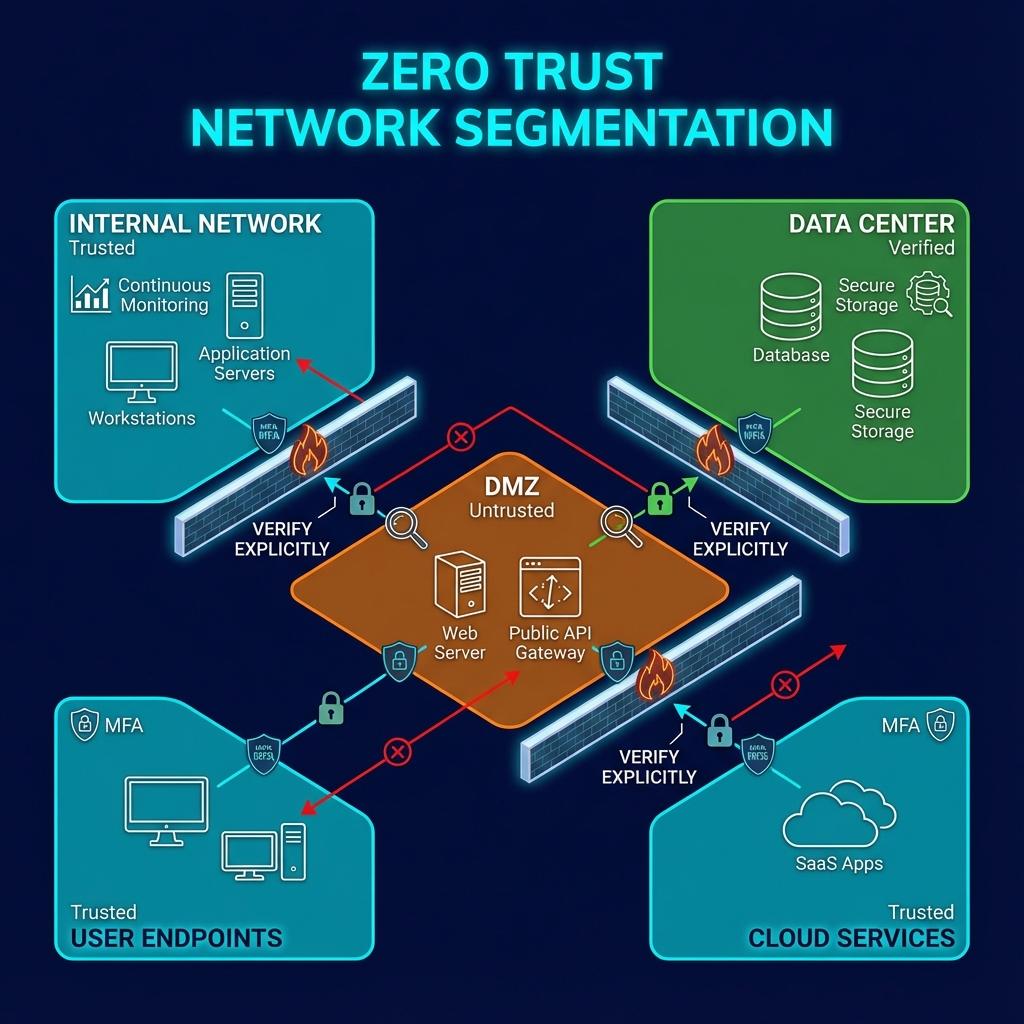
Network segmentation serves as the physical infrastructure that makes a Zero Trust philosophy enforceable. By verifying identities, validation states, and access permissions at every single segment boundary, the network stops assuming internal traffic is safe. To see how this architecture reshapes enterprise defense, explore our deep dive into what Zero Trust security is and why modern companies need it.
4. Streamlining Incident Response and Containment
During a live ransomware crisis, seconds matter. In a flat network, containment often requires a nuclear option: pulling the plug on the internet or shutting down every server simultaneously, self-inflicting massive downtime.
A segmented network turns containment into a precise, surgical procedure. If a security team discovers ransomware activity inside the human resources department, they can instantly block that specific segment’s communication channels. This contains the infection while allowing critical operations—such as logistics, retail portals, and customer billing—to continue running safely without interruption.
5. Safeguarding the Last Line of Defense: Backup Infrastructure
Ransomware syndicates deliberately target, compromise, and delete an organization’s backups before launching their encryption routines. If an organization cannot restore from a backup, their operational leverage evaporates, forcing them to consider a ransom payment.
Proper network segmentation isolates backup infrastructure entirely from standard enterprise networks. Backup systems should exist in highly restricted zones, using unique authentication paths that prevent them from being discovered or accessed via standard employee domains. This structural air-gapping ensures that even during a widespread network incident, a clean, uncompromised set of data remains safely available for recovery.
Challenges in Implementing Network Segmentation
While the security benefits of segmentation are undeniable, successful deployment requires careful, strategic planning. Organizations frequently run into hurdles when they attempt to implement segmentation without a clear understanding of their daily operational realities.
Hasty or poorly planned segmentation can accidentally block legitimate application traffic, disrupt critical business communications, and introduce massive operational complexity for system administrators.
[Asset Discovery] ➔ [Data Classification] ➔ [Traffic Mapping] ➔ [Policy Enforcement] ➔ [Continuous Testing]
A successful, sustainable segmentation program relies on several key steps:
Comprehensive Asset Inventory: Compiling an exhaustive inventory of every hardware device, virtual machine, and cloud asset connected to the ecosystem.
Application Dependency Mapping: Documenting how applications interact across the organization to avoid accidentally blocking legitimate workflows.
Strict Access Control Policies: Creating clear, definitive rules outlining exactly which users and systems require access to specific zones.
Continuous Security Monitoring: Constantly reviewing cross-segment traffic logs to spot configuration drift or emerging anomalies.
Regular Rule Optimization: Treating segmentation policies as living documentation that evolves alongside corporate restructuring, cloud migrations, and business growth.
Real-World Impact: Building a Resilient Defense-in-Depth
The historical record of major data breaches highlights a clear pattern: the most devastating, headline-grabbing ransomware attacks almost always take place within flat corporate environments where attackers encountered zero internal friction. Conversely, organizations with robust, mature segmentation protocols routinely turn potential disasters into minor, isolated cleanup tasks.
Security teams must remember that network segmentation is not a standalone cybersecurity silver bullet. Instead, it serves as a foundational component of a holistic, defense-in-depth strategy. For true enterprise resilience, segmentation must be paired with other core modern defenses, including behavioral Endpoint Detection and Response (EDR), rapid patch management, regular user simulation training, and robust identity protections like multi-factor authentication (MFA).
Conclusion
Network segmentation is no longer viewed as merely an advanced networking technique—it has become a core requirement for basic cyber resilience. By dividing enterprise infrastructure into isolated, secure zones, organizations actively restrict lateral movement, shelter their most critical assets, protect backup data, and empower their incident response teams with the gift of time.
In an era where threat actors use automated scanning and highly sophisticated extraction methods, relying on a strong outer perimeter is an outdated strategy. A properly segmented architecture ensures that a single compromised device remains a minor security incident rather than an existential enterprise crisis.
Frequently Asked Questions (FAQs)
1. What is network segmentation in cybersecurity?
Network segmentation is the architectural practice of splitting a large, interconnected network into smaller, isolated compartments. Each independent zone operates under its own distinct set of security rules and access controls, preventing unauthorized traffic from moving freely across the enterprise.
2. How does network segmentation help stop ransomware?
It directly addresses the threat of lateral movement. If ransomware compromises a single workstation, the network barriers prevent the malware from automatically propagating to critical file servers, sensitive corporate databases, or backup systems in other departments.
3. Is network segmentation only useful for large enterprises?
No. Organizations of all sizes face ransomware threats. Small and medium-sized businesses can significantly lower their risk exposure by setting up basic segmentation to separate public guest Wi-Fi, internal employee devices, operational servers, and backup repositories.
4. What technologies are commonly used for network segmentation?
Organizations typically enforce segmentation using a combination of next-generation firewalls (NGFWs), Virtual Local Area Networks (VLANs), access control lists (ACLs), software-defined networking (SDN), and micro-segmentation tools built into modern cloud environments.
5. Can network segmentation alone prevent ransomware attacks?
No. While it is highly effective at stopping the spread of ransomware, it does not prevent the initial entry. A comprehensive security strategy must combine network segmentation with endpoint protection, aggressive vulnerability patching, secure offline backups, and robust identity access management.